Advertisement
 Sponsored
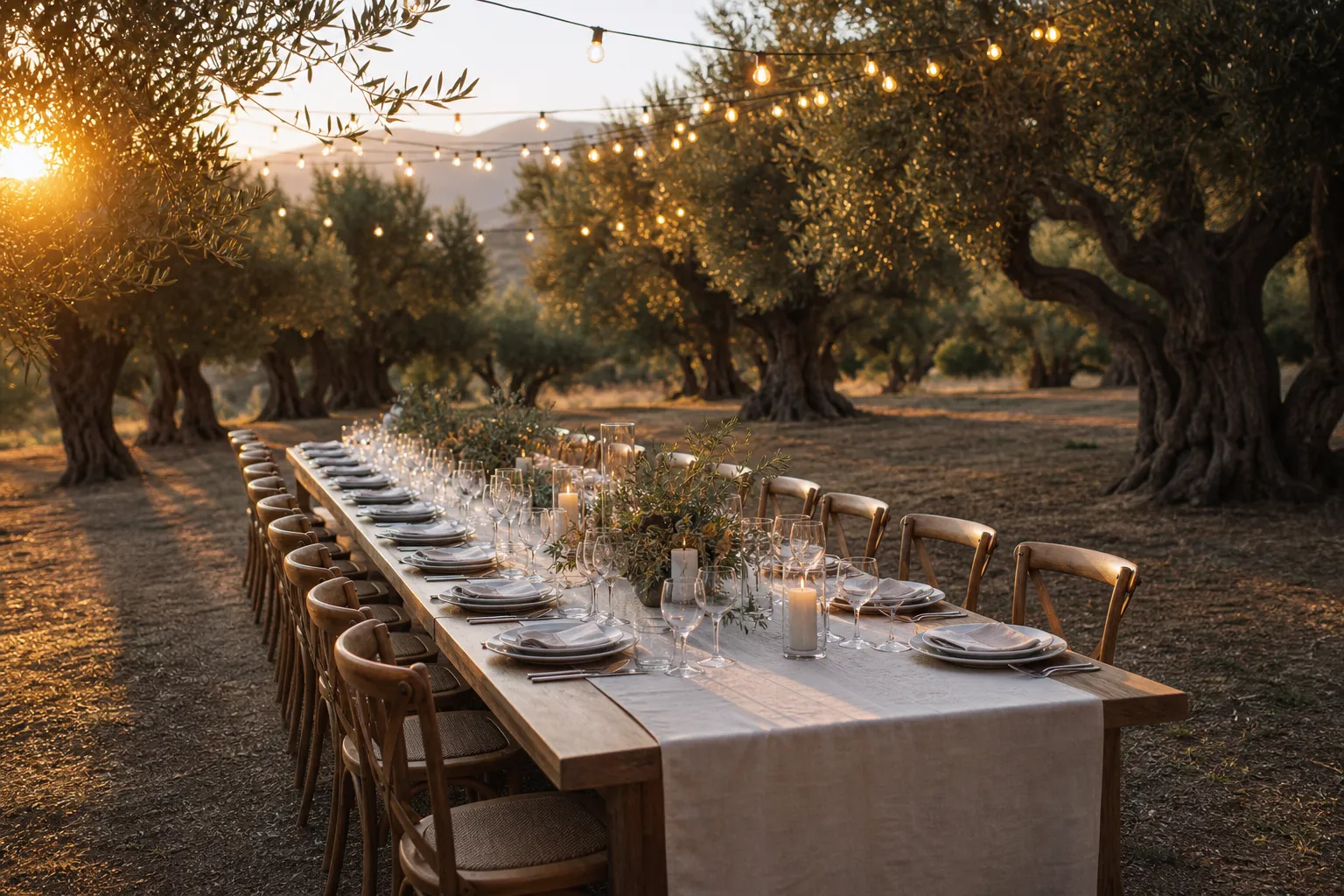
When Ellie and Marcus from Melbourne started planning their Greece wedding, they had a shortlist of seven venues across Santorini and Crete. Eighteen months later: after three video calls with coordinators, two spreadsheets, and one near-miss with a monastery that would have cut the music at 11 PM, they were dancing on a terrace above an olive grove near Heraklion with 95 guests around them.
Their first mistake, they told us, was falling in love with photos before asking the right questions. Their second mistake was not having a framework for comparing venues that look completely different on paper.
This is that framework. Whether you're choosing a Greece wedding venue from Sydney, London, or Athens, the same seven decision points come up every time, and asking them in the right order saves weeks.
Planning a wedding in Greece from abroad?
We're not wedding planners. We help you find the right Greek vendors for your date, place and budget, and explain the paperwork. Neutral advice, free.
We only pass your details to a vendor once you say so.
Seven Venue Types in Greece: What You're Actually Getting
Greece offers more variety than most couples realise when they first search "wedding venue Greece." The feed is full of white walls and blue domes, but the real options range from clifftop chapels to private islands with helicopter access. Before you shortlist anything, understand what each venue type delivers, and what it costs.
| Venue Type | Typical Capacity | Privacy | Catering Policy | Accessibility | Avg. Price/Head |
| Clifftop chapel / terrace | 20 to 80 | Very high | In-house only | Moderate (ferry / steep path) | €160 to €220 |
| Private villa | 30 to 120 | Very high | Open, bring your own caterer | Moderate to easy | €100 to €160 |
| Luxury hotel rooftop | 50 to 200 | Medium | In-house only | Easy (airport transfers available) | €150 to €250 |
| Olive grove estate | 60 to 250 | High | Open or flexible | Easy (road access) | €75 to €130 |
| Beach club | 80 to 300 | Low to medium | Mostly in-house | Easy | €90 to €160 |
| Historic monastery / courtyard | 20 to 100 | Very high | External caterer required | Varies | €60 to €120* |
| Private island | 10 to 60 | Exclusive | Fully custom | Challenging (boat or helicopter) | €300+ |
*The monastery price/head covers venue hire only. Add external catering separately, typically €80 to €140/head.
Pro tip: The catering policy column is the most underestimated factor in this table. Venues with an open policy typically save €40 to €80 per head once you compare real quotes, and give you meaningful control over the menu.
The Five Criteria That Actually Matter
Every couple starts with aesthetics. Almost every couple finishes with logistics. These five criteria, asked in this order, give you a clear ranking of venues before your heart runs away with the shortlist.
1. Event Licence and Sound Permit
This is the check most couples skip until it becomes a problem. In Greece, outdoor events with amplified music require a sound permit, formally a licence for a public gathering with music, from the relevant municipality. Some venues hold a standing licence; others apply per event. The critical question is not "do you have a licence?" but "is it valid for our specific date, and what is the music curfew?"
Venues near residential areas, including some of the most photogenic monastery courtyards and hillside terraces, operate under noise ordinances that cut amplified music at midnight, sometimes at 11 PM. If your wedding runs until 2 AM, discover this before you're emotionally attached to a venue.
2. Catering Policy
Ellie and Marcus shortlisted two Santorini venues and one Crete estate during their virtual tours. The Santorini venues were genuinely beautiful, and both used in-house catering only, with menus that started at €185 per head. The Crete estate had an open catering policy. With an external Athens-based caterer, the same guest experience came to €125 per head. The photos of the Santorini terraces were better. The numbers were not.
Always ask for a full per-head catering quote at your estimated guest count, including all service charges and staffing. Venues often quote a base price that moves considerably by the time service staff, rental items, and minimum spend clauses are applied.
3. Guest Accessibility
How do your guests actually arrive, and who bears the cost and coordination when they don't all fly into the same airport? Mainland venues in Halkidiki, the Peloponnese, and Attica are generally road-accessible from a major airport within two hours. For island venues, you're planning a travel logistics operation alongside a wedding.
Consider your wedding guest list specifically: how many people are flying from abroad, how many are older or have mobility needs, and how many won't want to manage a ferry schedule on the morning of your wedding. Venues that score well on access tend to convert better on RSVPs.
Pro tip: Score each shortlisted venue informally on "airport proximity": how many connections does the average guest need to reach the nearest airport, and what's the last practical transport option on the day? Venues that score well on this often have better overall logistics, not just for guests but for vendors.
4. Capacity and the 20% Buffer
Venue capacity listed online is usually the maximum, the number where everyone fits if the tables are tight and nobody needs to move freely. Your comfortable working capacity is typically 80% of that figure. A venue listed at 200 guests works best for around 160.
If your guest list sits at 150 and the venue maximum is 160, explore the layout in detail: is there a natural separation between ceremony, cocktail, and dinner areas? Can the dinner space accommodate your band or DJ without removing guest seats? For detailed guidance on managing venue capacity research, wedding venue research tools for couples covers the practical digital tools that help you work through this without spreadsheet overload.
5. On-Site Accommodation
Does the venue have overnight rooms, or do guests scatter to hotels at the end of the evening? On-site accommodation keeps the energy alive after the speeches and means guests aren't watching the clock for a taxi. Check whether there is a minimum room-night requirement, common at private villas and boutique estates, and factor this into your overall venue cost before comparing prices.
Virtual Venue Tours for Remote Couples
Most couples planning a Greece wedding from abroad spend months researching venues they haven't physically visited. Here's what works.
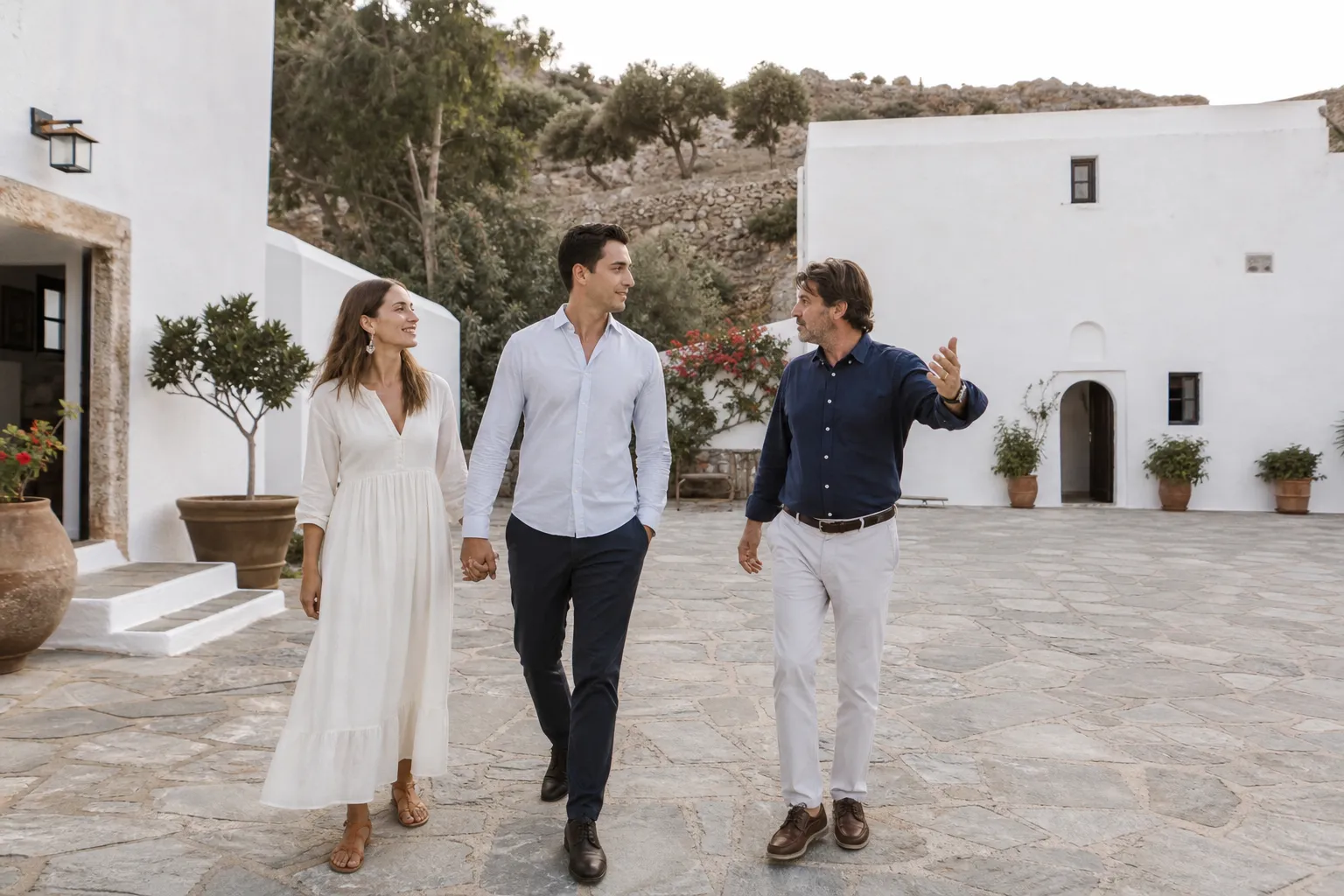
Live video walkthroughs. Most venue coordinators will do a 45-minute FaceTime or WhatsApp video tour if you ask directly. Prepare a shot list first: entrance path, ceremony area, cocktail space, dinner terrace, bathrooms, car park, overnight rooms. Send it to the coordinator 24 hours in advance so they don't improvise. Ask them to walk the exact route a guest arriving by taxi would take from the gate to their seat, this reveals accessibility issues and lighting gaps that don't appear in photos.
360° scans and drone footage. Many Greek venues shot Matterport scans or drone videos after 2020 and don't advertise them on their websites. Ask specifically. Most coordinators have these on their phone or a Google Drive link.
Review platforms. Verified couple reviews on platforms like Easywedding.gr surface details coordinators won't volunteer: the noise from the road, the 40-minute gap between ceremony and dinner because of a narrow path, the catering that ran cold. WedReserve is another platform worth checking for peer reviews with genuine detail.
Coordinate your shortlist digitally. For couples managing a destination wedding from overseas, AI tools for wedding venue research covers how to use AI assistants and specialised platforms to extract pricing, compare policies, and build comparative shortlists faster, particularly useful when venue websites bury catering costs and capacity limits in separate PDFs.
12 Questions to Ask Every Venue
Run through this list before you sign anything. Every question has either a cost or a timing consequence.
- Is your event licence valid for our specific date, and does it cover outdoor amplified music?
- What is the music curfew, and has it changed in the past two years?
- What is your catering policy: in-house only, open, or approved external caterers?
- Can we see a full per-head catering quote at our estimated guest count, including all service charges and staffing?
- What is the ceremony space capacity, and how does it differ from the dinner capacity?
- Is there a minimum spend or minimum guest count?
- What does the venue provide (tables, chairs, linen, AV, lighting) and what must be hired externally?
- What is the access situation for guests with mobility needs?
- Is there on-site overnight accommodation, and is there a minimum room-night requirement attached to venue hire?
- What is the parking provision, and does the venue have a shuttle arrangement or a preferred taxi company?
- What is the wet-weather contingency, is there a covered backup space with equivalent capacity and the same permit?
- Which paperwork does the couple need to arrange independently: civil ceremony documentation, sound permits, food safety certification for external caterers?
Building Your Venue Search Timeline
The one rule that saves the most couples from last-minute panic: lock your venue before you set a fixed date with guests. Many couples do this backwards, they announce a date (often driven by a church booking or an anniversary), then discover the venue they want is taken.
For summer peak dates (June to September), popular venues in Santorini, Mykonos, Rhodes, and Corfu book 14 to 18 months ahead. Shoulder season, May and October, gives you considerably more choice and often better value. October light in Greece is worth the conversation if your guest list is flexible on timing.
Once your venue is confirmed, the destination wedding checklist for essential steps helps you sequence everything else: civil ceremony paperwork, vendor bookings, guest travel coordination, and the many small deadlines that stack up in the six months before a destination wedding.
Keeping the Coordination Together
Managing a Greece wedding from another country, or even from another Greek city, means coordinating flights, accommodation, RSVPs, schedules, and eventually photo sharing across guests on multiple continents. Keeping all of that in one place removes the email chaos that tends to take over in the final three months.
Once Ellie and Marcus locked in their Crete estate, they set up a wedding website through WhiteClover's destination wedding tools where guests could see the venue location, access the travel guide, check the schedule, and confirm their RSVPs, all without a single group email chain.
Planning a Greece wedding means navigating venue types, paperwork timelines, logistics, and a guest list that often spans multiple countries, all while keeping the experience genuinely personal. WhiteClover is built to hold all of this together: a single planning hub where your guests stay informed, your RSVP list is always current, and your post-wedding photo gallery is ready when the last dance ends. Start planning at whiteclover.io, and see how much simpler the coordination becomes when it's all in one place.
Frequently Asked Questions
How far in advance should I book a wedding venue in Greece?
For peak summer dates (June to September), book 14 to 18 months ahead at popular island venues: particularly in Santorini, Mykonos, and Corfu. Mainland venues and shoulder season (May, October) often have 8 to 12 months of lead time available. As a rule, confirm the venue before you announce a fixed date to guests.
Can I hold a legally recognised ceremony at a Greek wedding venue?
A civil ceremony in Greece requires either registration with the local municipality (in the district where the venue sits) or a marriage contracted in your home country with Greek consulate authentication. Many international couples do the legal paperwork at home and hold a symbolic ceremony at the venue. Ask your venue coordinator, most have standard documentation they share with international couples as a starting point.
Can I bring my own caterer to a wedding venue in Greece?
Only if the venue operates an open catering policy. Many of the most popular venues, particularly clifftop terraces and luxury hotel rooftops, use in-house catering exclusively. Ask about this in your first enquiry email before the shortlist gets any longer. For a detailed Athens estate comparison that includes catering policies by venue, Athens wedding estate price comparison provides a useful benchmark.
What is a realistic per-head cost for a Greek wedding?
Pricing ranges from roughly €75 at an accessible olive grove estate with open catering to €300+ at a private island. A well-organised summer wedding across Greece typically lands between €90 and €160 per head all-in: venue hire, catering, basic décor, and service staff. That figure can move significantly based on catering policy, island transfer costs, and the minimum spend requirements of the venue.
How do I manage guests who cannot travel to Greece?
Some couples arrange a live stream from the venue, most coordinators can recommend a local videographer who provides this service. For the broader communication challenge, a wedding website with the schedule, venue details, travel guide, and RSVP link is the most effective single tool. Guests who cannot make the trip in person still feel part of the planning, and the photo gallery afterwards brings them into the day regardless.
Written by
Katerina K
Part of the WhiteClover team, helping couples and hosts plan unforgettable events with modern digital tools. Passionate about simplifying the celebration planning journey.
You Might Also Like
 Wedding Planning
Athens Wedding Venues 2026: Prices
Compare Athens wedding estates and venues for 2026: Attica regions, hire vs per-head packages, questions to ask, seasonality, and planning your shortlist.
 Wedding Planning
Wedding Venue Research Tools for Couples
Build a wedding venue shortlist with directories, Google Maps, Instagram tags, drone footage and a planning hub. The six-tool stack couples use.
 Checklists
7 Essential steps for your destination wedding checklist
Discover 7 essential tips for couples planning a destination wedding in Greece.