Advertisement
 Sponsored
Every island wedding produces the same forty messages, and they are all versions of one question: how do I actually get there?
The couple usually answers each one individually, from a phone, at increasingly unsociable hours, for about four months. The alternative is a travel page that answers it once, properly, before anybody has to ask.
This is what belongs on that page. Confirm current schedules and operators yourself before publishing, because routes and timetables change every season and a wrong departure time in a wedding guide is worse than no departure time at all.
Planning a wedding in Greece from abroad?
We're not wedding planners. We help you find the right Greek vendors for your date, place and budget, and explain the paperwork. Neutral advice, free.
We only pass your details to a vendor once you say so.
The two routes, and why guests pick the wrong one
There are broadly two ways to reach most Greek islands, and guests default to the wrong one because it looks simpler on a booking site.
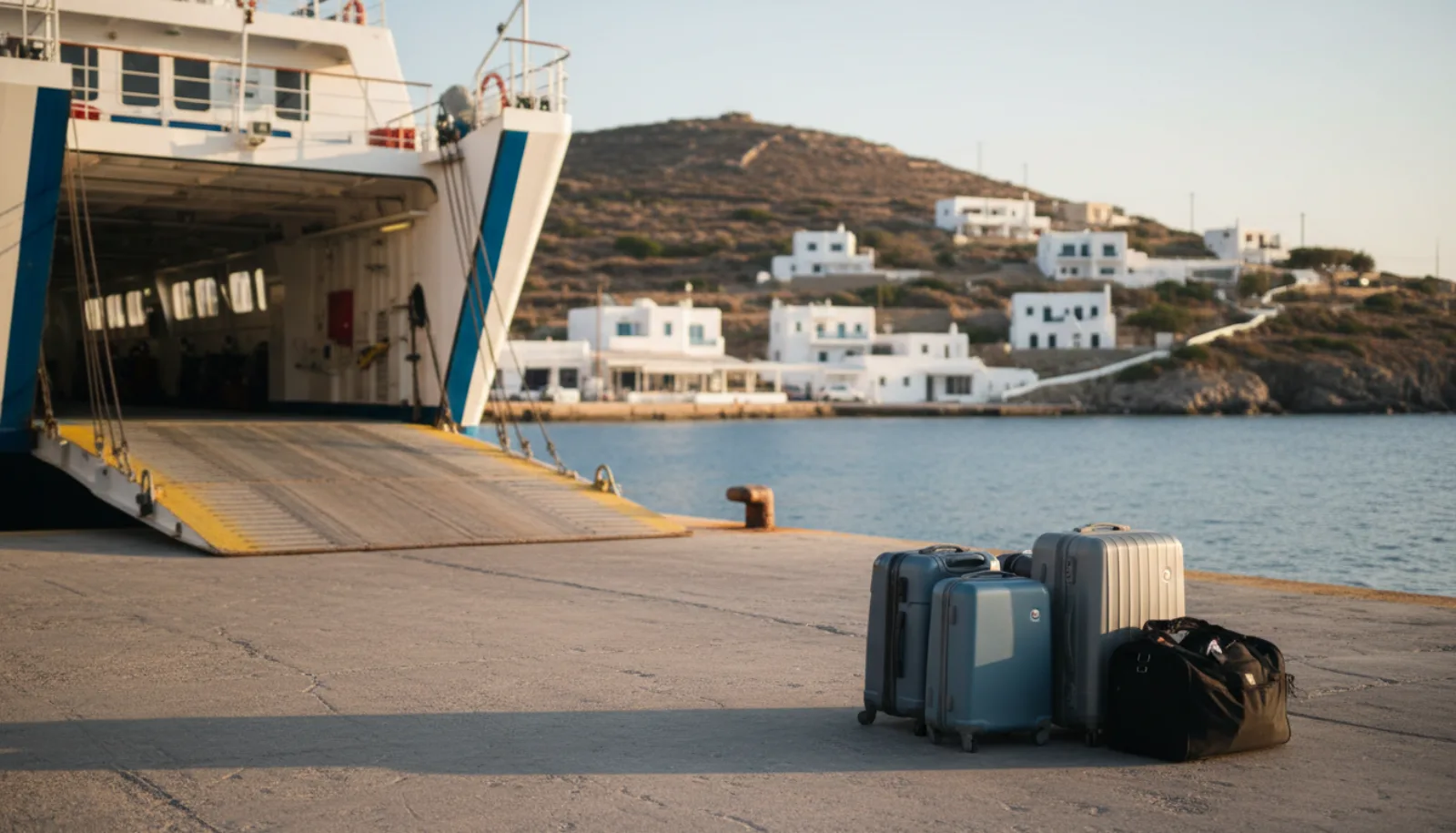
Fly to Athens, then ferry. Cheapest and most flexible, and it works for almost every island. The catch is the transfer between the airport and the port, which guests consistently underestimate.
Fly direct to the island. Only possible where there is an airport, usually more expensive, often only from certain cities, but removes the entire ferry question.
The mistake is booking a flight into Athens that lands two hours before the last ferry. That is not enough time, and it is the single most common way a guest ends up sleeping in Piraeus.
Three ports, not one
This is the detail that catches people out. Athens has more than one ferry port, and which one you need depends on the island.
| Port | Reach from | Typically serves |
| Piraeus | Metro from central Athens, or taxi from the airport | The largest range of islands |
| Rafina | Bus or taxi from the airport, closer to it than Piraeus | Several Cyclades routes |
| Lavrio | Taxi or bus, furthest from the city | A smaller set of islands |
Guests who assume Piraeus and book accordingly can end up at the wrong side of Attica with a ferry leaving from somewhere else. Name the port explicitly on your travel page, in bold, more than once.
High-speed versus conventional
Both exist on most routes and they are genuinely different products.
High-speed is considerably faster and more expensive. It is also the one that gets cancelled first when the meltemi picks up, because lighter fast craft are more wind-sensitive than heavy conventional ferries.
Conventional takes longer, costs less, and keeps running in conditions that stop the fast boats.
For a wedding, that trade matters more than it normally would. A guest who books a fast ferry for the morning of the ceremony and finds it cancelled has no fallback. A guest arriving the day before on a slower boat has an entire day of margin.
The advice worth putting on the page in plain language: do not travel on the day of the wedding. Arrive the day before at minimum.
The last boat
Every island has a last departure, and it is usually earlier than guests expect, especially outside peak season.
Two consequences to spell out:
- Guests planning to leave the island on the wedding night will be leaving during the reception, not after it.
- Guests planning a same-day onward connection from Athens should not do it.
If there is a last boat that matters, put its rough time on the page and say plainly what it means for the evening.
Port to venue
The transfer nobody plans. Island ports are not always near the venue, roads can be narrow, and taxi supply is finite and shared with every other arrival on the same ferry.
Two hundred guests arriving on one boat will not find two hundred taxis. If you are doing anything at scale, arrange coaches from the port for the main arrival, and say on the page exactly where they will be and at what time.
If you are not arranging transport, say that too, and tell people to book in advance. Guests who know they are on their own will plan for it. Guests who assume something is arranged will not.
What the page should actually contain
Keep it to what a guest needs to make a booking decision:
- Which airport, and whether a direct island flight exists.
- Which port, named explicitly, and how to get there from the airport.
- Rough crossing time for both ferry types, and the wind caveat.
- The recommendation to arrive at least a day early.
- The last boat, and what it means for the wedding night.
- Whether transfers are arranged, and if so from where and when.
- Where to stay, with two or three options at different prices.
- Your contact for anything not covered.
That is the whole thing. It is a page, not a brochure, and it saves you those forty messages. A wedding website with a travel section is the natural home for it, because guests can reach it from the invitation and check it again a month later when they are actually booking.
Conclusion
Island logistics are not complicated, they are just unfamiliar, and unfamiliar is what generates questions.
Name the port. Explain the two ferry types and which one the wind stops. Tell people to arrive a day early. Say what happens with the last boat and whether transfers exist. Do that and the questions stop, because you have answered them before they occurred to anybody.
If you would like one link that carries the travel details, the schedule and the RSVP together, start free with WhiteClover.
Frequently asked questions
Should guests fly to Athens or direct to the island? Direct is simpler where an airport exists, though usually pricier and less frequent. Via Athens is cheaper and reaches every island, but adds an airport to port transfer that guests routinely underestimate. Whichever you recommend, be explicit, because guests default to whatever looks cheapest on a booking site.
Which Athens port do I need? It depends on the island, and there is more than one. Piraeus serves the widest range, while Rafina and Lavrio serve their own sets of routes. Name your port explicitly on the travel page, because a guest who assumes Piraeus can end up on the wrong side of Attica.
Are high-speed ferries worth it for a wedding? They are faster and more expensive, but they are also the first to be cancelled when the wind gets up, since light fast craft are more wind-sensitive. For travel around a wedding date, the slower conventional ferry with a day of margin is the safer choice.
How early should guests arrive? At least the day before, and say so plainly on the page. Ferries can be cancelled at short notice in windy conditions, and a guest travelling on the morning of the ceremony has no fallback option if their crossing does not run.
Do I need to arrange transfers from the port? If a large number of guests arrive on the same ferry, yes, because island taxi supply is finite and shared with everyone else on that boat. If you are not arranging anything, say so clearly so guests book their own rather than assuming.
Read next
Written by
Ioanna V.
Part of the WhiteClover team, helping couples and hosts plan unforgettable events with modern digital tools. Passionate about simplifying the celebration planning journey.
You Might Also Like
 Checklists
7 Essential steps for your destination wedding checklist
Discover 7 essential tips for couples planning a destination wedding in Greece.
 Inspiration
Make Your Greece Wedding Truly Memorable
Planning a wedding in Greece? These 10 ideas, from local welcome bags to rebetiko music, help you create a day that feels genuinely, unforgettably Greek.
 Invitations
What Does RSVP Mean? Wedding Guide + Templates [2026]
What is an RSVP and what does RSVP mean on a wedding invitation? Complete 2026 guide to RSVP timelines, wording templates, digital vs paper, and tracking.