Advertisement
 Sponsored
Wedding invitation trends for 2026 are less about choosing between paper and digital, and more about building a calm communication rhythm for your guests. The invitation is no longer a single card that says "we're getting married". It is the first chapter of the guest experience: save the date, RSVP, travel notes, dress code, reminders, maps, dietary questions, and the last small update everyone needs before they leave home.
That shift is good news for couples. A modern invitation suite can still feel personal, beautiful, and carefully designed, while doing far more practical work behind the scenes. The best 2026 weddings use invitations to reduce back-and-forth messages, collect better guest data, and set the tone for the celebration before anyone reaches the venue.
Plan Your Event
One platform for every occasion: weddings, baptisms, corporate events and private parties.
Why wedding invitations are changing in 2026
Couples are planning with more moving parts than they did a decade ago. Guest lists often include family abroad, friends travelling from several cities, mixed-language households, children, dietary requirements, welcome events, brunches, transport plans, and hotel blocks. A pretty card alone cannot carry all of that information without becoming crowded.
At the same time, guests have changed too. They are used to checking a link for live details, saving a date to their phone calendar, and confirming attendance in a few taps. They still enjoy a printed invitation when it feels meaningful, but they do not want to hunt through old messages for the ceremony address.
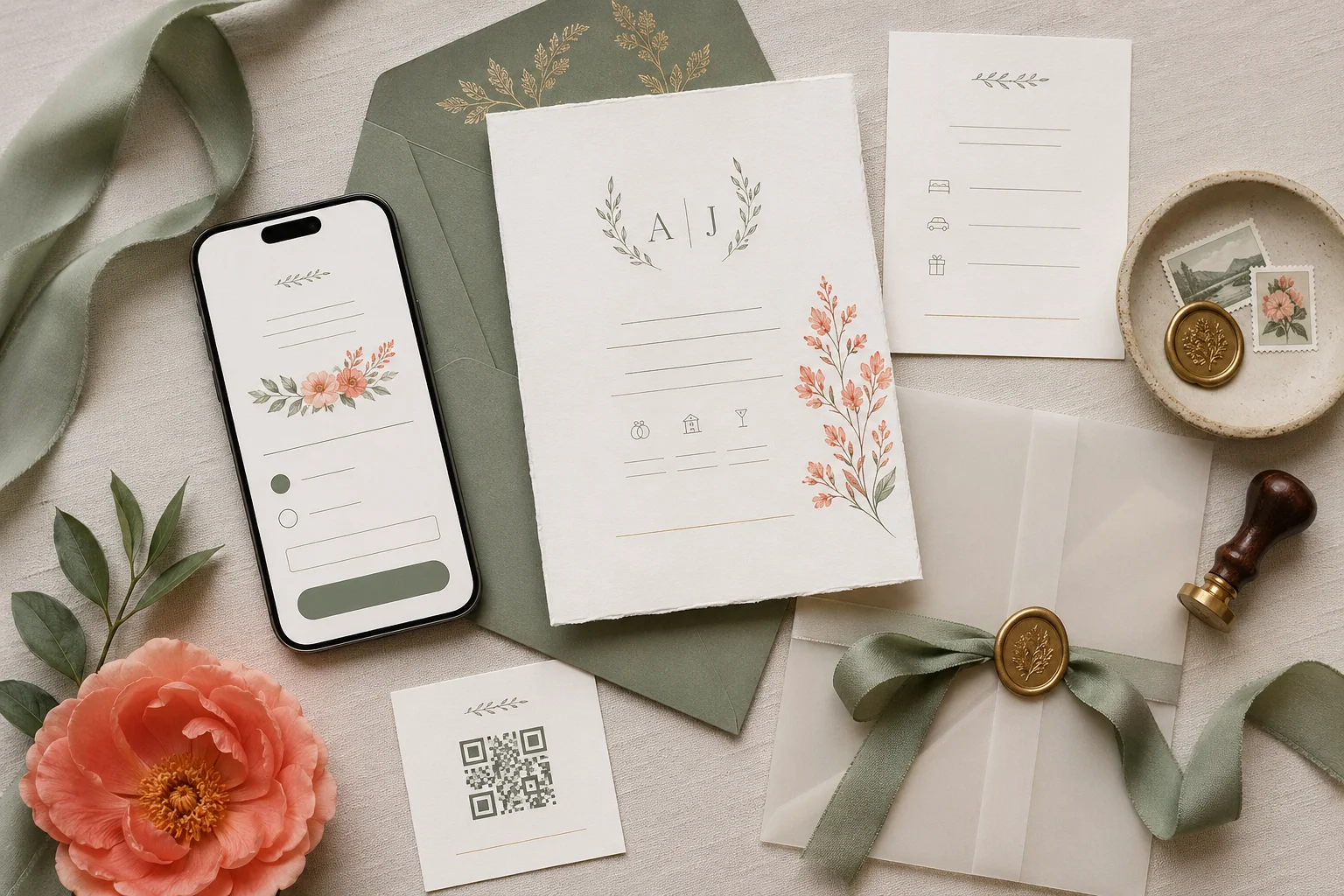
The trend, then, is not "digital replaces print". It is "design and logistics finally work together". That is where tools such as a wedding RSVP experience fit naturally: the invitation sets the mood, and the RSVP flow captures what you need to plan with confidence.

Trend 1: The invitation becomes a sequence, not a single send
The most organised couples in 2026 are splitting communication into clear stages instead of trying to say everything at once. A simple sequence might look like this:
- a save the date, sent as soon as the venue and date are fixed
- a formal invitation, sent when key details are ready
- an RSVP reminder before the deadline
- a final logistics update with transport, timing, and weather notes
This phased approach helps guests absorb information at the right time. It also protects the tone of your wedding. A formal invitation can stay elegant because it is not forced to include every shuttle detail, hotel note, and menu choice.
For destination weddings, the sequence matters even more. Guests need time to book flights, ask about childcare, arrange annual leave, and understand the flow of events. If you are planning across countries or time zones, pair the invite sequence with a central wedding website so each update has one reliable home.
Pro tip: Write down your invitation sequence before you design anything. It will help you decide what belongs on the card, what belongs on the website, and what can wait until the final update.
Trend 2: Hybrid print and digital becomes the new standard
Hybrid invitations are not a compromise. They are often the most thoughtful choice.
Print gives weight to the moment. It feels ceremonial, photographs beautifully, and matters to parents, grandparents, and anyone who loves a keepsake. Digital gives you speed, flexibility, tracking, and the ability to correct details without reprinting. Together, they let you respect tradition while planning in a way that fits real life.
A strong hybrid setup usually includes:
- a printed invitation or details card for the people who will value it most
- a digital version for quick sharing and guests abroad
- one RSVP link or QR code used everywhere
- a wedding website for details that may change
- reminders sent only to guests who have not replied
The mistake to avoid is running print and digital as two separate systems. If one cousin replies by text, another through a form, and three guests tell your mum they are coming, you are back in spreadsheet chaos. The modern version keeps the guest response in one place, even if the invitation itself arrives through several channels.
Trend 3: QR codes are becoming softer and better designed
QR codes used to feel like a practical afterthought. In 2026, they are part of the design language. Couples are placing small, well-labelled QR codes on details cards, envelope inserts, menus, welcome signs, and table cards. The difference is that the QR is no longer treated as a black square dropped onto a beautiful layout at the last minute.
Designers are giving QR codes breathing room, pairing them with gentle copy such as:
- "RSVP and see the weekend details"
- "Scan for travel notes and timings"
- "Your answer, menu choice, and song request"
- "Everything you need for the wedding weekend"
The wording matters. A guest is more likely to scan when they know exactly what will happen next. A QR code labelled only "scan me" feels vague; a QR code labelled "RSVP by 12 May" gives clear direction.
If you are using QR on a printed invite, test it on several phones before printing. Check it in daylight, low light, and from the size it will actually appear. A tiny QR on textured paper may look refined, but it is not helpful if guests cannot scan it.
Trend 4: Invitation micro-sites carry the details cards used to carry
Details cards are not disappearing, but they are getting lighter. Instead of printing every hotel, taxi, menu, child policy, parking instruction, and gift note, couples are moving the living details to a small wedding micro-site.
This works especially well when the wedding includes:
- more than one event, such as a welcome drink or next-day brunch
- guests travelling from abroad
- a venue with parking or access instructions
- a dress code that needs examples
- accommodation suggestions
- registry, gift, or bank transfer information
- updates that may change close to the wedding
The invitation can then focus on the emotional moment: your names, the date, the place, and the feeling of the celebration. The micro-site carries the information guests will keep checking.
For a deeper planning flow, the guide on online invitations and RSVP is useful because it shows how invitation wording, RSVP questions, and guest tracking can work together.
Trend 5: Guest data is collected earlier and more cleanly
One of the quiet invitation trends for 2026 is operational: couples are asking better questions during RSVP. Not more questions, better ones.
Useful RSVP fields include:
- attendance for each event
- meal choice, if needed
- dietary requirements
- children attending
- transport interest
- accommodation needs
- accessibility notes
- song requests, if that suits your style
The key is restraint. Ask only for information you will genuinely use. A long RSVP form feels like homework, and guests may abandon it. A short form with the right questions saves you hours later.
Clean RSVP data also supports the rest of planning. Catering counts become easier. Seating becomes less painful. Transport estimates are based on real numbers instead of guesswork. If you want to connect this with the wider planning picture, it pairs well with a guest list management strategy from the beginning.
Trend 6: Invitation design is calmer, clearer, and more tactile
The 2026 visual mood is not one single aesthetic. Some couples love editorial minimalism, some want Mediterranean colour, some prefer romantic florals, and others choose playful typography. The shared thread is clarity.
Readable design is now a trend in itself. Couples are choosing:
- larger names and dates
- fewer typefaces
- generous spacing
- soft neutrals with one accent colour
- hand-drawn maps or venue sketches
- paper with texture rather than heavy decoration
- one memorable detail, not five competing details
This is partly practical and partly emotional. A clear invitation feels confident. It gives guests the sense that the wedding will be well organised, without making the design feel cold.
Pro tip: Print one test copy at real size and hand it to someone who is not involved in the wedding. If they cannot find the date, venue, and RSVP path in a few seconds, simplify before you approve the final design.
Trend 7: Personal wording beats formal templates
Formal invitation wording still has its place, especially when families are hosting or the ceremony is traditional. But more couples are moving away from stiff templates and writing in a voice that sounds like them.
That does not mean casual at all costs. The right wording depends on the wedding. A black-tie city celebration may call for a polished tone. A beach wedding in Greece may suit warmer, lighter language. A multicultural wedding may need direct, simple wording so nothing is lost between languages.
Try writing your invitation in three layers:
The ceremonial line
This is the formal heart of the invite: who is getting married, when, and where.
The practical line
This tells guests how to reply and where to find details.
The personal line
This adds your voice: "We cannot wait to celebrate with you", "Bring your dancing shoes", or a short note that reflects your story.
The best wording feels edited, not generic. If a sentence sounds like it could appear on any couple's invitation, make it more specific or remove it.
Trend 8: Automation gets more polite
Invitation automation is useful only when it feels considerate. Guests should not feel chased by a robot, and you should not spend evenings sending the same reminder to ten different people.
A balanced reminder plan looks like this:
- first reminder: around three weeks before the RSVP deadline
- second reminder: five to seven days before the deadline
- final logistics message: two to three days before the wedding
The tone can stay warm:
"Just a little reminder that RSVPs close this Friday. We are finalising numbers with the venue and would love to know if you can join us."
That is much better than a cold "Your RSVP is pending". When automation supports your voice, it protects your time without making the invitation feel impersonal.
For couples starting earlier in the journey, save-the-date automation is a helpful companion because it keeps the first announcement and the formal invitation part of the same communication rhythm.
Trend 9: Invitations now connect to seating, food, and transport
Your invitation choices affect more than guest communication. They shape the quality of your planning data.
If RSVPs are collected clearly, your seating chart is easier. If dietary requirements are captured early, your caterer gets cleaner notes. If guests tell you whether they need transport, you can brief your shuttle provider with real numbers. If every update lives in one place, fewer people text you on the wedding morning asking where to park.
This is why invitations in 2026 sit closer to the planning hub. They are not just stationery; they are the front door to your event operations.
A practical 2026 invitation timeline
Use this as a starting point and adjust for destination weddings, school holidays, religious dates, or guests travelling long distances.
9-12 months before
Send save the dates once the date, city, and venue are secure. For destination weddings, lean toward the earlier side.
4-6 months before
Prepare invitation design, RSVP questions, website details, and guest groups. This is when you test links, QR codes, and wording.
10-14 weeks before
Send formal invitations. If many guests are travelling internationally, send closer to 14 weeks.
3-4 weeks before the RSVP deadline
Send a gentle reminder only to guests who have not replied.
2 weeks before
Review meal choices, dietary notes, transport interest, and family group responses. Start cleaning the data for vendors.
2-3 days before
Send the final logistics message: arrival time, map link, parking, dress code reminder, weather note, and contact person if guests need help.
Frequently Asked Questions
Are printed wedding invitations outdated in 2026?
No. Printed invitations still matter, especially for close family, formal weddings, and couples who want a keepsake. What has changed is that print now works best with a digital layer. The card sets the tone; the link or QR code handles RSVP, updates, and details that may change.
Should we use a QR code on the wedding invitation?
Yes, if it is clearly labelled and tested before printing. A QR code is helpful on a details card or the back of the invitation, especially when it leads to RSVP, schedule, maps, and travel notes. Keep a short written URL as a fallback for guests who prefer typing.
What wedding invitation trends should destination couples prioritise?
Destination couples should prioritise early save the dates, a wedding website, travel information, and RSVP questions that capture attendance across multiple events. Guests need more time and more context when flights, hotels, transfers, and local customs are involved.
How many RSVP reminders should we send?
Two reminders are usually enough before the deadline, followed by one final logistics message close to the wedding. Send reminders only to guests who have not replied, and keep the wording friendly and practical.
What should be on the invitation versus the wedding website?
Put the essential ceremony details on the invitation: names, date, time, venue, and RSVP direction. Put changing or detailed information on the website: accommodation, transport, dress code notes, registry, maps, FAQs, and weekend schedule.
Bringing it together
The strongest wedding invitations in 2026 are beautiful, but they are also kind to the couple and clear for guests. They reduce uncertainty, guide people gently, and collect the information that makes the rest of planning easier.
If your invitation planning is already spread across spreadsheets, messages, stationery proofs, and a half-written details card, WhiteClover can help you bring the flow into one place. Use WhiteClover to connect invitations, RSVP tracking, guest updates, and wedding details so the first message your guests receive feels like the beginning of your story, not the start of a long admin thread.
Written by
Pantelis S.
Part of the WhiteClover team, helping couples and hosts plan unforgettable events with modern digital tools. Passionate about simplifying the celebration planning journey.
You Might Also Like
 Invitations
Save the Date Automation: Revolutionising Wedding Planning
Save the date automation streamlines guest list collection, digital invitations, and response tracking. Discover its benefits, types, and common pitfalls.
 Invitations
How to Handle 5 Common RSVP Challenges for Your Wedding
Late replies, surprise plus ones and guests who never answered: five RSVP problems and what to do, starting with a deadline two weeks early.
 Invitations
Invite Friends to Wedding, Baptism or Party
Learn how to invite guests using email, SMS, or a shareable website link.