Advertisement
 Sponsored
Civil vs Religious Wedding in Greece: Costs, Paperwork, and How to Choose
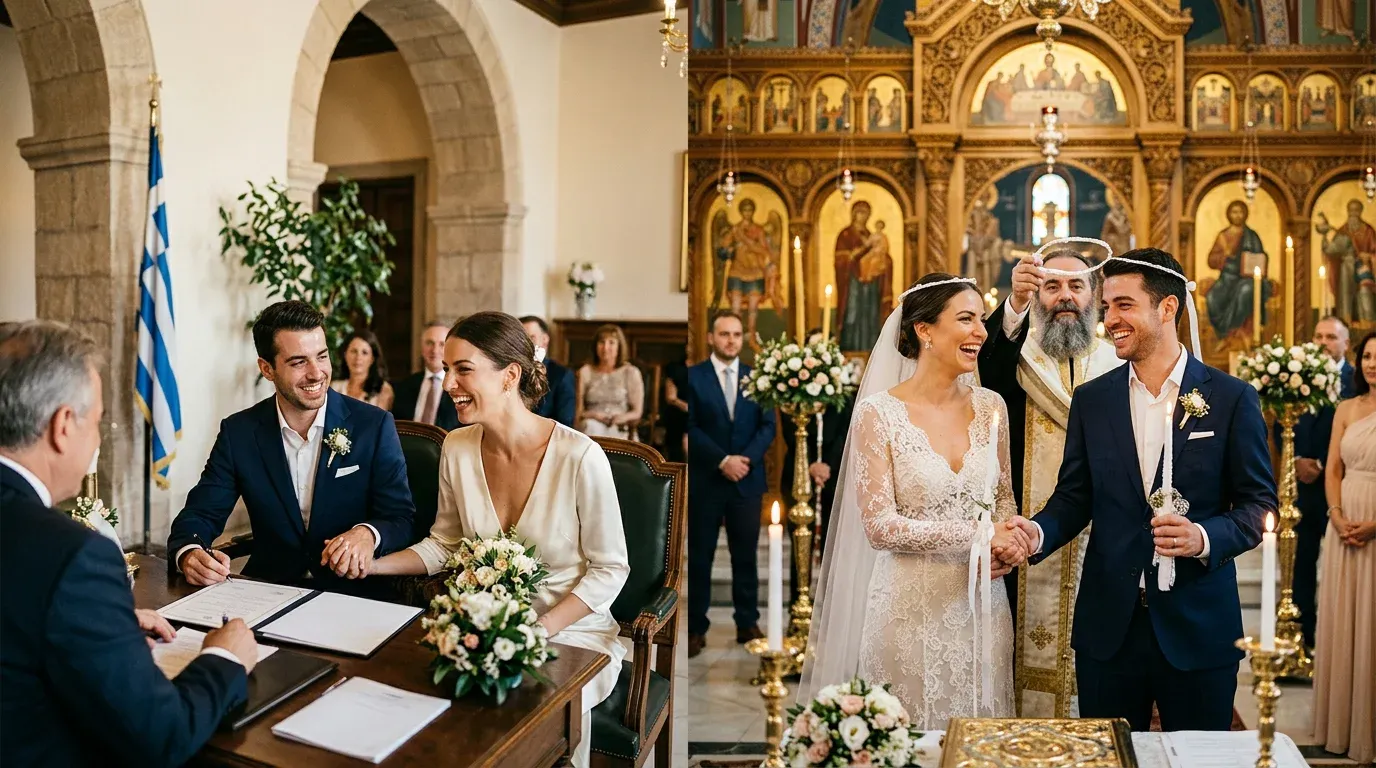
“Civil or church?” is one of the first decisions Greek couples face, and one of the most emotionally loaded. The good news legally: in Greece, a civil marriage performed according to law is fully equivalent to a religious (Orthodox) marriage for public authorities, inheritance, taxation, and daily life. The differences sit in who marries you, which documents you gather, where you can stand, how long the rite lasts, and what the day feels like for you and your families.
This guide compares process, cost, venues, and modern trends, then shows how either path still needs the same operational backbone: guest list, RSVP, wedding website, and a planning hub for budget and vendors.
Plan Your Event
One platform for every occasion: weddings, baptisms, corporate events and private parties.
Legal equivalence (what actually changes)
Civil marriage was codified in Greece in 1982 and produces the same legal marriage as the Orthodox sacrament. Both are registered at the municipality; both create the same spousal status. The officiant differs: a mayor or deputy (or authorised official) for civil, an Orthodox priest for religious.
Pro tip: If someone claims civil marriage is “not real,” that is a cultural opinion, not a legal one. Choose based on values and logistics, not myths.
Civil marriage: documents and timeline (typical)
Papers usually go to the municipality where at least one fiancé resides (rules vary slightly, confirm locally):
| Document | Notes |
| Recent birth certificate extract | Often last six months |
| Marriage application | Municipality form |
| Statutory declaration (no impediment) | Standard Greek declaration |
| ID / passport copies | Both parties |
| Certificate of family status | Recent |
| Newspaper publication | Required public notice |
| Fees | Modest municipal charges |
Timeline sketch: file 6 to 8 weeks ahead; newspaper notice about a week before; ceremony at town hall or licensed outdoor venue; registration within statutory limits. Many municipalities now allow beach, estate, or hotel ceremonies when properly licensed, ideal if you want nature without a full church programme.
The civil rite itself is short: often 15 to 30 minutes: legal declarations, rings, signatures, two witnesses (adults with ID). There is no koumbaros role in the legal sense, though couples still honour a “best person” informally.
Religious (Orthodox) marriage: documents and timeline (typical)
Papers go through the metropolis / parish:
| Document | Notes |
| Birth extracts | Recent |
| Baptism certificates | Orthodox baptism required |
| Certificate of eligibility to marry | From church authorities |
| Application to marry | Parish / metropolis |
| Newspaper publication | Also required |
| Fees / offerings | Parish dependent |
| Koumbaros | Must be Orthodox Christian |
Timeline sketch: book church 3 to 6 months ahead in busy areas; submit documents ~2 months before; allow 45 to 60 minutes in church for the full service: betrothal, crowning, common cup, Dance of Isaiah, removal of crowns.
The koumbaros is central: crowns, rings, and a deep social role in Greek culture.
Cost comparison (ceremony only)
Reception pricing is the same either way; differences concentrate in fees, music, and church flowers.
| Cost item | Civil (typical) | Religious (typical) |
| Ceremony fees | Lower municipal range | Church + administrative offerings |
| Newspaper notice | Similar | Similar |
| Church flowers / chanter | , | Often €300 to €2,000+ combined |
| Koumbaros items (crowns, etc.) | , | Often €200 to €800+ |
| Ceremony subtotal (rough) | Tens to low hundreds of euros + notice | Often higher once church layer added |
Pro tip: If you marry civilly at an estate, ask whether the municipality charges an on-location fee. Island municipalities often publish package lists for foreign couples, useful for destination wedding Greece planning.
Venues: where each type usually happens
Civil: town hall; licensed hotel, estate, beach, restaurant setups.
Religious: parish church, chapel, some estate chapels, monasteries for certain couples.
Your reception can be anywhere in either case. Track venue comparisons and payment milestones in your planning hub so legal deadlines and catering deposits do not collide quietly.
Can you do both?
Yes, common patterns:
- Civil first, church later: legal or immigration timing drives the civil date; the big celebration follows in church.
- Civil abroad + church in Greece: the legal marriage is already registered; the church celebration is pastoral and cultural for family. Clergy guidance matters, always ask your priest.
Decide early which day is the “main” guest event so you do not accidentally budget two full receptions.
Why civil share is rising
Couples cite flexible locations, shorter ceremonies, lower church-layer costs, interfaith marriages, and personal tone. Public statistics have shown civil marriages growing as a share of new unions over the past decade, your choice is increasingly normal, not exceptional.
Why some still choose religious first: family tradition, the beauty of crowns and hymns, the koumbaros bond, and active faith.
Family conversations (without a civil war)
Parents and grandparents often have strong feelings. Practical habits that help:
- Talk early, not the week invitations ship.
- Explain your reasons calmly: logistics, beliefs, fairness to both families.
- Compromise on symbols: some civil couples still use crowns as cultural gesture where permitted.
- Remember authority: the marriage is yours; respect and empathy travel both directions.
Planning tools work for both paths
Regardless of ceremony type, you still need:
- A clear timeline: see wedding planning step by step.
- Digital wedding invitations or a hybrid print + web approach.
- RSVP that scales from thirty guests at a town hall to three hundred at an estate.
- Guest list discipline: witnesses, VIP tables, dietary notes.
WhiteClover’s planning hub keeps budget, vendors, and notes in one workspace whether your “venue walk-through” is a nave or a harbour terrace.
FAQ
Is civil marriage recognised abroad? Yes, with apostille / legalisation where required, check the destination country’s rules.
Witnesses vs koumbaros? Civil needs two witnesses; Orthodox needs a qualified koumbaros under church law.
Church after civil? Generally possible, your priest confirms; the civil record remains the legal backbone.
Island civil weddings? Popular; municipalities are experienced, book early for June to September Saturdays.
Duration? Civil ~15 to 30 minutes; Orthodox service ~45 to 60 minutes before photos.
Closing
There is no universal “better”, only better for you. Compare legal steps, total ceremony spend, and emotional meaning, then build the operational layer once: website, RSVPs, budget, vendors. Start organising on WhiteClover with a wedding website, planning hub, and calm guest management, whether you say “I do” under a dome or an open sky.
Written by
Marios P
Part of the WhiteClover team, helping couples and hosts plan unforgettable events with modern digital tools. Passionate about simplifying the celebration planning journey.
You Might Also Like
 Wedding Planning
Wedding Planning Step by Step (2026)
Wedding planning step by step: a clear timeline from budget to vendors, guest list, website, RSVPs, and week-of logistics, without the overwhelm.
 Wedding Planning
What's the Best Way to Stay Organised for My Wedding?
Stay organised for your wedding with one place for guest list, RSVP, and timeline.
 Wedding Planning
Manage Multiple Wedding Events in One Place
Manage multiple wedding events in one place: welcome dinner, ceremony, reception, brunch.