
Advertisement
 Sponsored
Can Americans Legally Marry in Greece?
Short answer: yes, absolutely. The longer answer involves a specific document from the US Embassy that most American couples have never heard of, a visit to a local Greek civil registry, and a post-wedding apostille to make your Greek marriage certificate work back home: in Texas, California, or wherever you call home.
My partner and I started planning our Santorini wedding from Dallas about fourteen months before the date. We assumed we knew what we needed: passports, birth certificates, enthusiasm. We were wrong about one critical document, the Single Status Affidavit, issued only by the US Embassy in Athens or the Consulate in Thessaloniki. This guide covers everything we wish we'd found on day one, including whether a Greek marriage is legally valid in the US and the 8-step timeline that keeps nothing falling through the gaps.
Planning a wedding in Greece from abroad?
We're not wedding planners. We help you find the right Greek vendors for your date, place and budget, and explain the paperwork. Neutral advice, free.
We only pass your details to a vendor once you say so.
Is a Greek Marriage Legally Valid in the USA?
Yes. A civil marriage performed in Greece under Greek law is a legally recognised marriage, and the US government accepts foreign marriages when they are valid in the country where they took place. Once you return home, you will need to:
- Have your Greek marriage certificate translated into English by a certified translator.
- Attach an apostille: the standardised authentication used under the Hague Convention, of which Greece is a signatory.
- Keep the certified translation and apostilled certificate as your official record. Most US states do not issue a new domestic marriage certificate; they accept the foreign document as proof.
Every state has its own process, but all 50 accept a legally performed Greek civil marriage for name changes, Social Security updates, insurance, and community property purposes. If your county clerk looks blank when you hand over an apostilled foreign document, print the US State Department's plain-language explainer on the Hague apostille, it tends to clear things up in minutes.
Pro tip: Community property states (Texas, California, Arizona, New Mexico, Nevada, among others) treat a valid foreign marriage as effective from the date of the Greek ceremony, not from when you register it at home.

Civil vs Symbolic: Which One Is Actually Legal?
This is where many couples get caught off guard, especially when browsing Instagram-ready venues in Santorini or Mykonos.
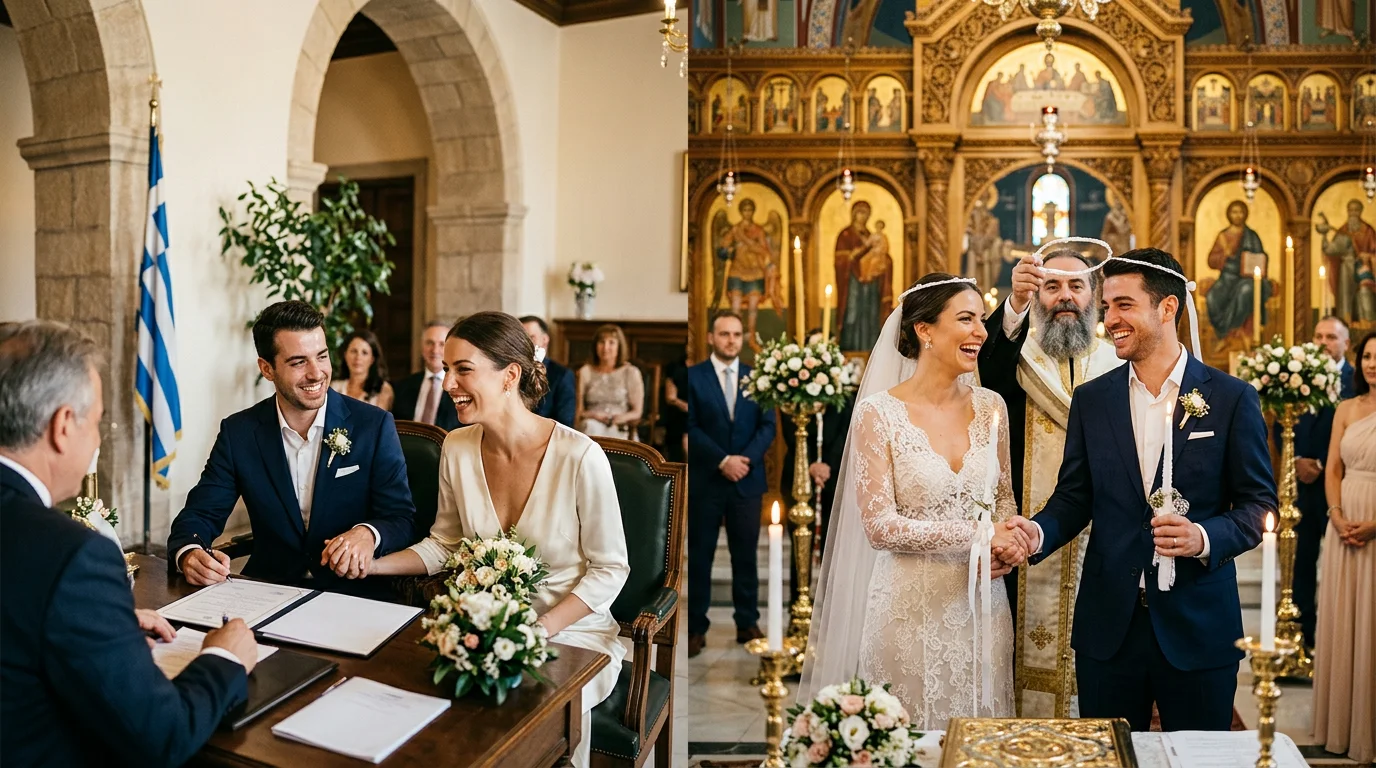
Civil ceremony: the only legally binding option for most American couples. It is conducted by a licensed municipal official at the local town hall or a venue that holds a civil marriage licence. You are married in the eyes of Greek law the moment the officiant signs the register.
Symbolic ceremony: the package most destination wedding companies lead with. These are genuinely beautiful and personally meaningful, but they carry no legal weight whatsoever. If a quote does not explicitly state that a Greek civil registrar is performing the ceremony, you are having a vow-renewal-style event, not a marriage. You would then need to marry legally, either in Greece beforehand or at a courthouse at home.
Ask your venue directly, in writing, before signing anything: "Is this a legally registered civil marriage or a symbolic ceremony?" Planning a destination wedding in Greece on the legal track requires a different logistics setup from the start.
Documents You'll Need (The Full List)
This is where preparation either gives you breathing room or causes a panic at the 8-week mark.
| Document | Details |
| Valid US passport | Both partners; valid beyond the wedding date |
| Original birth certificate | Long-form (not the short extract or wallet card) |
| Apostille on each birth certificate | From your state's Secretary of State office |
| Single Status Affidavit | Issued by the US Embassy Athens or Thessaloniki, not a US notary |
| Divorce decree, if applicable | With apostille and certified Greek translation |
| Certified Greek translations | Of all foreign documents, your planner can recommend an accredited translator |
The document that surprises people most consistently is the Single Status Affidavit. It is a sworn statement that you are free to marry, not currently married to anyone else. The Greek civil registry (ληξιαρχείο) will not accept a notarised letter from a US notary public in its place. It specifically requires the Embassy-issued version, and the officer there takes an oath from you in person.
How to Get the Affidavit at the US Embassy
The US Embassy in Athens and the Consulate in Thessaloniki issue the affidavit through their American Citizens Services appointment system. The process is more straightforward than it sounds:
- Book an appointment online through the Embassy portal. In summer months, slots book out 2 to 4 weeks ahead, sometimes longer, book as soon as your wedding date is locked.
- Both partners attend together if possible. Bring your passports and any documents that confirm your current marital status (or prior divorce, if applicable).
- Swear the oath before a consular officer. You declare under penalty of perjury that you are presently unmarried.
- Receive the affidavit the same day. The Embassy charges approximately $50 per person.
- No further apostille needed. The Embassy's official seal is accepted directly by Greek civil authorities, you do not need to take the affidavit back through any additional authentication step.
Pro tip: The affidavit is typically valid for 6 months. Do not book the appointment too far in advance, and do not book it so late that a scheduling delay pushes you past the wedding date without a valid document.
The 8-Step Legal Marriage Timeline
Allow 2 to 3 months minimum. If you're marrying in peak season (June to September), build in 3 to 4 months to account for Embassy appointment queues and municipal registry schedules.
| Step | What happens | Who handles it | How long |
| 1 | Decide civil vs symbolic; confirm with planner and venue | You + planner | 1 to 2 weeks |
| 2 | Order long-form birth certificates from your state | You | 2 to 4 weeks |
| 3 | Get apostilles on birth certificates | State Secretary of State | 2 to 6 weeks (varies by state) |
| 4 | Book US Embassy appointment for Single Status Affidavit | You (online) | 2 to 4 weeks to get a slot |
| 5 | Attend Embassy; receive affidavit (same day) | You + consular officer | 1 appointment |
| 6 | Submit full document set to ληξιαρχείο (civil registry) | Your planner + you | 4 to 6 weeks before wedding |
| 7 | Mandatory municipal publication (public notice) | Municipality / planner | 10 to 14 days required by law |
| 8 | Ceremony; then apostille marriage certificate for US use | Officiant → Greek authority → you | 2 to 4 weeks post-wedding |
Most couples are surprised by Step 7. Greek law requires a public notice of the intended marriage to be published, typically in a designated local newspaper or official gazette, before the ceremony can take place. Your planner handles this, but it adds a hard minimum of 10 days to your timeline that cannot be compressed.
The Role of a Local Greek Wedding Planner
A good local planner is not a luxury for legal destination weddings. It is the difference between a filing that goes smoothly and one that stalls because a document was sent to the wrong municipal office.
The civil registry (ληξιαρχείο) operates with some variation by municipality. The rules and accepted document formats in a Cyclades island registry are not identical to those in central Athens. A planner who regularly works with that specific registry:
- Knows which certified translators the local office accepts.
- Can submit documents on your behalf where proxy submission is permitted.
- Tracks mandatory publication windows and ensures the notice goes out on time.
- Flags document expiry dates, some certificates are only valid for a few months after issue.
Before hiring anyone, work through the right questions to ask a wedding planner, specifically asking how they have handled foreign couple documentation in the past and which civil registries they have experience with.
Our full destination wedding checklist helps you run the legal paperwork track in parallel with venue, catering, and guest logistics so nothing collides quietly. Document delays are one of the most common, and most preventable, unexpected wedding costs.
US State-by-State Recognition: Practical Notes
A few things worth knowing when you arrive home married:
- All 50 states recognise a foreign civil marriage that was legally valid where it occurred.
- Name change: Take your apostilled Greek certificate plus a certified English translation to the Social Security Administration first, then the DMV. The process mirrors a domestic name change; only the source document differs.
- Benefits and insurance: Most HR departments accept a certified translation. If yours pushes back, a short letter from a family law attorney confirming the marriage's validity usually resolves it.
- Worried about a specific state? A 30-minute consult with a family law attorney in your home state before the wedding is money well spent.
Civil or Orthodox? Understanding the Options for Americans
If you have Greek heritage or a Greek-descended partner, the family may want an Orthodox church ceremony. Here is what that means practically for Americans:
- The Orthodox church in Greece requires both partners to be baptised Orthodox Christians, typically with baptism certificates from their respective parishes.
- If one partner is not Orthodox, the church will generally not perform the ceremony.
- The civil ceremony is the legal default for mixed-faith or non-Orthodox couples: and it is fully valid, increasingly common, and carries no lesser legal standing.
For a full breakdown of what changes between civil and religious ceremonies in Greece: documents, costs, venue options, the koumbaros role, see our guide on civil vs religious wedding in Greece.
Your Wedding Day Sorted: Let WhiteClover Handle the Rest
Managing a legal documentation timeline across two continents is genuinely the hardest part of a destination wedding in Greece. Once that paperwork is filed, you still have a guest list to manage, RSVPs to track across US and Greek time zones, a wedding website your guests can actually use, and a seating plan that doesn't fall apart when three cousins confirm late.
WhiteClover's tools for destination weddings in Greece are built for exactly this situation. An RSVP system that works across time zones, a wedding website your guests can check for venue directions and the day's schedule, and a planning hub where vendor payments, document milestones, and budget notes sit in the same workspace. You handle the paperwork, WhiteClover handles the rest. Start at whiteclover.io.
FAQ
Do both partners have to be physically present for the entire process? For the ceremony itself, yes, both must be present for the legal vows. Some document pre-submission can be handled by your planner acting on your behalf, but the day-of ceremony requires you both there.
Can we marry symbolically in Greece and then legally at home? Yes, and many couples do exactly this. A symbolic ceremony in Greece gives you the location and atmosphere you want; a courthouse ceremony at home handles the legal registration. Just be honest with guests about which event is the legal marriage if it matters to you.
How much does the US-side paperwork cost in total? Budget roughly $200 to $500 USD: birth certificate apostilles typically cost $15 to $25 per document depending on the state, and the Embassy charges approximately $50 per person for the affidavit. Greek registry fees, certified translations, and the mandatory publication add a few hundred euros on the Greece side.
Is the Single Status Affidavit the same as a Certificate of No Impediment? Functionally, yes, different countries use different names for the same sworn statement that you are free to marry. The US Embassy issues the American version; Greek authorities accept it directly.
What if I was previously married? You will need your divorce decree (or a former spouse's death certificate) with an apostille and a certified Greek translation. The civil registry needs proof that the previous marriage was legally dissolved before your new marriage can be registered.
Written by
Riol M
Part of the WhiteClover team, helping couples and hosts plan unforgettable events with modern digital tools. Passionate about simplifying the celebration planning journey.
You Might Also Like
 Wedding Planning
Civil vs Religious Wedding in Greece
Civil or Orthodox wedding in Greece? Legal equivalence, documents, timelines, venue options, costs, and family conversations, clear facts for 2026 couples.
 Checklists
7 Essential steps for your destination wedding checklist
Discover 7 essential tips for couples planning a destination wedding in Greece.
 Vendor Tips
Questions to Ask a Wedding Planner
Hiring a wedding planner? Ask these practical questions about fees, communication, vendors, budget control, and wedding-day responsibility first.