
Advertisement
 Sponsored
When Sarah and Michael from New York started pricing their Santorini wedding for 50 guests, they assumed the headline venue fee was the main number to track. By the time the first round of deposit invoices arrived, they had discovered a second budget sitting quietly underneath the first, made entirely of costs that only apply because you are flying in from thousands of miles away. This guide is built around that second budget: the extra layer of fees, logistics, and planning decisions unique to couples organising a destination wedding in Greece from abroad. It covers everything from venue hire to apostille stamps, with tiered cost ranges for intimate, mid-size, and luxury celebrations, and a frank section on the hidden expenses that rarely show up in magazine-style overviews.
Planning a wedding in Greece from abroad?
We're not wedding planners. We help you find the right Greek vendors for your date, place and budget, and explain the paperwork. Neutral advice, free.
We only pass your details to a vendor once you say so.
Why Planning from Abroad Adds Extra Costs
If you live in the UK, USA, or Australia, planning a Greece wedding is not the same as a local couple who can drive to every venue visit, phone the registrar in Greek, and call in favours with vendors they already know. As a destination couple, you are paying for access, logistics, and legal compliance across two countries simultaneously.
The costs that catch most couples off guard are not the obvious big-ticket items. They are the connective tissue between them. Your planner needs to coordinate vendors who have never worked with each other. Your guests need somewhere to sleep within transfer distance. Your paperwork needs to meet Greek civil registry requirements even though it was issued in another country. A welcome dinner exists because your nearest family members just flew nine hours, you cannot reasonably say hello at the reception and goodbye after the first dance.
None of these extras are optional. They are the price of having your wedding in one of the most sought-after locations in the world rather than somewhere 20 minutes from home.
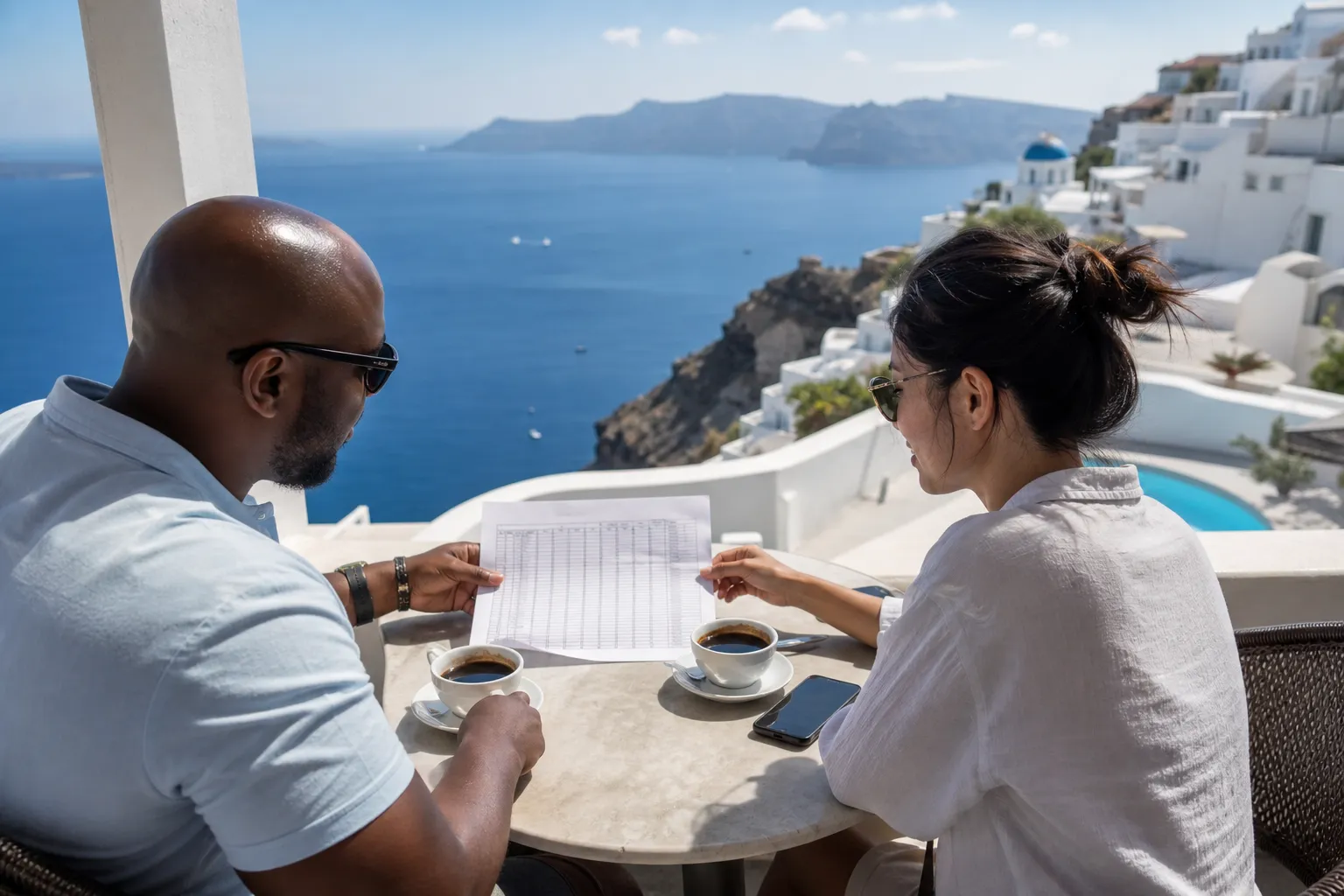
Breaking Down Your Greece Wedding Budget
Venue Hire vs Per-Head Catering
This is the single most common source of budget shock. In Greece, especially on premium islands like Santorini and Mykonos, top venues charge a venue hire fee and a per-head catering minimum as two separate line items. Assuming you only need to budget for one is the fastest way to blow your spreadsheet.
A caldera-view venue in Oia might charge €5,500 to €8,500 for exclusive use across 8 to 10 hours. Catering from the same venue or a partner caterer runs €220 to €340 per head for a full reception dinner including drinks. For 50 guests, that catering line alone is €11,000 to €17,000. Combined with venue hire, you are looking at €17,000 to €25,500 before a single flower or a photographer is in the picture.
For more grounded islands, Rhodes, Lefkada, Pelion, venue hire fees are lower (€2,500 to €5,500), and catering rates are typically €160 to €240 per head. The gap between "peak Santorini" and "beautiful lesser-known island" is substantial.
Pro tip: Always ask whether the catering quote includes Greek VAT (currently 24%). Some vendors quote net; others quote gross. Comparing two quotes without knowing which is which will mislead you.
Florals: Local Sourcing vs International
Shipping flowers or centrepiece materials from abroad is almost never worth it for a Greece wedding. Import rules, customs delays, and the Mediterranean heat in summer make international florals a logistical gamble. The good news is that Greek florists working in the wedding market are genuinely skilled, and local sourcing: olive branches, anemones, bougainvillea, gypsophila, Santorini's own grape vines, results in arrangements that actually belong in the setting.
Budget €2,500 to €4,000 for a modest floral setup (bridal bouquet, ceremony arch, table centrepieces for 50 guests). A more elaborate programme with statement installations runs €5,500 to €9,000+. A local florist recommended by your planner will always give a better rate than one you cold-contact via Instagram from overseas.
The Destination Wedding Planner Fee
For a destination couple, a local Greece-based planner is not a luxury. It is one of the highest-return line items in your budget. A Santorini-based full-service planner typically charges €3,500 to €6,000 for a complete coordination package. A New York or London "destination specialist" handling the same brief will often charge more and deliver less, simply because they lack the local vendor relationships, the language, and the familiarity with Greek civil registry paperwork.
Sarah and Michael hired a Santorini-based coordinator for €4,500. She negotiated €800 off the catering rate, organised all their apostille and translation paperwork, and flagged a florist quote that was significantly inflated for international clients. The net saving more than covered her fee. For a step-by-step approach to building your wedding checklist before you even contact vendors, the destination wedding checklist guide is a good starting point.
Welcome Dinner and Farewell Brunch
When your guests have travelled intercontinentally, the wedding day itself is not the full picture. A welcome dinner the evening before, typically a relaxed taverna buyout or a private terrace dinner, is both expected and genuinely useful: it gives guests who do not know each other a chance to connect before the main event, and it means you spend your wedding-morning getting ready rather than making introductions.
A taverna buyout for 40 to 50 guests runs €1,800 to €3,500 depending on the island and the menu. A farewell brunch the next morning (coffee, pastries, a view) adds €600 to €1,500 if you host it, though many couples leave this informal and let guests self-organise.
Accommodation Block Bookings
You are not obliged to pay for all your guests' rooms, but you may be expected to negotiate a room block: a reserved group of rooms at a negotiated rate that guests book individually. Most venues on the islands require or strongly encourage this, partly because transport off Santorini (for example) is limited and guests staying nearby reduces logistics headaches.
Working with your planner to secure a room block costs nothing directly, but many couples choose to subsidise a handful of rooms for close family. Budget €2,000 to €5,000 if you plan to contribute to 5 to 10 rooms for 2 to 3 nights, depending on hotel category.
Legal and Paperwork Fees
Getting legally married in Greece as a foreign national requires:
- Apostille on your birth certificates (issued in your home country): €150 to €400 depending on country
- Certified Greek translations by a sworn translator: €200 to €350
- Civil registrar appointment and registration fee: €100 to €200
- Certificate of no impediment or equivalent, obtained from your home country's consulate or registry office: varies widely
Total legal and paperwork cost: €500 to €1,100 for a couple. This is a fixed cost that applies regardless of whether you are having an intimate elopement or a 120-person celebration. It is also the part most couples leave until far too late, allow at least 3 months for paperwork processing before your wedding date.
Pro tip: If you want a religious ceremony with the Church of Greece, check document requirements directly with the local parish. Orthodox ceremonies have additional baptism certificate requirements that vary by diocese.
Ferry, Coach, and Transport Logistics
Moving guests between accommodation, ceremony venues, and reception sites is often the most logistically intense part of a Greek island wedding. Ferries, if guests are island-hopping, and coaches from hotel clusters to the venue are both standard line items.
Coach hire for a group transfer (return, 30 to 50 guests) runs €350 to €900 depending on island road conditions and journey time. If your guests are spread across two or three accommodation areas, factor in multiple vehicles. Ferry tickets for guests arriving from Athens are typically their own cost, but including a suggested ferry schedule in your wedding website means far fewer last-minute messages asking for help.
Budget Tiers at a Glance
The following ranges are indicative for 2026 and based on typical destination-couple scenarios. They include venue, catering, florals, planner, photography, transport, welcome dinner, and legal fees. They do not include guests' own flights or accommodation.
| Category | Intimate (≈20 pax) | Mid-Size (≈60 pax) | Luxury (≈120 pax) |
| Venue hire | €2,500 to €4,500 | €5,000 to €9,000 | €8,000 to €18,000 |
| Catering (per-head) | €150 to €220/pp = €3,000 to €4,400 | €200 to €280/pp = €12,000 to €16,800 | €280 to €380/pp = €33,600 to €45,600 |
| Florals | €1,500 to €3,000 | €3,000 to €6,000 | €7,000 to €15,000 |
| Planner | €2,500 to €4,000 | €4,000 to €6,500 | €6,000 to €12,000 |
| Photography + video | €2,500 to €4,500 | €3,500 to €6,000 | €6,000 to €15,000 |
| Legal/paperwork | €500 to €1,100 | €500 to €1,100 | €500 to €1,100 |
| Welcome dinner | €800 to €1,800 | €2,000 to €4,000 | €4,000 to €8,000 |
| Transport/coaches | €400 to €800 | €700 to €1,500 | €1,500 to €4,000 |
| Miscellaneous buffer | €1,000 to €2,000 | €2,500 to €4,500 | €5,000 to €10,000 |
| Estimated total | €15,000 to €25,000 | €35,000 to €60,000 | €80,000 to €150,000+ |
For a more detailed look at what Greek weddings cost from a local couple's perspective, the post how much does a Greek wedding cost in 2026 provides useful comparison numbers. And if you are worried about budget creep, avoiding unexpected wedding planning costs is worth reading before you sign any contracts.
Hidden Costs Most Couples Miss
Greek VAT (ΦΠΑ at 24%)
Greece applies a standard VAT rate of 24% on most services, and it is not always included in the first quote you receive. Some vendors, especially smaller, local operators, quote net prices and add VAT on the invoice. A €15,000 catering quote becomes €18,600 once VAT is applied. Always confirm whether a quote is inclusive or exclusive of ΦΠΑ before comparing two vendors. Build a 10 to 15% VAT buffer into your initial spreadsheet on every service line.
Tipping Culture
Greece has a tipping culture, but it is not at American scale. Expect to tip:
- Wedding planner (day-of): €80 to €150
- Head waiter / catering supervisor: €50 to €100
- Individual waitstaff: €20 to €40 each (budget €200 to €400 for a 50-person reception)
- DJ or band: €50 to €100 at end of night
- Hair and makeup team: €30 to €50 each
Total tip budget: €400 to €800 for a mid-size wedding. Have cash prepared in envelopes the morning of the wedding, your planner will distribute them at the right moment if you ask in advance.
Currency Exchange
If you are paying vendors in euros from a non-euro account, exchange rate movement can shift your total spend by more than you might expect. A 3% USD/EUR swing on a €55,000 wedding is €1,650. Options to manage this:
- Book a forward contract through a currency specialist (Wise, OFX, or a bank FX desk) once you have signed your main vendor contracts
- Ask vendors if they accept bank transfers in your home currency (some do, though most will set the rate themselves)
- Keep a 5% currency buffer in your budget as a practical floor
Keeping Track of It All
Planning a Greece wedding from abroad means managing vendors, timelines, and guest logistics across time zones. Keeping your wedding guest list, RSVP responses, and travel details in one place, rather than across five email threads and a spreadsheet shared with your planner, saves hours and prevents the kind of miscommunication that leads to last-minute crises.
Managing all of this can feel like a second job when you are coordinating from across the world. WhiteClover brings your guest list, RSVP tracking, and wedding website into one place, so your guests know exactly where to be and you have one less inbox to monitor at midnight. Designed for modern couples who want the day to run itself, WhiteClover makes it straightforward to send updates, track confirmations, and share travel details with guests wherever they are. Start planning at WhiteClover and spend more of your energy on the parts that actually matter.
Frequently Asked Questions
How much does a destination wedding in Greece cost on average?
For a mid-size wedding of 50 to 70 guests on a popular Greek island, most destination couples spend €35,000 to €65,000 in 2026. Intimate weddings of 20 guests can come in at €15,000 to €25,000, while luxury celebrations of 100+ guests regularly exceed €100,000. The biggest variable is usually the island: Santorini and Mykonos command a significant premium over Crete, Rhodes, or the Ionian islands.
Do I need a local wedding planner for a destination wedding in Greece?
Strongly recommended, yes. A Greece-based planner handles vendor negotiations, paperwork coordination with local registrars, and on-the-day logistics in a way that no remote coordinator can match. Their fee (€3,500 to €6,500) typically pays for itself through vendor discounts and time saved on legal documents alone.
What paperwork do I need to get legally married in Greece?
Foreign nationals typically need: apostille-certified birth certificates, sworn Greek translations, a certificate of no impediment from their home country, and a civil registrar appointment in the municipality where the wedding will take place. Requirements vary slightly by nationality, consult the Greek consulate in your home country at least 4 months before your wedding date.
Is catering usually included in the venue fee?
Not in Greece. Most premium venues charge a venue hire fee (for the space and time) separately from catering, which is either handled by an in-house team or a preferred caterer. Always request both figures upfront and compare total spend, not just venue hire, when evaluating multiple venues.
What are the most overlooked costs in a Greece destination wedding?
The five most commonly overlooked line items are: (1) Greek VAT at 24% on all services, (2) the welcome dinner the evening before, (3) legal and translation paperwork fees, (4) airport and inter-hotel coach transfers for guests, and (5) tips. Together these typically add €3,000 to €7,000 to a mid-size wedding budget that didn't account for them.
Recommended Reading
Written by
Dimitris S
Part of the WhiteClover team, helping couples and hosts plan unforgettable events with modern digital tools. Passionate about simplifying the celebration planning journey.
You Might Also Like
 Budget & Tools
How Much Does a Wedding Cost in Greece in 2026?
Realistic Greece wedding costs for 2026: venue, catering, islands vs Athens, savings tactics, and free budget tools, so your numbers stay under control.
 Checklists
7 Essential steps for your destination wedding checklist
Discover 7 essential tips for couples planning a destination wedding in Greece.
 Budget & Tools
Avoid Unexpected Wedding Planning Costs
Avoid unexpected wedding costs: contingency, clear vendor contracts, accurate headcounts, and one budget tracker. Practical tips for stress-free planning.