Advertisement
 Sponsored
A baptism seating plan starts from a different place than a wedding one. Wedding guests mostly arrive in twos. Baptism guests arrive as families, with children, buggies and high chairs, and the guest of honour is the godparent.
Plan a baptism or christening lunch the way you'd plan a wedding and the children will have swapped tables before the first course lands. The order below runs from the family table to the day you send the plan to your venue. It's written with a Greek Orthodox baptism in mind, where the godparent (nonos or nona) has a big role, but most of it holds for any christening with a seated meal.
Plan Your Event
One platform for every occasion: weddings, baptisms, corporate events and private parties.
A baptism fills tables with families
A round table usually seats 8 to 10. At a wedding that means four or five couples you can mix however you like. At a baptism it means two or three families, and a family doesn't split across two tables.
So count families before you count people. A list of 90 guests might be thirty families of three, and then tables of ten never divide evenly. One ends up with nine, another with eight.
That's fine. An empty chair bothers far fewer people than a mother sitting at one table while her toddler eats at the next.
Two things are easy to forget. A high chair takes up a seat's worth of space, so a table with two babies fits one adult fewer. And children's menus: caterers charge per head, so note how many children's meals each table has. You pay for what's served, and the waiting staff don't have to guess where the small portions go.
The family table: parents, godparent, grandparents
There's no top table at a baptism, and you don't need to invent one. There is one table everyone looks at, though: the parents with the baby, the godparent and their partner, and the grandparents.
The godparent sits next to you, not at the end. They're the guest of the day, and everyone will come over to congratulate them. If they have children of their own, seat them at the same table, or the godparent will spend the meal walking back and forth.
If the priest is staying for the meal, put him at the family table or the one next to it, near the grandparents and away from the speakers.
Keep your own two seats on the side facing the door. You'll be up and down all afternoon, greeting people or feeding the baby, and squeezing behind five chairs every time gets old fast.
With two sets of grandparents, a great-grandmother and a godparent who brings the whole family, that table passes twelve very quickly. Then set two tables side by side, one for each side of the family, rather than one long table the room can't fit.
Where the children sit
A kids' table sounds lovely on paper. In practice, under-fives are back on a parent's lap within fifteen minutes and their places sit empty with full plates in front of them.
Babies and small children sit with their parents, at tables near the door and the toilets. Put two or three families with babies at the same table and they look after each other, and nobody feels they're disturbing the neighbours when a baby cries.
Children from about six to ten can have their own table, as long as there's an entertainer or one adult sitting with them. Place it where the parents can see it from their seats. Teenagers will sit wherever they like, usually together, and that's fine.
The order to build it in
- Wait until most guests have replied to the invitation. Build a plan off half a list and you'll rebuild it three times.
- Group your guests by family, with the children inside the same group.
- Seat the family table first.
- Then the tables with babies, near the exits.
- Everyone else last: friends, colleagues, neighbours.
In Greece, venues and caterers usually ask for the final plan 7 to 10 days before. Have it ready two weeks out and you have room for the last-minute changes, which at a baptism is nearly always a child who's fallen ill or a family who are now bringing a grandparent too.
Doing it on your phone
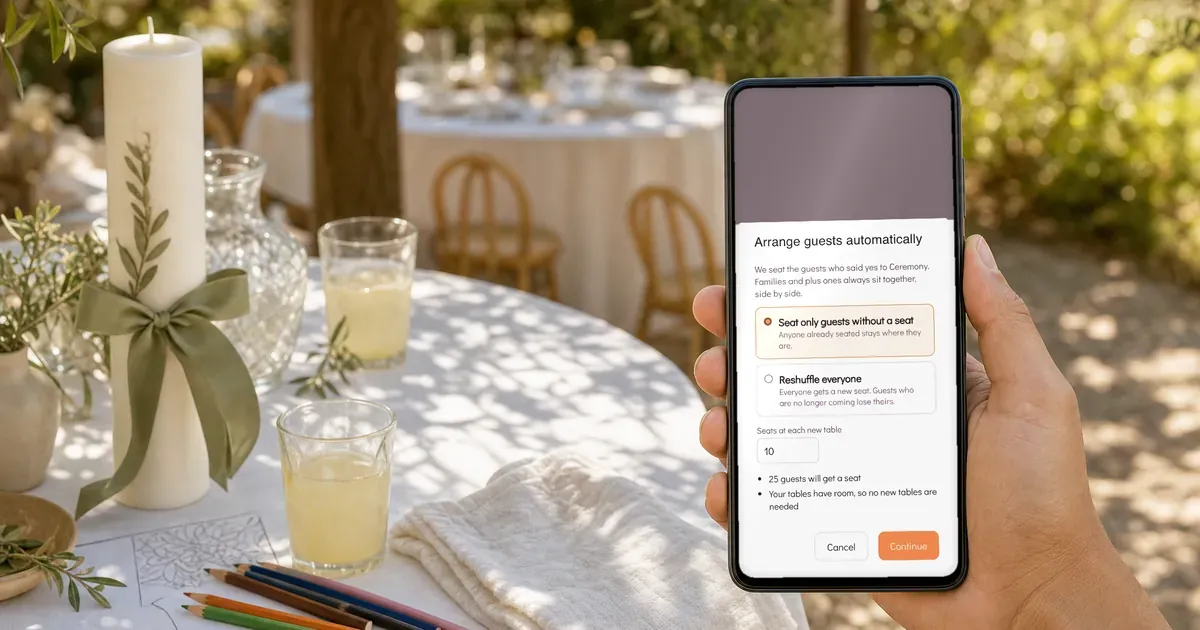
In the WhiteClover seating chart a family is already a party. Seat the mother and her partner and children take the seats next to her. Arrange automatically keeps every party together, so you'll never find a child at a different table from their parents. It all works on a phone: tap the guest, tap the seat, and Undo is there if you get one wrong.
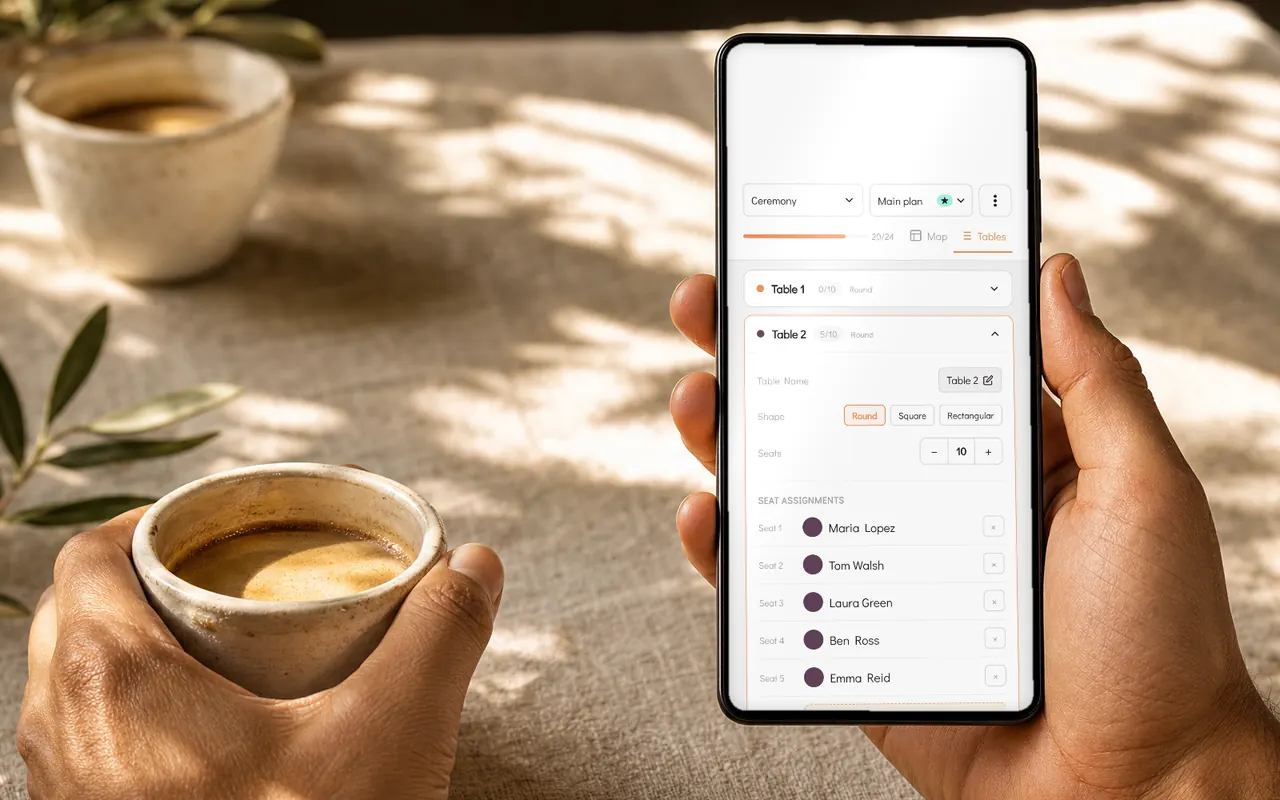
You send the venue one link that always shows your Default plan, so a change in the last week doesn't need another email. And 2 hours before the meal, every seated guest who has joined the guest app sees their table on their phone, so far fewer people stand at the door asking.
The seating chart is free. If you want a second plan to try a different layout, that's €3.99, once, for that event.
In short
Baptism seating is built around families. Count families, seat the godparent next to you, keep small children with their parents near the door, and send the venue your plan with a few days to spare.
If you're planning the rest of the day too, our complete baptism planning guide covers it from the church to the favours. And if you still need an invitation, see the digital baptism invitation, which collects the replies as well.
FAQ
Is there a top table at a baptism? No. There's a family table with the parents, the baby, the godparent and the grandparents. It doesn't need to be raised or set apart, just somewhere everyone can see it.
Where does the godparent sit at a baptism? Next to the parents at the family table, with their partner and children if they have them. They're the guest of honour.
How many people fit at a baptism table? A round table seats 8 to 10 adults. Count each high chair as a seat, because it takes the same space.
Do we need a kids' table at a christening? Not for under-fives, who will go back to their parents anyway. For children aged six to ten it works, if an adult or an entertainer sits with them and the parents can see the table.
When should we send the seating plan to the venue? Most Greek venues and caterers want it 7 to 10 days before. Send the number of children's meals per table with it.
Further reading
Written by
Nicole V.
Part of the WhiteClover team, helping couples and hosts plan unforgettable events with modern digital tools. Passionate about simplifying the celebration planning journey.
You Might Also Like
 Baptism
 Planning: A Complete 2026 Guide for Greek Families
Baptism planning in Greece: godparents, church documents, reception, budget, guest lists, favours, and digital invites, step by step for busy parents.
 Baptism
How Much Money to Give at a Greek Baptism
How much money to give at a Greek baptism as a guest, what the godparent pays for instead, and what a nono or nona really spends in 2026, item by item.
 Wedding Planning
How to Create a Wedding Seating Chart [2026 Guide]
Step-by-step guide to creating your wedding seating chart. Table layout tips, etiquette rules, handling no-shows, and free drag-and-drop tools for 2026.