Advertisement
 Sponsored
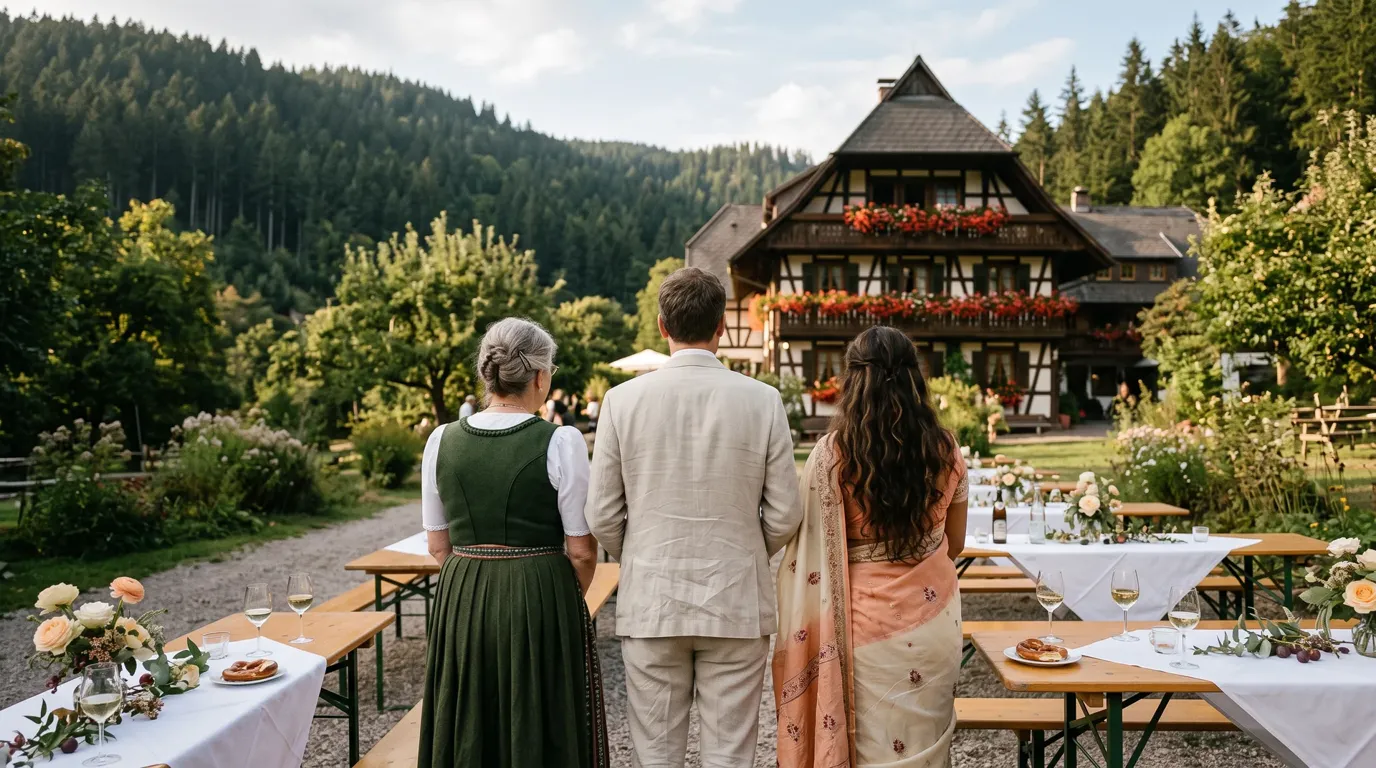
Anjali and Felix come from our imagination, not our customer list. Anjali grew up in Leicester and works in Freiburg. Felix is from a village twenty minutes away. They're marrying at the Standesamt on a Thursday with about twenty people, then holding a free ceremony and party at a country inn in the Black Forest on the Saturday. Felix's relatives speak German, and some of the older ones speak very little English. Anjali's side flies in from England, Delhi and Nairobi.
Most English-language guides cover either the paperwork for a German wedding or German customs for visiting guests. This one is for couples like Anjali and Felix, running one wedding for two sets of guests who expect different things.
TL;DR: Tell international guests early which of your dates is the legal one and which is the party, then translate the things guests act on, not every word.
- In Germany only the Standesamt makes you legally married, so it can sit on a different day from the big celebration.
- Guests who need a Schengen visa can apply no earlier than 6 months before travel. Your save the date should reach them before that window opens.
- Translate times, places, dress code, gifts and transport. Leave speeches in their own language with a short summary.
- Write your website in English and German yourselves. One link, and each guest reads it in their own language.
Plan Your Event
One platform for every occasion: weddings, baptisms, corporate events and private parties.
Two dates, and only one of them is legal
Under §1310 BGB, a marriage is concluded only when the couple declare before the registrar (Standesbeamter) that they want to marry each other. A church service or a free ceremony (freie Trauung) on the Saturday may be the part everyone remembers, and it still has no effect on your legal status.
German guests already know this. Your guests from Manchester or Delhi may not, and they'll book flights for whichever date on the invitation looks like "the wedding". Put it in the first lines of everything you send:
"We're getting legally married at the registry office in Freiburg on Thursday 3 June 2027 with close family. The wedding celebration, with a ceremony, dinner and party, is on Saturday 5 June 2027. That's the day we'd love you to be there."
Still deciding where to sign? Our comparison of marrying in Germany or Denmark covers both routes for foreign partners.
If you do invite everyone to both, say what each is. Registry rooms can be small, so tell guests how long the ceremony takes, how early to arrive and whether anything follows it, such as drinks outside or a lunch.
The German terms your international guests need explained
Your German guests will use these words without thinking. A short glossary on your website saves a dozen confused messages. The last three rows are customs described on Planet Wissen, the German public broadcasters' knowledge site:
| Term | What it is | What to tell international guests |
| Standesamt | The civil registry office, where the legal ceremony happens | Whether they're invited, how long it takes, where to be afterwards |
| Trauzeugen | Witnesses at the civil ceremony. German law (§1312 BGB) allows one or two, and they're optional | Only relevant to the two people you ask |
| Polterabend | A party where guests smash old crockery for luck. Traditionally the evening before the wedding | Bring old porcelain or stoneware, never glass. The couple sweeps up the pieces together |
| Baumstamm sägen | The newlyweds saw through a log with a two-handed saw | It's meant as a test of teamwork. Cheer them on |
| Brautentführung | Friends "kidnap" the bride to a pub and the groom pays the round in every pub until he catches up | Don't panic if the bride disappears for an hour |
Take the glass rule seriously. In the tradition, smashing glass brings bad luck, and the guest who kindly turns up with a box of old wine glasses will cause a small, awkward silence.
Pro tip: If you're holding a Polterabend, give it its own event and its own explanation. International friends have no picture of what it is, and "Friday night, bring a chipped plate" is a strange line to find at the bottom of a wedding invitation.
Guests who need a visa: start from six months
If any of your guests need a Schengen visa, EU rules set their timeline. According to the European Commission's visa guidance, they must apply at least 15 days before travel and no earlier than 6 months before. The standard decision time is 15 days, which can stretch to 45. The fee for adults is €90 (fees as of October 2026).
So get your save the date to visa guests seven or eight months out, so they can plan and book their consulate appointment the day the six-month window opens.
Some guests will be asked to show they can cover their costs. If they can't, someone living in Germany can sign a formal sponsorship declaration, the Verpflichtungserklärung. In Berlin you apply online, the immigration office reviews it in three to six weeks, and only then do you sign it in person. It costs €29 for one adult or a married couple, and employees need three recent payslips (service.berlin.de, fees as of October 2026). Other cities run their own process, so check with your local Ausländerbehörde. If you plan to sponsor someone, start this before the invitations go out.
A message to send visa guests with the save the date:
"We'd love you at our wedding in Freiburg on Saturday 5 June 2027. We know you'll need a visa, so we're telling you early. You can apply from early December 2026. Tell us if you need anything from us for the application, and we'll send it straight away."
What to translate, and what to leave alone
Translate anything a guest has to act on and leave the rest.
| Translate | Leave in one language |
| Times, addresses, parking, shuttles | Vows (summarise them in the programme) |
| Dress code | Speeches (with a short summary in the other language) |
| Gifts and how to give them | Readings and song lyrics |
| What happens at each stage of the day | Your love story on the website, if you'd rather write it once |
For speeches, keep each one in the speaker's language and ask someone bilingual to give a two-minute summary straight after.
For the programme, print one card per household with German on one side and English on the other, listing the moments of the day in order.
At the Standesamt itself, the registrar conducts the ceremony in German. If either of you doesn't speak German well enough, Berlin's registry offices require a sworn interpreter (beeidigter Dolmetscher), arranged by the couple (service.berlin.de). Ask your own Standesamt early, because finding and booking an interpreter takes time.
One website, two languages
The German side asks about the Polterabend and parking. The international side asks which airport to fly into and whether Thursday is for them. Put both in the Q&A section of one website.
On a WhiteClover wedding website you write each section in English and in German, and guests switch between them. The site opens in a guest's own browser language when it's one of yours, so Felix's aunt lands on German and Anjali's cousin lands on English from the same link. There's no automatic translation, so you write both versions yourselves. That's worth doing anyway: to a German reader, a machine-translated page reads like a hotel booking confirmation. If some relatives read a language the site doesn't offer, such as Polish or Czech, print them a one-page sheet instead.
Here are answers you can paste and adapt. Each language was written on its own, so the German reads like German.
Which day is the wedding?
EN: "We're legally married at the registry office on Thursday with close family. The celebration you're invited to is on Saturday, from 2pm until late."
DE: "Am Donnerstag heiraten wir standesamtlich im kleinen Kreis. Gefeiert wird am Samstag ab 14 Uhr, und genau da möchten wir euch dabeihaben."
What should I wear?
EN: "Smart summer clothes. The ceremony is outside on grass, so leave the stilettos at home."
DE: "Sommerlich schick. Die Trauung ist draußen auf der Wiese, lasst die High Heels also lieber zu Hause."
What is the Polterabend?
EN: "A party on Friday from 7pm where you smash old plates for luck. Bring porcelain or stoneware, never glass. We'll do the sweeping."
DE: "Unser Polterabend ist am Freitag ab 19 Uhr. Bringt altes Porzellan mit, aber bitte kein Glas. Das Fegen übernehmen wir."
For more on what belongs on the site, see our guide to sharing your wedding website with guests.
Who gets asked about Thursday
Thursday, Saturday and the Polterabend are three events with three guest lists. Running them in one spreadsheet is how the cousin from Delhi ends up booked for the wrong day.
Set each one up as its own event, and make Saturday the main event. Saturday's date and venue then lead your website and save the date, so that's what the cousin from Delhi reads first. The Standesamt and the Polterabend become extra events that ask only the guests you add to them. Every event can ask its own RSVP questions, so Saturday asks about meals and the shuttle, while the Standesamt only needs a yes or no. Our multi-event RSVP guide shows the setup. On the day, one link with the schedule and addresses is how you stop guests texting you questions.
Give both families the same page
Once the paperwork is done, the work left is making sure Felix's grandmother and Anjali's university friends both know where to be, and that neither side feels the wedding was planned for someone else.
Answer "which day is the wedding?" on a wedding website that both families can read in their own language. Then collect every reply per event on the RSVP page: who's coming to the Standesamt, who's coming on Saturday and who needs the shuttle, with no translated email chains.
FAQ
Is a church wedding legally valid in Germany?
No. Under §1310 BGB only a declaration before the registrar at the Standesamt makes the marriage legal. A church or free ceremony can follow on the same day or months later.
When should international guests get the save the date?
Seven to eight months before the wedding if any of them need a Schengen visa. They can apply no earlier than 6 months before travel, and decisions can take up to 45 days.
Do we need an interpreter at the Standesamt?
If one of you doesn't speak German well enough, yes. Berlin's registry offices require a sworn interpreter, arranged by the couple. Check the rule with your own Standesamt.
Recommended
Written by
Konstantinos P.
Part of the WhiteClover team, helping couples and hosts plan unforgettable events with modern digital tools. Passionate about simplifying the celebration planning journey.
You Might Also Like
 Invitations
Multi-Event RSVP: One Weekend, Three Events
A welcome dinner, a ceremony and a brunch are three different guest lists. Collect RSVPs once, per event, and get a real headcount for each one.
 Guest Experience
Share Your Wedding Website With Guests
Learn how to share your wedding website with guests: where to put the link on invitations, when to send it, and how to collect RSVPs online.
 Guest Experience
Easiest Way to Share Wedding Details With Guests
The easiest way to share wedding details with guests is a single wedding website: one link for schedule, venue.