Advertisement
 Sponsored
Brooke and Tobias are a made-up couple, but their situation is a common one. Brooke is Canadian and lives in Hamburg on a German residence permit. Tobias was born there. They want the legal part done quietly this winter and a big party in Hamburg next summer, with Brooke's family flying in from Ontario.
The first thing they ask is whether to go through the German registry office or take the train to Denmark and get it done there. Both routes end in a legal marriage, with different paperwork, timing and travel. Below are the official rules for each, and then some help with the celebration afterwards, which neither registry office will give you.
TL;DR: Germany suits you if you want to marry where you live and can manage translated documents and two six-month deadlines. Denmark suits you if you want one national application and are happy to travel for a small ceremony.
- Germany: a certificate of no impediment from your home country, documents translated into German, and (in Berlin) a sworn interpreter if your German isn't good enough.
- Denmark: one application to the Agency of Family Law, a DKK 2,100 fee, and documents accepted in English or German.
- Neither route is instant. Germany runs on six-month validity windows, and Denmark's five working days only applies to a complete application.
- Whichever you choose, your guests will treat the party as the wedding, so plan it like one.
Plan Your Event
One platform for every occasion: weddings, baptisms, corporate events and private parties.
The German route: five steps
In Germany only the registry office (Standesamt) makes a marriage legal. Under §1310 BGB, a marriage is concluded only when the couple declare before the registrar that they want to marry. Here is the order things happen in for a couple where one partner is foreign.
- Get a certificate of no impediment from your home country. German law calls it the Ehefähigkeitszeugnis. It loses its validity if you don't marry within six months of the date it was issued, or sooner if the certificate itself states a shorter validity (§1309 BGB). If your country doesn't issue one, the president of the higher regional court can grant an exemption, which is also valid for six months.
- Gather and translate your documents. In Berlin, documents not in German must be translated by a translator sworn in Germany, and some countries' documents need an apostille or legalisation attached to the original (service.berlin.de). Exactly which papers you need depends on your situation, so ask your registry office before you order anything.
- Register the marriage (Anmeldung). You register at a Standesamt where one of you lives. If neither of you lives in Germany, you register at the Standesamt where you plan to marry (§12 PStG). In Berlin you can register no earlier than six months before your chosen date.
- Marry within six months. If more than six months pass after the registry office confirms the registration, you have to register again (§13 PStG).
- The ceremony. In Berlin you can choose any registry office in Germany for the ceremony itself. If either partner lacks enough German, you must bring a sworn interpreter (beeidigter Dolmetscher), and you arrange it (service.berlin.de).
There are two separate six-month clocks here. A certificate issued in March is useless for a wedding in October, even if your registration is still valid. Time the certificate so it's issued less than six months before the wedding, and ask your consulate how long it takes to produce.
What it costs in Berlin and Munich
Fees are set locally. These are Berlin's, from service.berlin.de, and Munich's, from stadt.muenchen.de. Fees as of October 2026.
| Item | Fee |
| Registration and checking the marriage requirements (Berlin) | €45 |
| Extra, per partner whose home-country law applies (Berlin) | €45 |
| Ceremony at a different registry office from the one you registered with (Berlin) | €40 |
| Ceremony outside opening hours (Berlin) | €80 |
| Ceremony outside the registry office's own rooms (Berlin) | €75 to €150 |
| Marriage certificate (Berlin) | €12, further copies €6 |
| Saturday ceremony (Munich) | €90 extra |
Translations, apostilles and the interpreter cost extra. If you register in another German town and marry in Munich, the Standesamt you registered with must send the file to Munich at least two weeks before the date.
The Denmark route: one agency, then a municipality
In Denmark the paperwork sits with one national agency, the Agency of Family Law (Familieretshuset). You apply to it for a Certificate of Marital Status, which confirms you meet the conditions of Danish marriage law. Then a Danish municipality marries you.
- Check you can legally be in Denmark. The agency is clear: "To get married in Denmark, you must be able to legally enter Denmark and stay here." It asks for documentation of that right, and it introduced new documentation requirements for non-EU/EEA citizens on 10 April 2026 (familieretshuset.dk).
- Apply and pay. Both of you complete your part of the application, and the agency closes the case if it hasn't received both parts within 14 days. The fee is DKK 2,100, and the agency doesn't start until it has been paid. Documents go in their original language plus a translation into Danish, English or German, and some may also need legalisation or an apostille (familieretshuset.dk, fees as of October 2026).
- Wait for the certificate. The agency says you can expect it "within 5 working days, if there are no information or documentation missing". If it has to ask you for more, the wait is longer: in October 2026 it said it was processing applications received in August 2026 (familieretshuset.dk).
- Marry within four months. The certificate is valid for four months from issue, or less if a passport, visa or permit runs out sooner.
- The ceremony. The municipality arranges the date with you. In Kolding, for example, two witnesses must be present, and you leave with two international marriage certificates in Danish, German, English, French and Spanish (kolding.dk). Ask the municipality you choose about its own fees and booking rules.
Germany vs Denmark at a glance
| Germany | Denmark | |
| Who handles it | Your local Standesamt | Agency of Family Law, then a municipality |
| Key documents from home | Certificate of no impediment (valid 6 months), birth certificate and other papers your Standesamt asks for | Passport, proof of residence, proof any earlier marriage has ended, and proof you can legally enter and stay in Denmark |
| Document languages | German (Berlin: by a translator sworn in Germany) | Original plus Danish, English or German |
| How long it takes | No fixed processing time. In Berlin you can register up to 6 months ahead, so ask your Standesamt | 5 working days if complete. If the agency asks for more, it was working on August applications in October 2026. Both partners' parts are due within 14 days |
| Interpreter | Berlin: sworn interpreter required if your German isn't enough | Check with the municipality |
| Main official fee | €45 plus €45 per foreign partner (Berlin) | DKK 2,100 |
Fees and processing times as of October 2026. Both countries can ask for apostilles or legalisation on foreign documents.
Which route should you pick?
Germany makes sense if the German family wants to see the ceremony, if one of you lives here and reads German, or if you'd rather not travel for the legal part.
Denmark makes sense if your documents are already in English or German (so no sworn German translation is needed), if a small ceremony with two witnesses suits you, and if you're both able to enter Denmark legally.
With Denmark, and often with Germany too, the legal date and the celebration end up as two separate events, and the second one needs the planning.
If you marry in Denmark: registering it at home
If one of you is German, the marriage can be entered in the German marriage register on application (§34 PStG). You have to apply for it; nobody does it for you. If neither of you is German, or for your other home country, ask that country's authority what it needs from you.
Then plan the party back home
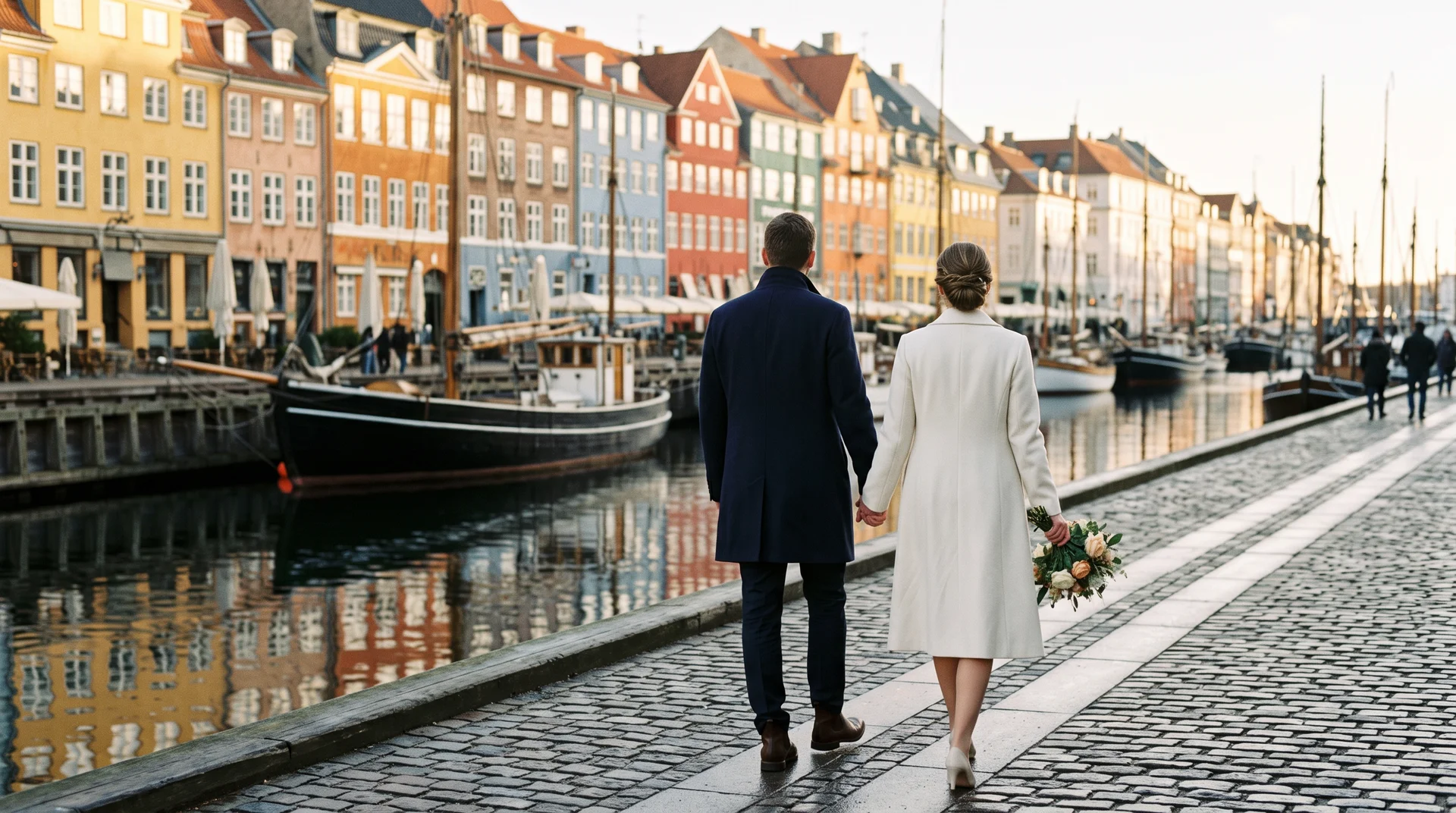
If you married at a German Standesamt with the whole family there, the party may simply follow. If, like Brooke and Tobias, you signed in Copenhagen, her relatives in Ontario will have one question: was that the real wedding? It was the legal one, and it helps to tell them so before anyone books a flight. A message to send the day after the registry office:
"We did it! We got legally married in Copenhagen on Friday, just the two of us and our witnesses. The real celebration is in Hamburg on Saturday 12 June 2027, and that's the one we want you at. Save the date, and more details soon."
And the answer to put on your wedding website's Q&A:
"Are we missing the wedding? No. We signed the papers in Denmark in February with two witnesses. The party in Hamburg on 12 June is the wedding for us: there's a short ceremony, dinner and dancing, and we'd love you there."
From there it's a normal wedding. Send the save the date early so long-haul guests can book, and write the website in English and German so both families can read it. Our guide to planning a German wedding with international guests covers customs like the Polterabend, and if there's more than one gathering, see how to manage multiple wedding events.
Wherever you sign, one page for the party
Whichever country you pick, the paperwork ends the day you sign. Your family will remember the celebration, and when it happens months after the legal date or in another country, guests need more information than they would for an ordinary wedding.
Start with a save the date that collects everyone's contact details as they reply, then a wedding website that tells the whole story in both families' languages: where you married, where the party is and how to get there. When the invitations go out, replies land in one place instead of your inbox.
FAQ
Can foreigners get married in Germany if neither partner lives there?
Yes. If neither of you lives in Germany, §12 PStG makes the registry office where you plan to marry responsible for the registration. You still need the same documents, translations and, if needed, an interpreter.
What does it cost to get married in Denmark as a foreigner?
The Agency of Family Law charges DKK 2,100 for the Certificate of Marital Status (fees as of October 2026). Ask the municipality that marries you about any further fees.
How long is a German certificate of no impediment valid?
Six months from the date it was issued, under §1309 BGB. An exemption granted by the court is also valid for six months.
Recommended
Written by
Marios P
Part of the WhiteClover team, helping couples and hosts plan unforgettable events with modern digital tools. Passionate about simplifying the celebration planning journey.
You Might Also Like
 Wedding Planning
Manage Multiple Wedding Events in One Place
Manage multiple wedding events in one place: welcome dinner, ceremony, reception, brunch.
 Invitations
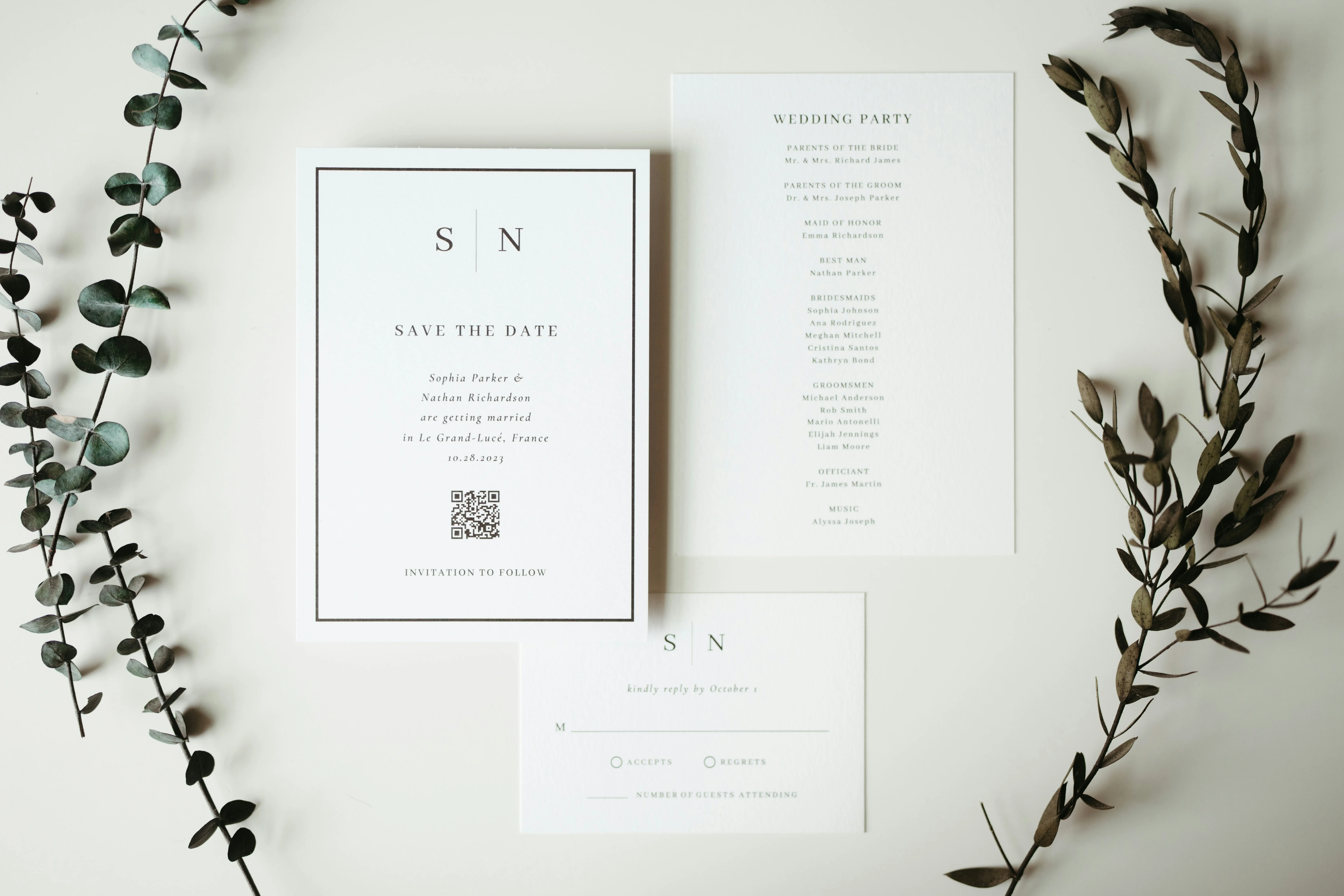
The Modern Save the Date: Collect Contacts
Discover the new way to send save the dates. Use a single link to collect guest contacts like emails and phones, saving you hours of wedding planning time.
 Guest Experience
Share Your Wedding Website With Guests
Learn how to share your wedding website with guests: where to put the link on invitations, when to send it, and how to collect RSVPs online.