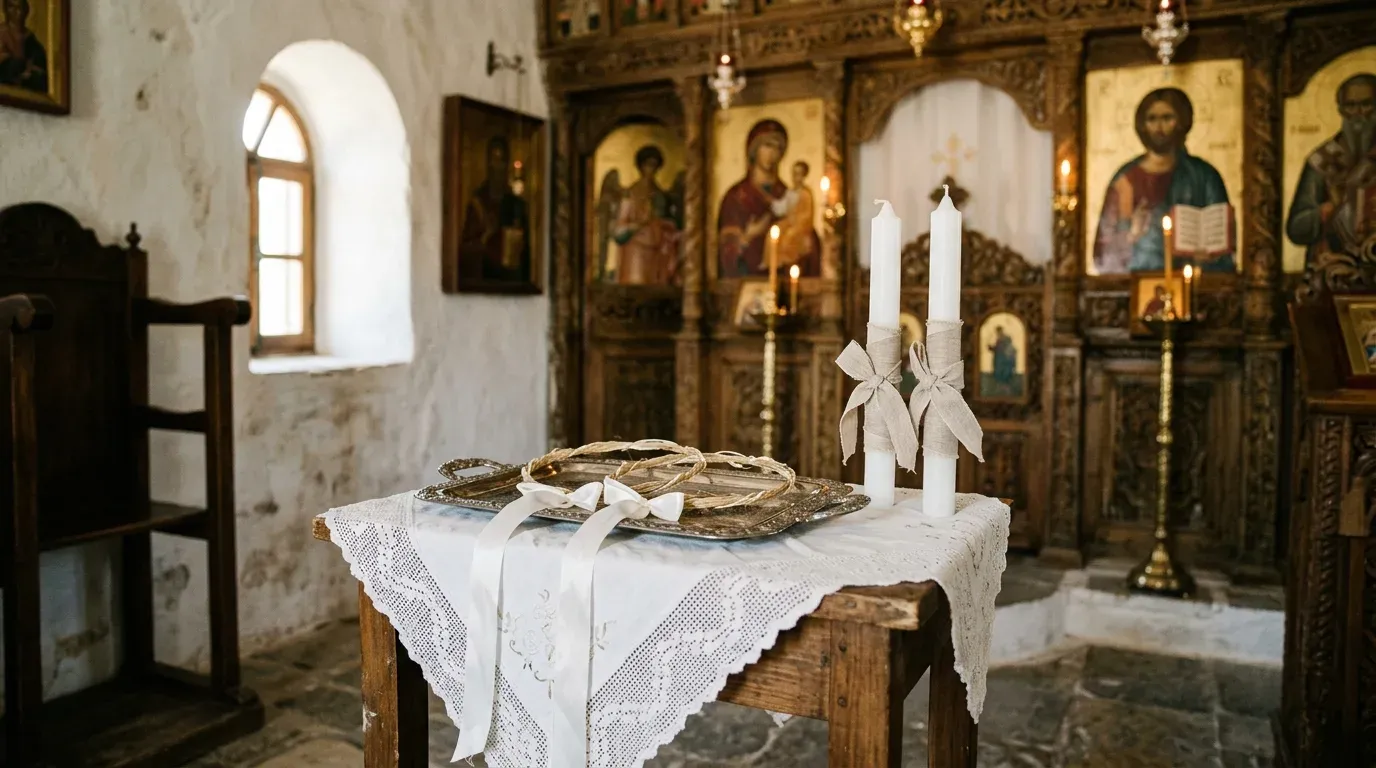
Advertisement
 Sponsored
Civil, Orthodox or Symbolic: Which Greek Ceremony Works for a Foreign Couple
Foreign couples planning a wedding in Greece choose between three ceremonies. Two of them make you legally married: a civil wedding before the mayor, and a religious wedding such as a Greek Orthodox one. The third, a symbolic ceremony, is a celebration with no legal effect, and it is what many destination packages actually sell.
Which one works for you depends on three things: whether you want the Greek ceremony to be the legal one, your religions, and how much paperwork you are willing to do from abroad.
TL;DR:
- Civil: legally binding, performed by the mayor or a deputy, at the town hall or another place the municipality designates. Open to all couples, including same-sex couples since 2024.
- Greek Orthodox: legally binding too. At least one partner must be Orthodox. A non-Orthodox partner must be a Christian baptised in the name of the Trinity, such as a Catholic, Anglican or Lutheran, and signs a declaration that children will be baptised Orthodox.
- Symbolic: no legal effect, no Greek paperwork, any place your venue allows. Many couples marry legally at home first.
- Civil and religious can be combined. The Greek registry records the second ceremony against the first.
Planning a wedding in Greece from abroad?
We're not wedding planners. We help you find the right Greek vendors for your date, place and budget, and explain the paperwork. Neutral advice, free.
We only pass your details to a vendor once you say so.
What is the difference between a symbolic and a civil wedding?
A civil wedding is a legal act. Greece's Ministry of Interior guidance says a civil marriage is valid when performed before the mayor or a deputy mayor, and a religious one when it is blessed according to the rules of the couple's faith. Either way, the marriage is then registered at the local registry (lixiarcheio).
A symbolic ceremony is neither. Anyone can lead it, a celebrant, a friend or the venue's coordinator, and it can happen on a beach, a cliff or a boat. You exchange vows, sign nothing official, and are not married under Greek law or your own. If you choose it, do the legal part at home before or after, and keep the paperwork out of your Greek trip entirely.
| Civil | Greek Orthodox | Symbolic | |
| Legally binding | Yes | Yes | No |
| Who performs it | Mayor or a deputy | Orthodox priest | Anyone |
| Where | Town hall or a place the municipality designates | A church | Anywhere your venue allows |
| Who can marry | Any couple free to marry, including same-sex couples | At least one Orthodox partner, the other a Trinitarian-baptised Christian | Anyone |
| Greek paperwork | No-impediment certificate, birth certificate, translations | Church documents plus Greek civil registration | None |
The civil wedding
The civil route works the same for every foreigner. Each partner files documents at the town hall: proof from their own country that they are free to marry, a birth certificate translated into Greek, and a passport. The mayor waits one week for objections, then issues a licence valid for six months, according to Greece's register of public procedures (mitos.gov.gr). The ceremony itself needs two adult witnesses, and mitos lists a fee of €0 to €150 depending on the municipality, though some towns charge more for weekend or outdoor ceremonies.
Where and when the mayor marries couples is set by each municipality. Some use only the town hall on weekdays, others designate parks, harbour fronts and even beaches. Our post on whether you can marry on a Sunday, in a town hall or on a beach shows how much this varies.
Since February 2024, Law 5089/2024 on equality in civil marriage has opened civil marriage to same-sex couples, and mitos lists the procedure alongside the one for mixed-sex couples. The Orthodox Church does not marry same-sex couples, so for them the civil wedding is the legal route in Greece.
Document details by nationality: getting married in Greece as an EU citizen, or as an Irish, Canadian or Australian citizen.
The Greek Orthodox wedding
An Orthodox wedding is a legal marriage in Greece as well as a sacrament, so you don't need a civil one too. The rules come from the Church, and each Metropolis applies them. The Archdiocese of Athens publishes the most complete list we found.
Who can marry in an Orthodox church?
The Archdiocese of Athens says the Church does not bless marriages with someone of another religion or no religion. By what it calls "oikonomia", a pastoral allowance, it permits mixed marriages between an Orthodox Christian and a Christian of another church who has a Trinitarian baptism. Its list includes Roman Catholics, Protestants, Lutherans, Calvinists, Anglicans, Methodists, Baptists, Evangelicals and Presbyterians, as well as the Armenian, Coptic, Ethiopian and Syriac churches.
It names groups whose baptism it does not accept for this purpose, including Seventh-day Adventists, Quakers, Mormons and Christadelphians, along with several Pentecostal movements. A partner who isn't baptised, or whose baptism isn't accepted, can't marry in an Orthodox church. The route the Church offers is baptism into Orthodoxy first, which is a conversation to have with a priest.
What the non-Orthodox partner needs
For a mixed marriage, the Archdiocese of Athens asks the non-Orthodox partner for:
- a baptism certificate, certified by the authority of their church in Greece,
- a certificate of single status from that church authority,
- a solemn declaration, addressed to the priest, that children born of the marriage will be baptised and raised in the Orthodox faith,
- if divorced, a church divorce for an earlier religious marriage, or the civil record showing the divorce.
On top of that, an Orthodox partner from abroad brings a baptism certificate and a single status certificate from their home church, officially translated and endorsed by the Holy Synod of the Church of Greece. Foreign partners who don't live in the EU also show proof that they are in Greece legally, such as a residence permit or a visa. The Archdiocese adds that foreign documents must be officially translated, and that state documents from outside the EU need an apostille.
The newspaper notice and the fee
For a church wedding, the Archdiocese of Athens asks for an announcement in a Greek newspaper, published no earlier than three months and no later than 15 days before the wedding, naming the couple, their parents and the area of the church. The whole newspaper page is handed in. There is also a €15 stamp duty fee. If the same couple has already had a civil wedding, no newspaper notice is needed.
Not every island answers to Athens
The Archdiocese's rules apply in its area. Crete has its own semi-autonomous Church, and the Dodecanese, including Rhodes, belongs to the Ecumenical Patriarchate, so their requirements can differ. Ask the parish priest where you want to marry, early, because church documents from abroad take time to certify.
Other faiths
Greek law recognises religious weddings performed according to the rules of the couple's own faith, not only Orthodox ones. Catholic, Protestant and Jewish communities in Greece marry couples, each with its own requirements. Contact the church or community directly, and ask whether it handles registration with the Greek registry or leaves that to you.
Can you have both a civil and an Orthodox wedding?
Yes, and many mixed couples do, often in different years. Greece's Ministry of Interior guidance explains that the second ceremony doesn't create a new registry record: it is noted in the margin of the first. That is why you give the registry the details of the first wedding when you register the second.
Is a civil marriage recognised by the Orthodox Church? The Greek state records both forms as marriage. On the Church side, the clearest practical sign is that the Archdiocese of Athens drops the newspaper notice for a couple who already married civilly. Anything beyond that is a question for your priest.
Which ceremony suits you?
- You want the simplest legal route and neither of you is Orthodox: civil.
- One of you is Orthodox, the other a baptised Christian, and family wants a church wedding: Orthodox, with the church documents started early.
- You want a beach, a cliff or a boat, or your documents would be hard to get: symbolic in Greece, legal at home.
- Same-sex couples: civil, in Greece or at home.
Whichever you choose, the guests' side is the same. A wedding website can explain the ceremony for friends who have never seen the crowns exchanged, and our guide to the Greek Orthodox ceremony for guests is a good link to share. Wedding RSVP keeps replies in one place. More for couples marrying abroad on our destination wedding in Greece page.
Ask us about your situation
We're not wedding planners. Email us at [email protected] and we'll explain the paperwork for the ceremony you're considering and suggest Greek vendors that fit your date, place and budget. Neutral advice, free, and we pass your details to a vendor only once you say so.
Frequently asked questions
Is a symbolic wedding in Greece legally binding? No. A symbolic ceremony has no legal effect in Greece or at home. Couples who choose it usually marry legally in their own country.
Can a Catholic marry an Orthodox Christian in a Greek church? Yes. The Archdiocese of Athens allows mixed marriages with Christians who have a Trinitarian baptism, including Catholics. The Catholic partner brings a certified baptism certificate and a single status certificate, and signs a declaration that children will be raised Orthodox.
Can a non-Christian marry in a Greek Orthodox church? No, not without being baptised Orthodox first. A civil wedding is open to them.
Can same-sex couples marry in Greece? Yes, in a civil ceremony, since Law 5089/2024 took effect in February 2024. The Orthodox Church does not marry same-sex couples.
Do we need a civil wedding as well as an Orthodox one? No. An Orthodox wedding is legally valid in Greece once it is registered. Some couples have both, and the registry records the second against the first.
Recommended
Written by
Marios P
Part of the WhiteClover team, helping couples and hosts plan unforgettable events with modern digital tools. Passionate about simplifying the celebration planning journey.
You Might Also Like
 Wedding Planning
Getting Married in Greece as an EU Citizen
The documents a Greek town hall asks EU citizens for, what EU rules say about apostilles and translations, and whether your Greek marriage counts at home.
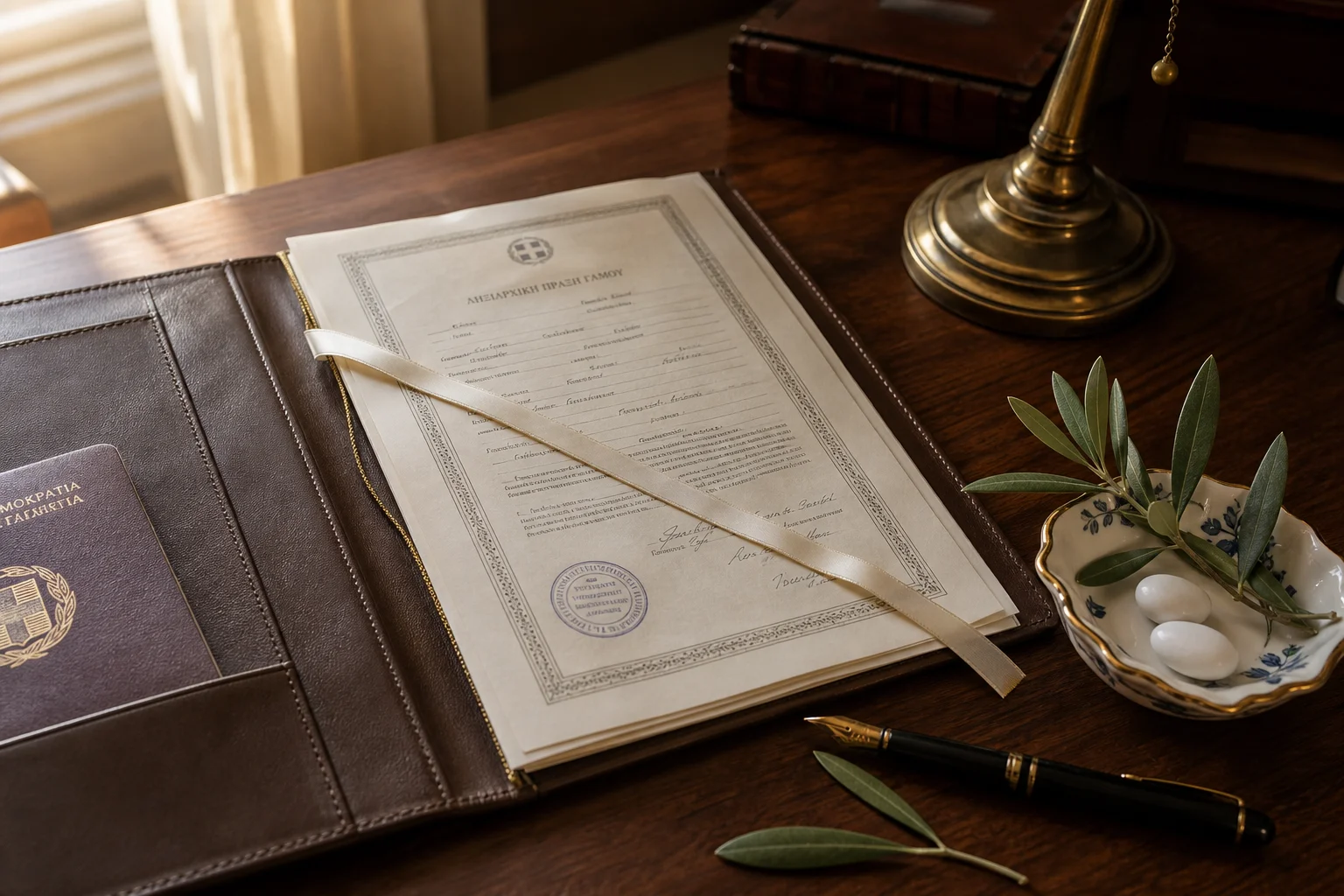 Wedding Planning
Greece Marriage Laws Guide for Foreigners (2026)
How foreigners legally marry in Greece in 2026: the civil licence, documents for UK, US and EU citizens, apostille, translations, church rules, registration.
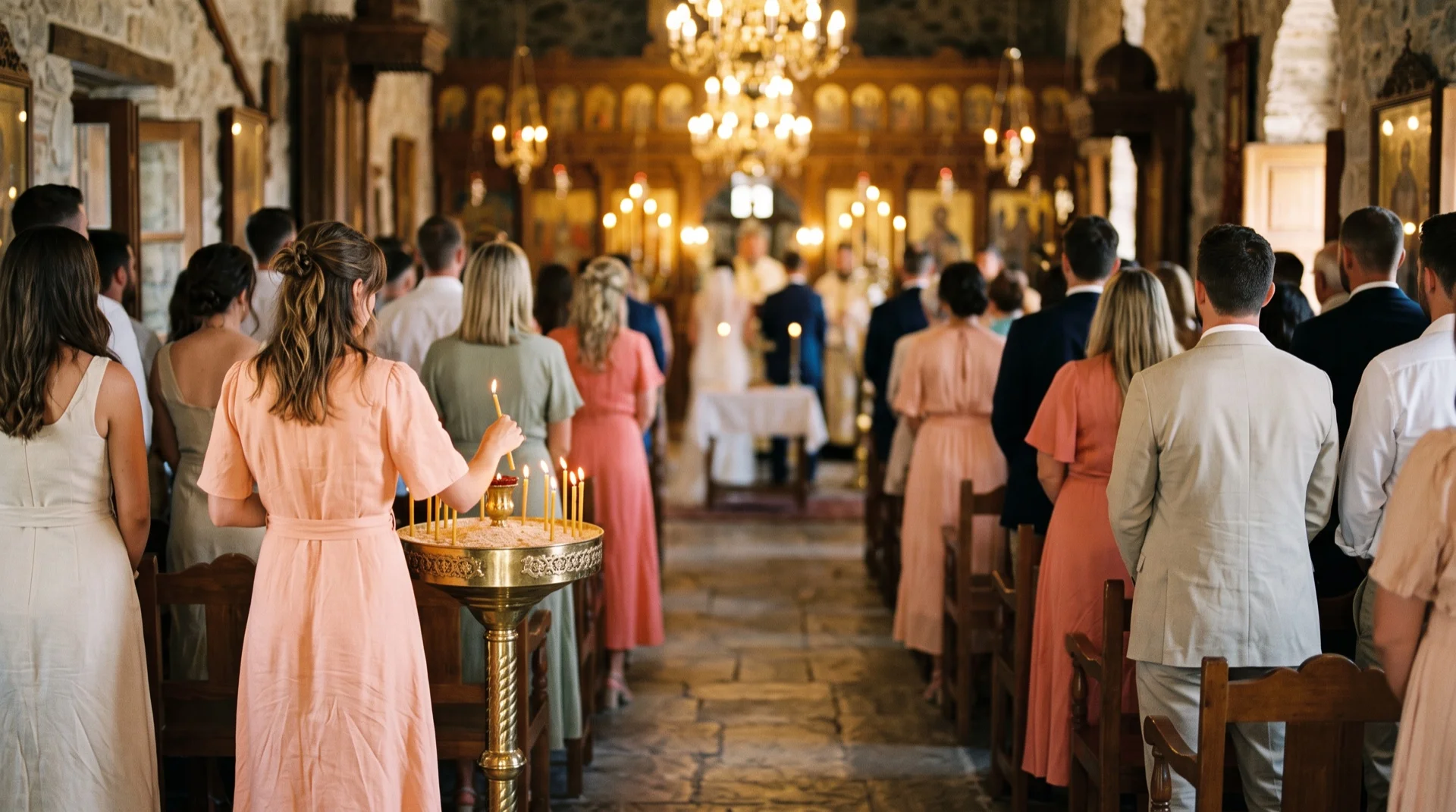 Guest Experience
Greek Orthodox Wedding: A Guide for Guests
Your first Greek Orthodox wedding? How long it lasts, when to stand, what the crowns mean, when the rice flies and why dinner starts at ten. A guest's guide.