Advertisement
 Sponsored
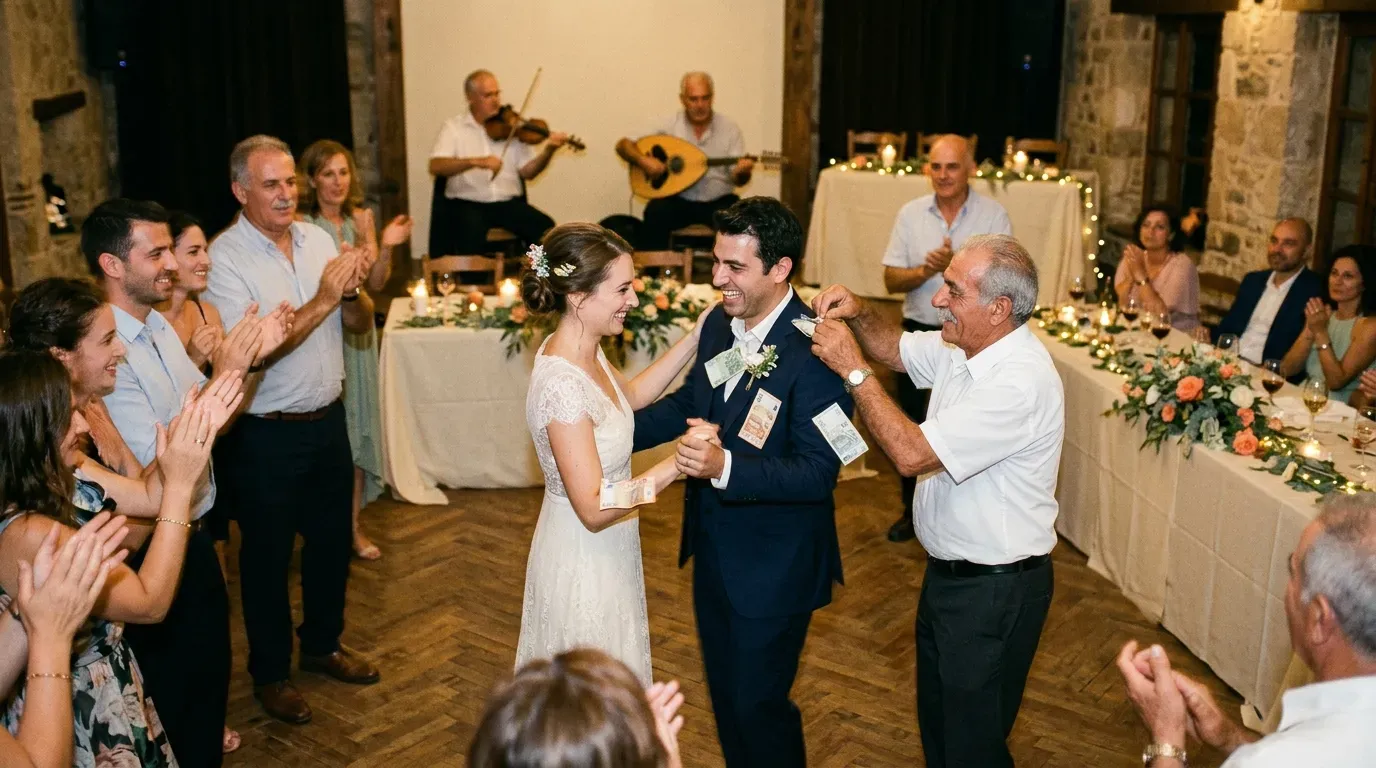
At a Greek or Cypriot wedding reception, the custom you're most likely to take part in is the money dance: guests pin banknotes to the couple's clothes while they dance. Plate smashing is rarer than films suggest, and the bed custom, the krevati, doesn't happen at the reception at all. It happens at the couple's home before the wedding.
Picture a guest from Leeds at her first Cypriot wedding in north London. She expects plates. She gets a long line to hand the couple an envelope, a dance floor where the couple end up wearing half the guests' cash, and, two days earlier, an invitation to a bedroom where she's asked to throw money onto a mattress. Nobody thought to warn her about any of it.
This guide covers the reception and the customs around it. For the church service itself, our guide to the Greek Orthodox wedding ceremony walks through it step by step.
TL;DR:
- The money dance: guests pin notes to the couple's clothes as they dance. In Cyprus it's often during their first dance.
- Most guests give money in an envelope too, handed over in the line or at a table.
- Real plate smashing is uncommon now. Flowers or plaster plates have mostly replaced it.
- The krevati, making the marriage bed, happens at the couple's home before the wedding. You only go if you're invited.
- Say "Na zisete" (may you live long) to the couple.
Plan Your Event
One platform for every occasion: weddings, baptisms, corporate events and private parties.
The money dance
In both Greece and Cyprus, guests walk up to the couple while they dance and pin money to their clothes. In Cyprus it usually comes during the couple's first dance. The Cypriot site dom.com.cy, writing about Cypriot wedding traditions, calls it the golden dance and says that in the past every guest took part, while today it's mainly relatives and close friends. In mainland Greece it varies more by region and family, and some couples swap pinning for a decorated box where guests drop envelopes.
What this means for you as a guest:
- You don't have to pin. If you're a colleague or a friend from abroad, watching and clapping is fine. The people pinning are mostly family.
- If you want to join, have notes ready. Fold them lengthwise so they're easy to pin. Ask someone near you whether pins are being handed out, or bring two safety pins in your pocket.
- Keep it quick. Step in, pin, a few steps of dancing if the couple pull you in, and step back. Someone is waiting behind you.
- On how much: no source publishes a figure, and families do this very differently. Watch what the people around you pin. The pinned money is on top of your gift, not instead of it.
The envelope
Separately from the dance, most guests give the couple money in an envelope. In Cyprus there's a long tradition of the couple standing to receive guests one by one: dom.com.cy describes couples standing for an hour or longer to receive congratulations and gifts, where it once lasted four or five hours. At Greek weddings the envelope is often handed over in the line after the church or dropped into a box at the reception.
If you're not sure what to put in it, our guide to how much money to give at a wedding has ranges for Greece, Cyprus, the UK and the US, with Cyprus around €70 to €100 for a guest alone at a modest venue.
The plates
Plate smashing is the custom everyone expects and few weddings have. Under the military junta in Greece it was banned as an offence carrying up to five years in prison, according to Wikipedia's history of plate smashing, and it's far rarer today. Throwing flowers at the dancers took its place, a habit the same source credits to the singer Marinella. Where plates do appear today, they're usually plaster ones made to break safely.
As a guest, don't bring plates and don't throw anything that isn't handed to you. If the couple want it, the venue and the band will have it ready.
The bed: krevati
The krevati, or making of the marriage bed, takes place at the couple's new home in the days before the wedding. Close family and friends gather, the bed is made up with new sheets, and guests throw money and sometimes rice or petals onto it for prosperity. Children are put on the bed to roll or jump on it, a wish for children of the couple's own. In Cyprus, dom.com.cy notes that a small boy usually goes first, and today a decorated bed is sometimes set up just for the children.
You'll only be there if you're invited. If you go, bring notes for the bed. It's loud and cheerful, and nobody minds if you don't know the songs.
Couples planning one will find more in our guide to Greek wedding traditions.
Other Cypriot customs you might see
Several Cypriot customs happen at the families' homes on the morning of the wedding, and close friends are often invited:
- Shaving the groom. Friends and the best man gather while a barber shaves the groom, with music and a lot of teasing. The Cyprus National Commission for UNESCO, which recorded Cypriot wedding customs as intangible heritage in 2016, describes guests putting money on a plate for the barber and the musicians.
- Dancing the wedding clothes. Three women and three men dance with the bride's and groom's clothes to violin and song. The number of dancers is kept odd.
- The red belt and the sugar. The bride's father ties a red belt around her waist, and relatives drop a pinch of sugar into the fingers of her gloves for a sweet life, according to dom.com.cy.
- Resi. A dish of coarsely ground wheat boiled in meat broth, prepared as a ritual. UNESCO Cyprus notes families in the Paphos and Limassol districts still keep it.
What a Greek or Cypriot reception is like
It runs late. At a summer wedding in Greece, dinner often arrives after 10pm and the dancing can go past 2am. Expect circle dances where anyone can join the end of the line, and eat something in the afternoon.
The money dance is also the hardest moment of the night to photograph. The couple are surrounded, hands are everywhere, and the photographer is usually stuck behind someone's back. A guest's phone, held up from the edge of the floor, often gets the shot nobody else did. Before you post it in a group chat, ask whether the couple have a guest photo app with a QR code on the tables. Some couples collect guests' photos and videos in one private gallery and turn the best into a wedding photo album afterwards, and your clip of the dance is the one they'll want.
Before you go
Bring an envelope, a few extra notes folded for pinning, and comfortable shoes. Don't wait for plates. If you're invited to the krevati, go, and bring money for the bed. And when you reach the couple, say "Na zisete".
Frequently asked questions
What is the Greek wedding money dance?
Guests walk up to the bride and groom while they dance and pin banknotes to their clothes as a blessing. In Cyprus it's often during the couple's first dance. Today it's mostly relatives and close friends who pin, and other guests watch.
How much money do you pin at a Greek wedding?
There's no set amount, and no source publishes one. Families differ a lot. Watch what the people around you do. Pinned money is on top of your gift envelope.
Do Greeks still break plates at weddings?
Rarely. Plate smashing was banned under the junta, and throwing flowers mostly replaced it. Where plates appear today they're usually plaster plates made to break safely, provided by the venue.
What is the krevati at a Greek wedding?
The making of the marriage bed at the couple's home before the wedding. Close family and friends make up the bed, throw money and petals on it, and put children on it to bring the couple a family. Guests go only if invited.
What do you say to the couple at a Greek wedding?
"Na zisete" (Να ζήσετε), which means "may you live long". To the parents, "Na sas zisoun".
Recommended
Written by
Katerina K
Part of the WhiteClover team, helping couples and hosts plan unforgettable events with modern digital tools. Passionate about simplifying the celebration planning journey.
You Might Also Like
 Guest Experience
Greek Orthodox Wedding: A Guide for Guests
Your first Greek Orthodox wedding? How long it lasts, when to stand, what the crowns mean, when the rice flies and why dinner starts at ten. A guest's guide.
 Guest Experience
How Much Money to Give at a Wedding (2026 Guide)
How much money to give at a wedding in Greece, Cyprus, the UK and the US: honest ranges by relationship, the cover-your-plate rule, and what changes abroad.
 Inspiration
Greek Wedding Traditions: A Complete Guide
From the stefanoma crowning to koufeta favours, 10 authentic Greek wedding traditions every couple, Greek or not, can weave into their big day.