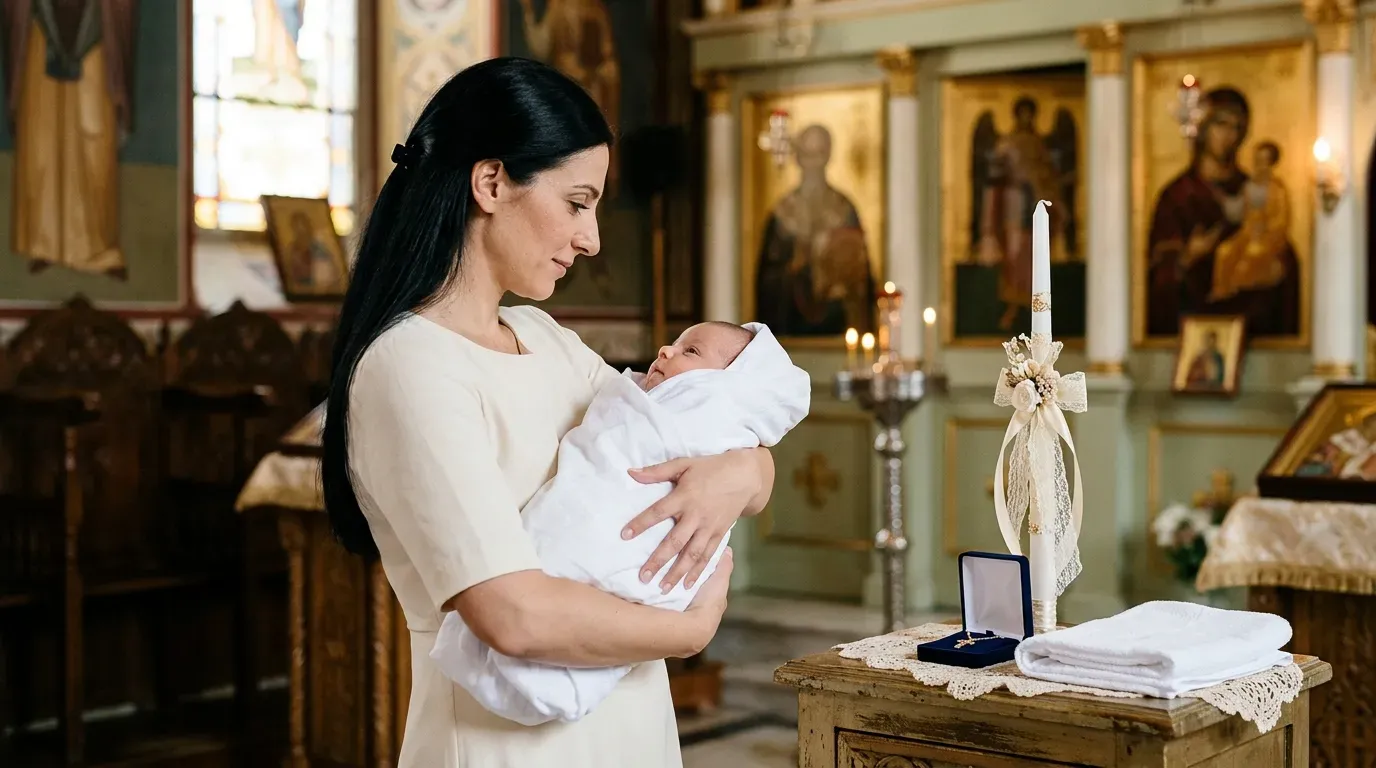
Advertisement
 Sponsored
A Greek godparent is called the nonos (godfather) or nona (godmother), and in many Greek-American and Greek-Australian families the nouno and nouna. To be one, the Church requires you to be a baptized Orthodox Christian, and if you're married, married in church. In return you take the child's vows at the font, pay for most of what the baptism needs, and stay in the child's life for good.
If a cousin has just asked you to be nouna and you said yes before asking what it involves, this is the guide. It covers the names, who the Church allows, what you do on the day, the documents to bring and what it costs.
TL;DR:
- Nonos and nona are the standard Greek words. Nouno and nouna come from the older forms νουνός and νουνά, and they're what many families abroad say. The Church's own word is anadochos, the sponsor.
- You must be a baptized Orthodox Christian. If you're married, it must have been a church wedding. Parents can't be godparents to their own child.
- Age rules vary by diocese. The Metropolis of Thessaloniki requires an adult.
- At the font you speak for the child, then receive the baby from the water in a white sheet.
- The godparent pays for the cross, the white clothes, the candle and the oil set. Our guide to baptism money puts the total at roughly €540 to €1,800, using Cosmos Events' 2026 ranges.
Plan Your Event
One platform for every occasion: weddings, baptisms, corporate events and private parties.
What Greek godparents are called
| Word | Greek | What it means |
| Nonos, nouno | νονός, νουνός | Godfather |
| Nona, nouna | νονά, νουνά | Godmother |
| Anadochos | ανάδοχος | The sponsor, the Church's formal word |
| Vaftistiri | βαφτιστήρι | Godchild |
| Koumbaros, koumbara | κουμπάρος, κουμπάρα | What the parents and the godparent call each other afterwards |
That last one confuses people, because koumbaros is also the wedding sponsor. After a baptism, the parents and the godparent become koumbaroi to each other. St. Katherine Greek Orthodox Church in Arizona even uses koumbaros and koumbara for the godparent in its own baptism guidelines.
Who can be a godparent
The rules come from the Church, and each diocese writes them down a little differently. These are the ones that hold across the official pages we checked.
Orthodox and baptized
The Metropolis of Thessaloniki says only Orthodox Christians can stand as sponsors. The Metropolis of Mani cites the Holy Synod's circulars on the same rule. A Catholic or Protestant friend can't be the godparent of record. In America, St. Katherine's puts it bluntly: "The Church does not permit honorary godparents", and suggests close friends be known to the child as "Theo" and "Thea" instead.
Married in church, if married
A civil-only marriage isn't enough, and neither is a cohabitation agreement. The Metropolis of Ilion cites Holy Synod decision 1009/2016 on this. Thessaloniki adds that it's fine once the couple has had a church wedding.
Not the parents
Parents can't be godparents to their own child. Mani cites Canon 53 of the Quinisext Council and a 1999 synodal circular. Clergy and monks can't either. We found no rule against a brother or sister being godparent on the three metropolis pages we checked, but ask the priest.
Age depends on the diocese
Thessaloniki asks for adults with full legal capacity. Ilion says the godparent should be old enough to teach the child the faith, and that another child can't be the only sponsor. We found no national minimum age, so if a teenager is being asked, check with the parish first.
One godparent of record
The Church records one anadochos. A second person may help at the font, according to the circulars Mani cites.
Becoming godparent also creates a spiritual kinship, which the Church treats as a bar to marriage between the godparent and the godchild, or the godchild's parent.
What the godparent does at the baptism
St. Katherine's puts the service at about 45 minutes. Your part, in order:
- At the entrance of the church you answer for the child. You renounce Satan on the child's behalf and recite the Creed, the Symbol of Faith. Ask for the text in advance, in Greek and in English, and practise it.
- You help the priest anoint the baby with blessed oil before the immersion.
- The priest immerses the child three times. You hold out the white sheet, the ladopano, and receive the baby from the font.
- You dress the child in the new white clothes you've brought, and the cross goes on.
- You carry the lit baptism candle as you walk around the font three times with the priest and the child.
In Greece the godparent says the child's name aloud during the service, and for many families that's the moment they hear the name for the first time. Your priest is the authority on local custom, so ask how it works in your parish.
Pro tip: Bring a spare towel and a spare set of clothes. Babies don't always cooperate with a white outfit, and the godparent is the one holding them.
Documents to bring
The lists differ by diocese, so ask the parish for theirs as soon as you agree. As a guide, the Metropolis of Thessaloniki asks the godparent for:
- A baptism certificate from the parish where you were baptized. If that parish is in another metropolis, the certificate needs countersigning by that metropolis.
- If you're single, a family status certificate from your municipal registry. Thessaloniki says it has to come from the registry, not from the gov.gr app.
- If you're married, your marriage certificate, showing a church wedding.
Mani accepts a birth certificate or a baptism certificate, plus the family status or marriage certificate.
People often search for a "certificate of Orthodoxy". None of the official pages we read ask for one by that name. What they ask for is the baptism certificate.
If you live abroad, expect the parish to ask for a letter of good standing from your own parish priest. St. Katherine's asks for one from any godparent who belongs to another parish. Start early if your baptism certificate is from a church in another country, because getting it to the right place can take weeks.
What the godparent pays for
Traditionally the godparent's gift is the baptism itself, so you don't hand over an envelope on top. You pay for:
- the cross, the item that moves the budget most
- the white clothes and shoes
- the baptism candle, and the oil set with its case
- the ladopana, the oil sheets
- the martyrika, the small witness favors guests pin on
Some families split the church donation and the font decoration between godparent and parents. Agree that early, out loud.
Our guide to how much money to give at a Greek baptism has the item-by-item prices from Cosmos Events, which come to roughly €540 to €1,800 in total. If you read Greek, what the godparent pays and what the parents pay splits it out in more detail.
After the baptism
The role doesn't end at the lunch. A few customs worth knowing:
- Some parishes ask the godparent to bring the child to communion on the Sundays after the baptism. St. Katherine's asks for three in a row.
- At Easter, the godparent traditionally gives the child a decorated candle, the lambada, often with a chocolate egg, tsoureki and sometimes new shoes.
- At Christmas, a gift from the godparent is common too. There's no set amount and no set age when it stops. Families decide.
- In Greek custom the godparent is expected to guide the child in the faith as they grow up, which in practice means being there: name days, birthdays, the phone call on exam day.
If you're the one organizing it
In many Greek families the godparent does a fair share of the organizing, alongside the parents: who's coming to church, who's staying for lunch, and how many children are on the list. The venue charges per head, and baptism numbers move until the last week.
With WhiteClover's baptism invitations, guests reply on their phone for the church and the meal separately, and families reply together, so the parents and the godparent are looking at the same number. If the godparent is also koumbaros at a wedding on the same day, the wedding and baptism setup covers both events from one link.
Frequently asked questions
What are Greek godparents called?
The godfather is the nonos and the godmother is the nona. Many Greek families abroad say nouno and nouna, from the older Greek forms νουνός and νουνά. The Church's formal word for the sponsor is anadochos.
Can a non-Orthodox person be a godparent at a Greek baptism?
No. Greek metropolis pages require the godparent to be a baptized Orthodox Christian, and parishes in America say the same. The Church doesn't allow honorary godparents, but a close friend can still be part of the child's life as Theo or Thea.
Can a godparent be married in a civil ceremony only?
No. A married godparent must have had a church wedding. A civil-only marriage or a cohabitation agreement isn't accepted, according to the Holy Synod decision cited by the Metropolis of Ilion.
What documents does a Greek godparent need?
Usually a baptism certificate, plus a family status certificate if single or a church marriage certificate if married. Lists vary by diocese, so ask the parish. Abroad, parishes often ask for a letter of good standing from your own priest.
How much does it cost to be a Greek godparent?
The godparent pays for the cross, clothes, candle, oil set, ladopana and martyrika. Using Cosmos Events' 2026 ranges, our baptism money guide puts the total at roughly €540 to €1,800, depending mostly on the cross.
Recommended
Written by
Dimitris S.
Part of the WhiteClover team, helping couples and hosts plan unforgettable events with modern digital tools. Passionate about simplifying the celebration planning journey.
You Might Also Like
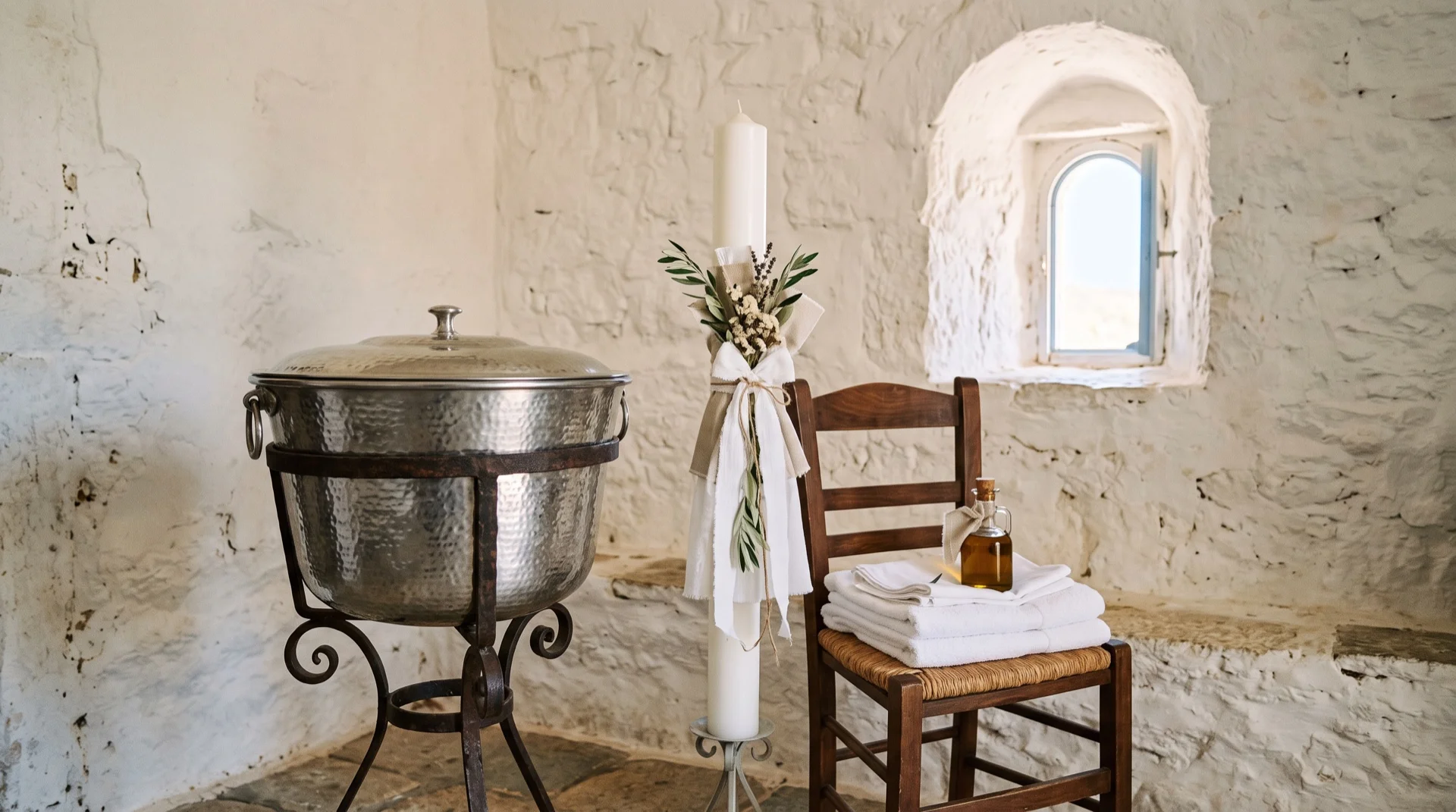 Baptism
How Much Money to Give at a Greek Baptism
How much money to give at a Greek baptism as a guest, what the godparent pays for instead, and what a nono or nona really spends in 2026, item by item.
 Baptism
 Planning: A Complete 2026 Guide for Greek Families
Baptism planning in Greece: godparents, church documents, reception, budget, guest lists, favours, and digital invites, step by step for busy parents.
 Baptism
Greek Baptism Wishes: What to Write in the Card
Greek baptism wishes to copy, from godparents, grandparents and friends, plus Να σας ζήσει explained with pronunciation and a letter idea for the child.