Advertisement
 Sponsored
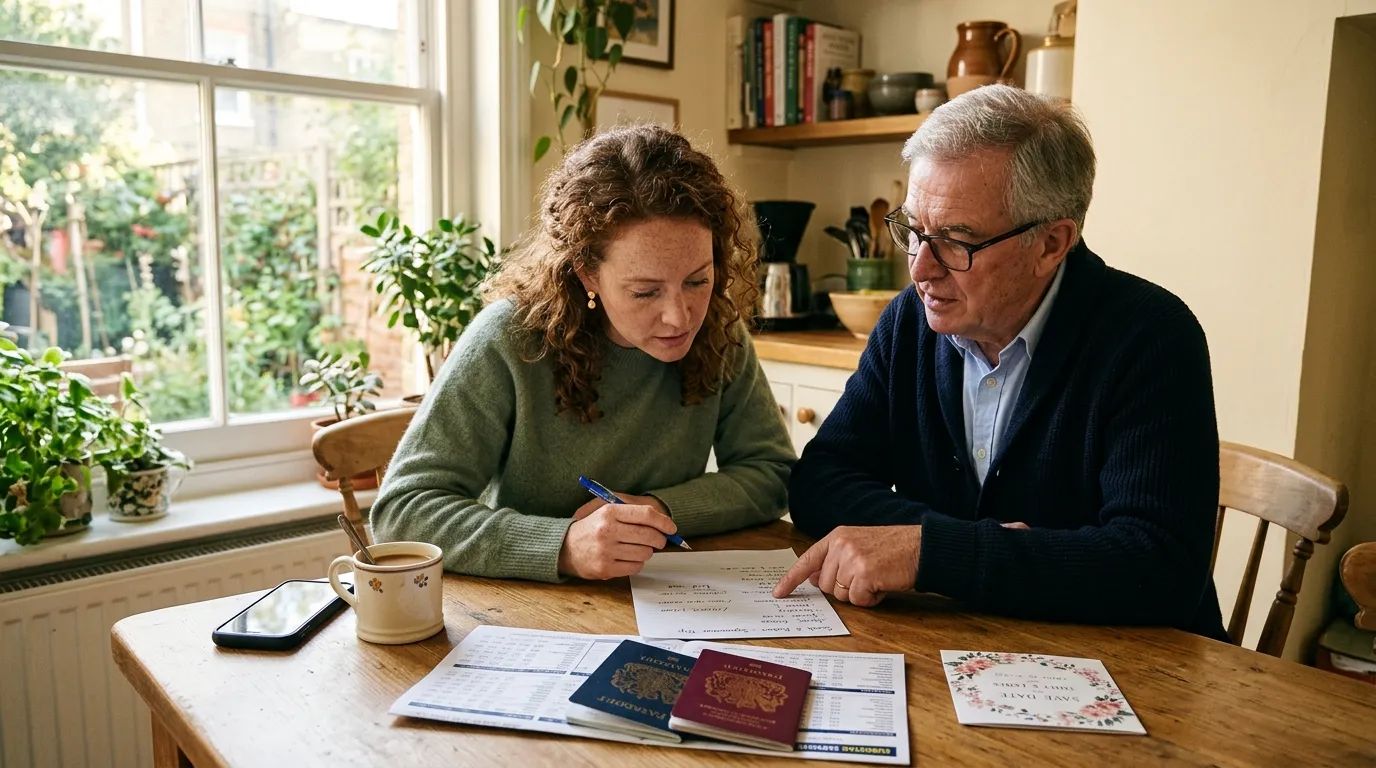
When your families live in two countries, send the save the date to everyone 12 to 18 months before the wedding, because the side that has to travel needs that long to book flights, leave and somewhere to stay. Then give both sides one RSVP deadline, three to four weeks before the day, and one website written in both languages.
The rest of this guide is the detail: which dates differ between the two countries, what to translate, and the travel checks that catch guests out at the airport.
Take Aoife from Dublin and Jonas from Hamburg (an example couple). They're marrying near Hamburg. His side, 70 people, can drive there. Her side, 45 people, has to fly, and her grandmother has a passport she last used in 2015.
TL;DR:
- Send save the dates to both sides at the same time, on the travelling side's timing: 12 to 18 months out.
- Check public and school holidays in both countries before you fix the date.
- One guest list and one RSVP deadline, with each household tagged by language.
- One website in both languages. You write the second language yourself.
- Ask travelling guests to check their passport the day the save the date arrives.
Plan Your Event
One platform for every occasion: weddings, baptisms, corporate events and private parties.
Pick a date that works in both calendars
A long weekend in one country is a normal working Friday in the other. Before you book the venue, put both countries' public holidays and school holidays side by side for your month.
If the date falls on a holiday at home for the guests who are travelling, flights and hotels cost more and fill sooner. If it falls on a holiday for the local side, half of them may already be away. Neither rules a date out, but both change how early you need to tell people.
The deadlines, side by side
| What | When | Why |
| Save the date | 12 to 18 months before, to everyone | The travelling side books flights and leave first |
| Passport check | The day the save the date arrives | Renewals take weeks, and some passports are too old to travel on |
| Invitation | 10 to 12 weeks before | Gives guests six to eight weeks to decide |
| RSVP deadline | 3 to 4 weeks before, one date for both sides | Venues usually want the final number one to two weeks out |
| Arrival and departure days | Asked in the RSVP | So you know who is at the welcome drinks and who needs a lift |
Our guide to UK save the dates explains the 12 to 18 month window for guests who fly, and the same reasoning holds for any border.
Send everyone the save the date on the same day. If the local side hears months later, it reads as an afterthought, and the two families compare notes more than you'd think.
One list, one deadline
It's tempting to run each family's list separately, with each set of parents chasing their own side. Don't. Two lists means two numbers, and the venue wants one.
Keep a single guest list and tag each household by country or language, so you know who gets which version of the invitation and who to phone. If a parent is collecting answers by phone from older relatives, give them a date a few days before your real deadline, so their replies are in before you send the number to the caterer.
Languages: one site, written twice
Build one wedding website with both languages on it. Two separate sites drift out of step the first time you change a time on one and forget the other.
In WhiteClover you add the second language and get a tab for each. Guests whose browser is set to German see German, the rest see English, and anyone can switch from the menu. Nothing is translated for you: you write the German, or ask someone in the family who writes it well. The reply form itself runs in English or Greek, so put both languages into your RSVP questions where it helps, such as "Hauptgang / Main course".
We've covered the details for three pairs already: English and German, English and Dutch, and Greek and English. The same site can carry up to 12 languages.
Write the second language for the people least likely to ask. A cousin will happily read English. A grandmother who can't won't tell you, she'll just ring your mother.
What the travelling side needs to know
Guests who travel ask the same questions, in roughly this order:
- How do I get there from the airport?
- Where should I stay, and is there a room rate?
- What happens on the day before and the day after?
- What do I wear, and will it be cold?
- Can I bring the children?
Answer them on the website before anyone asks. Each event on the schedule has its own location, so the ceremony and the party venue both show on the page. Everything else, from the train from the airport to the taxi number for the night, goes in the FAQ section as free text.
Then add a question or two to the RSVP that only travellers need: which nights they're staying, and whether they need a lift from the station. It saves you a week of messages.
If you've booked a block of hotel rooms, ask the hotel the date unbooked rooms go back on sale, and put that date on the website in both languages. Who pays for the rooms is a separate conversation, and our post on who pays for guest accommodation covers the usual arrangements.
Passports and border checks
This is where a guest can miss your wedding without anyone noticing until the airport. Ask everyone who travels to look at their passport the day the save the date arrives, not the month before.
Two current rules worth passing on, both from the UK government:
- British guests travelling to the Schengen area need a passport issued less than 10 years before the day they arrive, and valid for at least 3 months after the day they leave. A passport renewed before October 2018 may be too old, even if it hasn't expired. (GOV.UK, Germany entry requirements)
- Non-EU visitors to the Schengen area now register fingerprints and a photo at the border under the Entry/Exit System on their first entry. It's free, but the government advises planning for longer waits on arrival and departure. (Same source)
If the wedding is in the UK instead, most visitors from Europe, the US, Canada and Australia need an Electronic Travel Authorisation before they fly. It costs £20 and each traveller, children included, needs their own. (GOV.UK, apply for an ETA)
Rules change and depend on nationality, so link guests to the official page for their country rather than copying the rules onto your website.
Gifts from two countries
Families from different countries often have different habits around gifts. One side gives cash in a card, the other expects a gift list. Say what you'd like once, plainly, on the website in both languages, and nobody has to guess. If you'd like money and plan to share your bank details, our guide to an IBAN on the invitation has wording that doesn't feel awkward.
Putting it together
Aoife and Jonas sent one save the date to all 115 guests 15 months out, with a note asking the Irish side to check their passports. The grandmother's passport was renewed by spring. Their website ran in English and German, with the trains from Hamburg airport and the hotel's room deadline in both. Everyone replied to the same link, by the same date.
Building the website, publishing it and collecting replies is free, with no charge per guest. See how the wedding website handles two languages and travel details, and start with the save the date when you're ready.
Frequently asked questions
How early should we send save the dates when family lives abroad?
12 to 18 months before the wedding. The side that has to travel needs time to book flights, take leave and find somewhere to stay. Send it to both families on the same day.
Should each family manage its own guest list?
No. Keep one list and tag each household by country or language. Two lists give you two numbers, and the venue needs one. Parents can still collect phone replies and add them to the same list.
Do we need two wedding websites for two languages?
No. One site with two language versions keeps times and places in step. Guests see the version that matches their browser, and can switch from the menu. You write each language yourself.
What travel information should the wedding website include?
How to get from the airport, where to stay and any room deadline, the schedule for the days around the wedding, the dress code and whether children are invited. Each event can carry its own location, and the FAQ section takes everything else.
What passport rules should British guests know for an EU wedding?
GOV.UK says the passport must have been issued less than 10 years before arrival, and must be valid for at least 3 months after leaving the Schengen area. Ask guests to check as soon as the save the date arrives.
Recommended
Written by
Nicole V.
Part of the WhiteClover team, helping couples and hosts plan unforgettable events with modern digital tools. Passionate about simplifying the celebration planning journey.
You Might Also Like
 Digital Tools
A Wedding Website in English and German
How to run one wedding website in English and German: what to translate, how guests land on their language, and the parts that stay in one language.
 Invitations
UK Save the Dates: When to Send and Get Addresses
When to send save the dates in the UK, who gets one, and how to collect guest emails, phone numbers and postal addresses before the invitations go out.
 Guest Experience
Destination Wedding: Who Pays for Guest Rooms?
Should you pay for guests' accommodation at a destination wedding? Three models, what tends to bother guests, and lines to copy for your website.