Advertisement
 Sponsored
If you are sitting with a half-finished spreadsheet, trying to decide between a local ballroom and a terrace above the Aegean, you are not alone. Most couples who eventually choose Greece say the same thing: they expected it to feel impractical, and what surprised them was how logical, and how right. It turned out to be.
A destination wedding in Greece is not a luxury reserved for the very wealthy, nor is it a logistical marathon. It is a deliberate choice: one that trades a reception hall for the caldera, swaps generic catering for mezze and local sea bream, and turns "the wedding and the honeymoon" into a single continuous experience. Once couples do the actual maths: on guest count, on cost, on what the day will feel like, Greece tends to win.
Here are five reasons more couples are choosing Greece, and why, once they do, they rarely wish they had done it differently.
Planning a wedding in Greece from abroad?
We're not wedding planners. We help you find the right Greek vendors for your date, place and budget, and explain the paperwork. Neutral advice, free.
We only pass your details to a vendor once you say so.
Reason 1: The Built-In Honeymoon
The most underrated financial argument for a Greek island wedding is also the most obvious once you see it: you are already there.
A typical couple planning a wedding in the United States or the UK will spend months coordinating the event, then immediately turn around and plan a separate honeymoon: separate flights, separate hotels, separate time off work. The two experiences sit side by side on a calendar but have almost nothing to do with each other.
In Greece, they are the same trip. You arrive a few days early for final preparations, you get married on a terrace at sunset, and then your guests fly home while you stay on. No airport dash on day two. No "the honeymoon starts when we recover from the wedding." You are already in one of the most romantic places in the world, the logistics are done, and the only thing left is a few days on Naxos or a slow boat between Cycladic villages.
We kept a detailed spreadsheet when we were planning. The original plan, 165 guests at a venue back home, had a $12,000 line item just for the honeymoon trip to Europe. When we moved to Greece with 52 guests, the honeymoon was built into the same flights. That single change covered a significant chunk of the cost difference.
Pro tip: Build your post-wedding stay into the venue contract if you can. Many Greek island venues offer a complimentary night or two for the couple as part of the package. Ask before you book.
For couples who have not yet mapped out the full cost picture, our guide to how much a wedding in Greece actually costs in 2026 breaks it down venue-by-venue.
Reason 2: Natural Scenery That No Decorator Can Replicate
We almost booked a country estate before we shifted to Greece. One thing that convinced us: we listed every visual element we wanted: golden light, water views, something that felt old and romantic. Then we priced out what it would cost to create that at a venue that did not already have it.
The lighting rigs alone were £8,000. The florals to dress a neutral space into something that felt like somewhere were quoted at £14,000. A Santorini terrace, a Corfu olive grove, or a clifftop chapel in the Mani already are the decoration. The setting does not need to be built, it just needs to be shown up for.
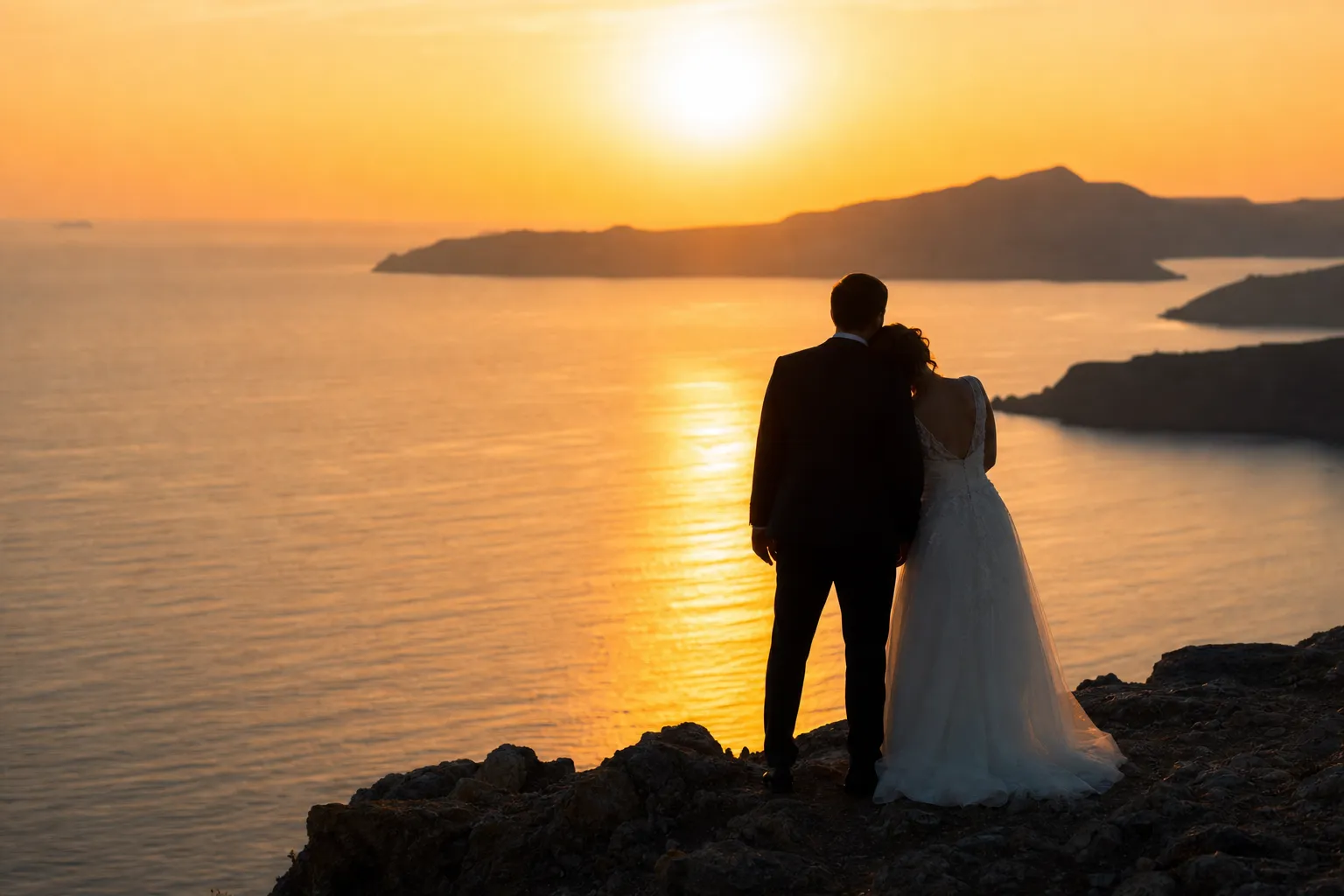
Greek light in July and September is not a marketing phrase. It is the specific quality of late-afternoon sun at 37° latitude that makes skin glow, turns white walls amber, and means your photographer does not need to fake anything. Photographers who regularly shoot in Greece know this intimately, they plan ceremonies around it the way architects plan buildings around natural light.
The variety of scenery is also wider than most couples expect. Santorini is the iconic caldera and blue domes, but Greece also offers:
- The Ionian coast (Corfu, Lefkada, Kefalonia): lush, green, with turquoise water
- The Peloponnese: ancient ruins, vineyards, stone villages
- Crete: mountains that meet the sea, long beaches, Venetian harbours
- Athens, rooftop ceremonies with the Acropolis in the background
Each setting creates a completely different atmosphere. A destination wedding in Greece does not mean one look, it means choosing the look that fits your story.
Reason 3: World-Class Cuisine That Elevates Every Catering Decision
This is the part most couples do not realise until they are in it.
Our caterer met us at the local fish market at 6am on the day before the reception. We walked between the stalls and she pointed out what had come in that morning: sea bream, octopus, local prawns, and told us what would hold best for a large dinner service. We chose together. The fish on our reception tables that evening had been in the sea the day before.
That kind of thing does not happen at a venue in a business park. It is not a premium upgrade. It is just how Greek catering works at its best.
Greek cuisine structures itself naturally for a wedding reception. Mezze, small shared plates that keep arriving across an unhurried evening, create a social atmosphere that rigid three-course menus simply cannot match. Guests at a Greek reception tend to move, to share, to stay at the table three hours longer than they would anywhere else. Food is one of the clearest reasons a Greek wedding feels different from the first hour.
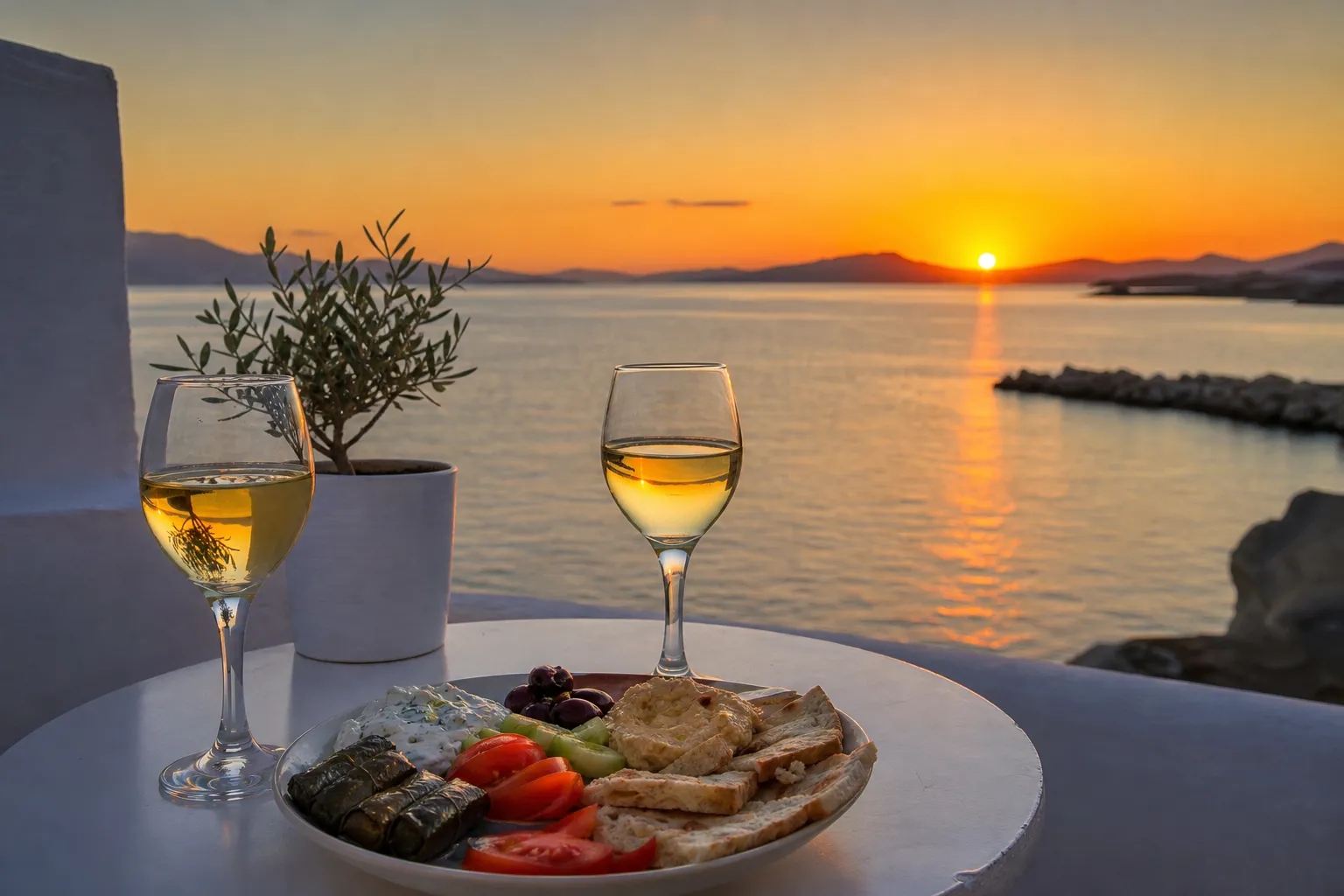
Then there is the wine. Greece has been producing wine on these islands for three thousand years. A small Paros winery, or an Assyrtiko from a Santorini producer, will be the best wine most of your guests have tasted at a wedding, and it will cost a fraction of an equivalent French label on the same menu.
For couples thinking through the full menu, our post on traditional Greek wedding menu ideas covers what works, what guests love, and how to brief a Greek caterer for a mixed international crowd.
Reason 4: A Smaller Guest List Means a Deeper Experience
There is a social pressure around the wedding guest list that rarely gets examined directly. The question "who do we have to invite?" is doing a lot of work, and it is almost never about who you actually want at your wedding.
A destination wedding in Greece applies a natural filter, and that filter is not cruel: it is clarifying. Not every colleague, not every distant relative, not every person who might feel obligated. The people who make the effort: who arrange flights, book time off, plan a trip, are the ones who wanted to be there.
We had 52 guests at our wedding. Not one of them was a reluctant attendee. Every conversation at the reception was genuine. Two guests who had not spoken in years ended up spending three hours on the ferry together the day before and have stayed in touch since.
A smaller, more intentional group also changes what the day feels like for you. You will actually talk to everyone. You will not spend four hours working the room like a politician. You will sit down, eat the food you chose, and be present at your own wedding.
This is the same logic behind the micro wedding movement: the realisation that intimacy, not scale, is what makes a wedding memorable. A destination setting simply makes that choice easier to explain and easier to execute.
Reason 5: The Cost Efficiency Surprise
This is the argument that wins the most sceptics, and the one most likely to be dismissed before anyone does the maths.
Here is the comparison we ran for our own wedding:
| Item | Local (165 guests) | Greece (52 guests) |
| Venue hire | $8,500 | $6,200 |
| Catering (per head) | $85 | $95 |
| Total catering | $14,025 | $4,940 |
| Florals | $12,000 | $3,800 |
| Photography | $5,500 | $4,800 |
| Entertainment | $4,000 | $3,200 |
| Total | ~$62,000 | ~$41,000 |
The per-head catering cost in Greece was slightly higher. The total catering cost was less than a third. The florist in Paros charged less than the florals for the cocktail hour alone in the original local quote.
The numbers will vary by island, by season, and by vendor, but the structure of the argument holds in almost every case: fewer guests is the biggest cost lever, and a destination wedding gives you a culturally legitimate reason to use it. Nobody thinks you are being cheap. They think you are giving them a trip.
For a detailed breakdown of venue and vendor pricing across Greece, the destination wedding in Greece cost guide for 2026 covers the full picture.
Pro tip: September and early October offer near-identical weather to July and August in most Greek islands, at 15 to 25% lower venue costs. Shoulder-season pricing is one of the least-used levers in destination wedding budgeting.
The Legacy: Your Photos Need No Filter
There is a reason that Greece destination wedding photos circulate endlessly on Pinterest and Instagram, and it is not that Greek photographers are universally better. It is that the locations are genuinely, reliably beautiful, and the light confirms it.
A wedding photo taken on a cliff terrace at golden hour, with the Aegean below and whitewashed walls in the background, does not need a preset. It does not need to be colour-graded to look like a magazine. The work is already done.
Years from now, those images will look the same as they do today. The light will not date. The setting will not go out of style. A good Greek island photograph has a kind of permanence that a well-decorated ballroom simply cannot match, not because the ballroom was wrong, but because stone and sea and late-afternoon light are older than trends.
Your wedding album is not just a record of the day. It is what the day becomes over time. Greece tends to age well.
Planning a destination wedding involves dozens of moving parts: guest travel, vendor coordination, accommodation, legal requirements. The article you just read covers the why. When you are ready for the how, our step-by-step destination wedding checklist walks you through the full preparation timeline so nothing falls through the cracks.
Coordinating all of that, from guest RSVPs and travel updates to the ceremony schedule and photo sharing, is where the right tools make a measurable difference. WhiteClover's destination wedding tools are built for exactly this: keeping international guests informed, collecting RSVPs from people in different time zones, and giving everyone a single place for schedules, maps, and the photo gallery. If you are planning a Greek island wedding and want to stop managing it across five different apps, start your WhiteClover wedding and see how it comes together.
Frequently Asked Questions
Is a destination wedding in Greece more expensive than a local wedding?
Not necessarily. The per-head catering cost in Greece can be slightly higher than in some local markets, but the total cost is typically lower because the guest count is smaller. A 50-person wedding in Greece often comes in under the budget for a 150-person local reception. The key variable is guest count, not geography.
How many guests typically attend a destination wedding in Greece?
Most destination weddings in Greece have between 30 and 80 guests. This is not a rule, some couples have 15, others have 120, but the destination naturally encourages a tighter, more intentional list. The people who come are almost always the people who genuinely wanted to be there.
What is the best time of year for a wedding in Greece?
Late May, June, September, and early October offer excellent weather with lower venue costs than peak July and August. The light in September is particularly good for photography. If budget matters, shoulder season is worth considering seriously.
Do I need to handle the legal paperwork myself?
Greek civil and religious ceremonies both have specific documentation requirements. Most couples work with a local wedding planner or coordinator who handles the legal paperwork on the ground. Alternatively, some couples complete the civil ceremony at home and treat the Greek event as the celebration, which simplifies the paperwork considerably.
Can guests who cannot travel still feel included?
Yes. A well-built wedding website with a schedule, venue details, and live photo sharing means that guests who could not make the trip can follow along in real time. After the event, a curated wedding photo album shared through the app keeps everyone connected. Distance does not have to mean exclusion, it just requires a little more thought about how you communicate.
Written by
Konstantinos P
Part of the WhiteClover team, helping couples and hosts plan unforgettable events with modern digital tools. Passionate about simplifying the celebration planning journey.
You Might Also Like
 Checklists
7 Essential steps for your destination wedding checklist
Discover 7 essential tips for couples planning a destination wedding in Greece.
 Inspiration
Best Honeymoon Destinations by Travel Style
Find the best honeymoon destination for your travel style with a practical framework on budget, season, pace, and priorities so your trip feels right.
 Budget & Tools
How Much Does a Wedding Cost in Greece in 2026?
Realistic Greece wedding costs for 2026: venue, catering, islands vs Athens, savings tactics, and free budget tools, so your numbers stay under control.