Advertisement
 Sponsored
Wedding favours guests will actually keep are rarely the ones that shout the loudest on a mood board. They are the small, useful, edible, or personal things that make sense in the hands of your real guests, at your real venue, on your real wedding day.
That sounds obvious, but favours can become a surprisingly emotional decision. You want the tables to look considered. You want your parents to feel the tradition is respected. You might have seen thirty beautiful ideas on Pinterest, from personalised olive oil bottles to embroidered napkins, and suddenly a small thank-you gift feels like another planning project with its own budget, supplier, packaging, delivery, and deadline.
The good news: wedding favours do not need to be expensive to feel thoughtful. They need a clear job. If a favour tastes good, solves a tiny problem, travels home easily, or says something honest about you as a couple, guests notice. If it only exists because "weddings are supposed to have favours", it is much more likely to stay behind on the table.
Plan Your Event
One platform for every occasion: weddings, baptisms, corporate events and private parties.
Start With The Guest, Not The Object
Before choosing a product, picture the person receiving it. A university friend flying in with hand luggage has different needs from your grandmother, your flower girl, or your colleague who will leave straight after dinner. This is why the most successful favour choices usually pass three practical tests:
- Can guests understand what it is in two seconds?
- Can they use it, eat it, or pack it without effort?
- Does it feel connected to the wedding rather than bought in panic?
A favour does not have to pass all three perfectly, but it should pass at least two. A tiny jar of local honey from the island where you are getting married may be useful and personal. A late-night espresso martini token may be fun and immediate. A handwritten note at each place setting may not be "useful", but it can be deeply memorable at a small wedding where you genuinely have time to write something specific.
The mistake is starting with the object first. "Let's do candles" can work, but only if the candle suits your guest list, season, luggage situation, and budget. "Let's give people something they will enjoy the next morning" is a stronger brief. It leads to better ideas: local coffee, breakfast biscuits, mini olive oil, a recovery kit, or a thank-you card with a photo-sharing QR code.

The Three Favour Strategies That Usually Work
Most wedding favour ideas fit into one of three families. Choosing your family early keeps the conversation calm, especially if several people have opinions.
Edible Favours
Edible wedding favours are popular because they remove the biggest risk: clutter. Guests do not need to decide where to display them at home. They can enjoy them during the weekend, in the taxi, or the next day.
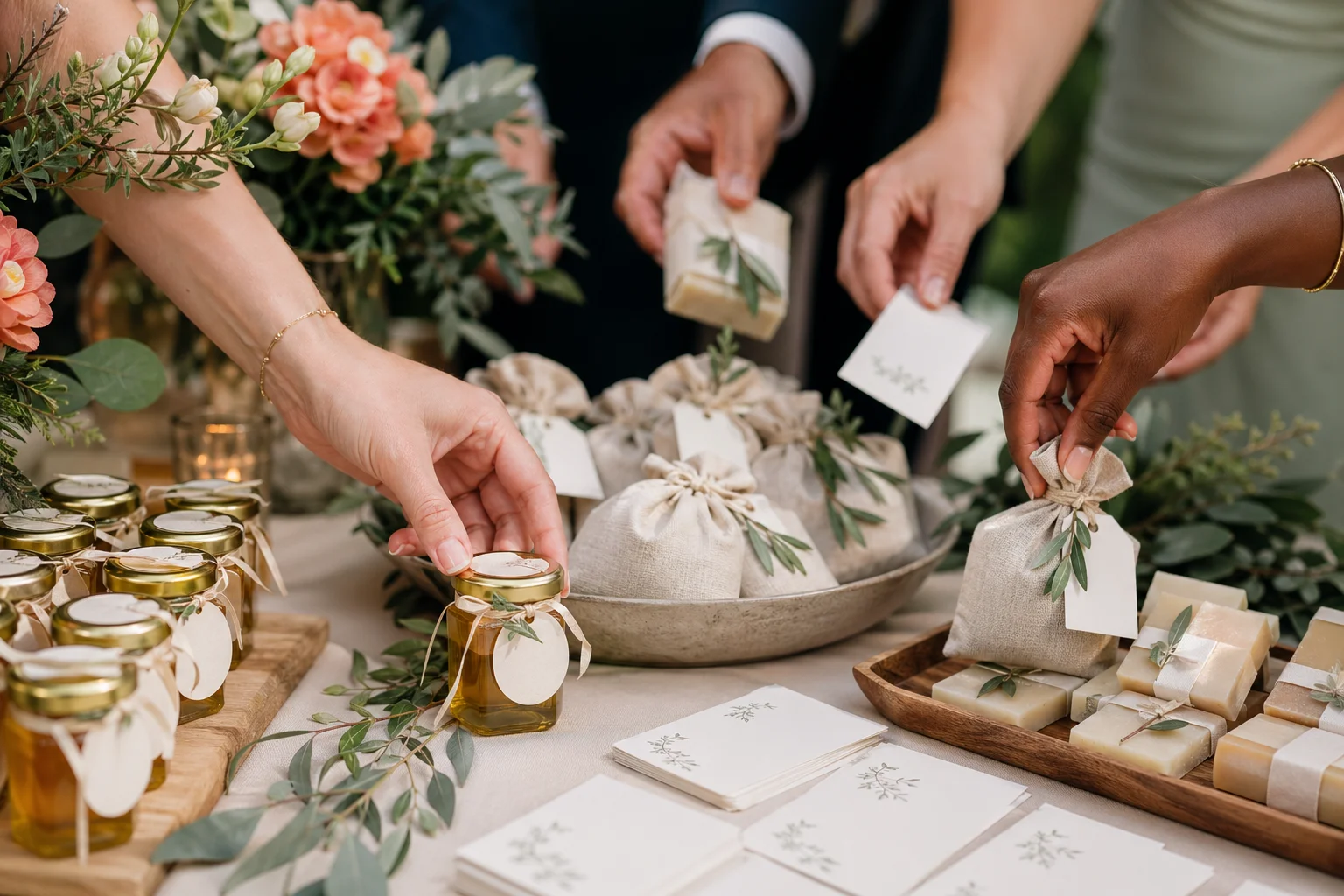
Good edible options include local honey, olive oil, handmade biscuits, chocolate, sugared almonds with a modern presentation, spice blends, tea, coffee, mini limoncello, or a sweet linked to your family story. For destination weddings, edible favours also give guests a small taste of the place. A couple marrying in Crete might choose thyme honey or olive oil. A city wedding could use a favourite bakery. A winter wedding might offer hot chocolate sachets or spiced nuts.
The practical details matter. Avoid anything that melts easily if the venue is hot. Check customs rules if many guests are flying internationally. Ask the supplier about shelf life and packaging. And if allergies are likely, add a small label rather than making guests guess.
Pro tip: If you are torn between two edible options, choose the one guests can enjoy without needing a kitchen, knife, fridge, or checked luggage.
Useful Favours
Useful favours work best when they solve a small problem guests already have. Think pashminas for a breezy island ceremony, fans for a summer outdoor wedding, flip-flops for dancing, bottle openers for a weekend welcome bag, luggage tags for a destination wedding, or mini soaps from a local maker.
The word "useful" should be honest. A favour is not useful just because it is an object. It becomes useful when it fits the setting. A fan in August can be a relief. The same fan in a February city wedding may feel like a prop.
Useful favours are also where quantity planning matters most. If the item is placed at each seat, you usually need one per guest. If it is offered from a basket, you may need fewer, but you should plan placement and signage so guests know they can take one. That difference can change the budget quickly, especially for weddings over 120 guests.
Memory-Led Favours
Memory-led favours are the most personal and the easiest to overdo. A photo strip, a tiny printed note, a custom playlist card, a mini illustration, or a table-specific message can feel beautiful when the idea is simple and the production is realistic.
This category is best for smaller weddings, intimate destination dinners, or couples who enjoy writing and personal touches. It becomes risky when every favour needs a name, a custom message, or a handmade element completed in the final week before the wedding.
If you love the memory-led route but have a large guest list, scale the idea. Instead of writing 180 long notes, write a short shared thank-you card for each table. Instead of a personalised gift for everyone, create a guestbook station or a private wedding photo album where people can add their own moments after the celebration.
A Simple Budget And Usefulness Matrix
Favours sit in an awkward budget category. They feel small until you multiply them by every guest, add packaging, tags, delivery, spares, and sometimes VAT or customs. That is why a usefulness matrix is more helpful than asking, "What is a normal favour price?"
Use this quick test:
- Low cost, high usefulness: usually the strongest default choice.
- Low cost, high emotional value: excellent for intimate weddings.
- Medium cost, high usefulness: good if the item supports the guest experience.
- High cost, low usefulness: avoid, even if it photographs well.
- High cost, high emotional value: reserve for very small guest lists or VIP groups.
For many weddings, a practical favour budget lands around €2-€5 per guest, with €6-€10 reserved for more premium edible gifts, local artisan products, or welcome-bag items. The right number depends on your overall priorities. If favours are forcing you to cut photography coverage, guest transport, food quality, or music, the balance is probably off.
Track favour spend alongside guest count, packaging, and supplier deposits in your wedding budget tools, not as an isolated line that gets checked once and forgotten. A favour that starts at €3 can become €4.20 when you add ribbon, tag printing, delivery, and a buffer for last-minute RSVPs.
Match Quantities To Real RSVP Data
One of the easiest ways to overspend is ordering wedding favours before your RSVP numbers have settled. It feels productive, but early quantities are guesses. Guest lists move. Families RSVP as groups. Some guests decline late. Plus-ones change. Children may need a different option.
A safer timeline looks like this:
- 3-4 months before: choose the favour strategy and shortlist suppliers.
- 8-10 weeks before: approve a sample, packaging, and label wording.
- 6 weeks before: check RSVP trends and likely final count.
- 4-5 weeks before: confirm quantity, plus a small buffer.
- 1-2 weeks before: organise delivery, table placement, and spare storage.
If your wedding has many family groups, grouped RSVP data is especially helpful. A household of five does not always need five identical favours. Children may need something simpler. Couples travelling together might prefer one higher-quality gift per room instead of two small items. For better quantity accuracy, connect your favour planning with family and group RSVPs rather than counting names manually in a spreadsheet.
This is also where your guest list becomes more than an address book. If dietary requirements, children, travel status, and RSVP responses are organised in one place, you can make practical favour decisions without sending ten follow-up messages. WhiteClover's Planning Hub is useful for this kind of cross-checking because budget, guest details, suppliers, and deadlines sit together instead of living in separate notes.
Ideas Guests Are More Likely To Keep
There is no universal "best" wedding favour. The best choice is the one that suits your guests and your day. Still, some categories tend to perform better because they are easy to understand and easy to take home.
Local Food Or Drink
Local food gifts are strong for destination weddings and weekend celebrations. Honey, olive oil, herbs, coffee, wine stoppers, small bottles, biscuits, or sweets from a local bakery feel connected to place. They also work well for couples hosting guests from several countries because the favour becomes part of the travel memory.
Keep the packaging compact. If the product is liquid, check bottle size and sealing. If guests fly with hand luggage, avoid anything over 100ml unless you expect them to pack it in checked bags.
Something For The Wedding Day
The most appreciated favour may be the one guests use immediately. Summer fans, paper parasols, heel protectors for lawn ceremonies, pashminas, flip-flops, water bottles, or a late-night snack can make the day more comfortable.
These favours do not need heavy personalisation. A clear basket sign and a small tag are enough. Guests care more that the item is available at the right moment.
A Photo Or Memory Prompt
Photo-led favours work when they invite guests into the story rather than giving them another object. You might place a small card at each seat with a prompt such as "upload your favourite photo from tonight" or "leave us one memory from the dance floor". Pair it with a QR code that leads to a private wedding gallery, and the favour becomes part of the guest experience.
This is a good option if you want something light, low-waste, and connected to the celebration. It also reduces pressure to produce a physical gift for every guest.
A Small Home Item With Restraint
Candles, soaps, coasters, bottle openers, and ceramic pieces can work beautifully, but they need restraint. Avoid over-branding them with names and dates in a way that makes the item hard to use at home. A small label on the packaging is usually better than printing your wedding date across the object itself.
If you would not keep the item after someone else's wedding, think twice before ordering 150 of them.
Presentation Matters More Than Extra Spend
Guests do not judge favours only by price. They judge the whole moment: where the favour is placed, how easy it is to understand, whether it matches the table, and whether it creates clutter.
A modest favour can feel considered with simple choices:
- neutral or wedding-colour packaging
- one clear label instead of several tags
- tidy placement at each setting or a well-styled favour table
- a note explaining the story behind the gift
- a plan for spares and leftovers
On the other hand, a more expensive favour can feel messy if it arrives in bulky wrapping, blocks the menu, or has no clear purpose. Before approving packaging, ask your venue or planner how the favour will sit on the table with charger plates, glassware, napkins, menus, florals, and name cards.
For destination weddings, presentation also includes transport. Heavy jars, glass bottles, and fragile ceramics may look lovely in photos but become annoying if guests need to pack them. If many guests are travelling, small and sturdy wins.
Common Favour Mistakes To Avoid
The most common favour mistakes are not creative mistakes. They are logistics mistakes.
- Ordering too early: You pay for guests who may not attend.
- Forgetting the weather: Chocolate, wax, and delicate packaging can struggle in heat.
- Ignoring children: Younger guests may need a different option or no favour at all.
- Over-personalising the object: Names and dates can make a useful item less useful.
- Underestimating assembly time: Tying 160 ribbons takes longer than people think.
- Skipping supplier deadlines: Small makers may need more notice than big retailers.
- Not planning leftovers: Decide in advance who takes spare favours home.
Good guest list planning workflows prevent many of these problems because you can see real numbers, households, children, and notes before you confirm the order. Favours feel simple, but they touch guest data, budget, supplier management, table styling, and the wedding-day run sheet.
How WhiteClover Helps You Keep It Calm
Favour planning becomes stressful when it is treated as a separate mini-project. One person has the supplier quote. Another has the guest count. Someone else has the table plan. The final quantity is buried in a message thread. That is how small details become noisy.
WhiteClover helps by keeping the practical pieces together: guest list, RSVPs, family groups, budget notes, supplier details, and planning tasks. You can decide whether children need a different favour, check how many guests are travelling, track the supplier deadline, and keep the cost visible next to the rest of your wedding budget.
It will not choose your favour for you, and that is a good thing. Your favour should sound like you. WhiteClover simply gives you a calmer place to make the decision, so the final choice feels intentional rather than rushed.
Frequently Asked Questions
How much should we spend per guest on wedding favours?
For most weddings, €2-€5 per guest is a practical range. You can spend less if the favour is edible, local, or beautifully presented, and you can spend more for a small guest list or welcome-bag style gift. The important thing is to calculate the full cost, including packaging, delivery, labels, and spare quantities.
Are edible wedding favours usually better?
Edible favours are often safer because guests can enjoy them without finding a place for another object at home. They are especially good for destination weddings, weekend weddings, and celebrations with guests travelling from abroad. Just check allergies, heat, shelf life, and luggage restrictions before ordering.
Should every guest receive the same favour?
Not always. A consistent favour looks tidy, but small variations can be more thoughtful. Children, guests with dietary needs, VIP family members, or guests staying in hotel rooms may need a different approach. If you vary favours, keep the packaging style consistent so the tables still feel organised.
When should we confirm final favour quantities?
Aim to confirm final quantities around 4-5 weeks before the wedding, once RSVPs are stable. Choose the supplier and approve samples earlier, but avoid locking the final number too soon. Add a small buffer for late changes, damaged items, or last-minute guest updates.
What can we do instead of physical wedding favours?
You can replace physical favours with a donation, a handwritten note, a shared photo gallery, a guestbook prompt, a late-night snack, or a practical comfort item used during the event. Guests remember care more than objects. If the alternative feels personal and easy to understand, it can work better than a traditional favour.
Final Thought
Wedding favours are small, but they sit at the meeting point of budget, guest experience, design, and logistics. Choose something that earns its place on the table. If it tastes good, helps your guests, travels easily, or carries a real piece of your story, it is already doing enough.
Managing those details can get messy when RSVP numbers, supplier quotes, dietary notes, and table plans live in different places. WhiteClover gives modern couples one calm planning space for the decisions that shape the guest experience, from favour quantities to family RSVPs and wedding-day details.
Written by
Konstantinos P.
Part of the WhiteClover team, helping couples and hosts plan unforgettable events with modern digital tools. Passionate about simplifying the celebration planning journey.
You Might Also Like
 Budget & Tools
Best Wedding Budget Apps: Track Every Expense [2026]
Which wedding budget app should you use? We compare dedicated planners, spreadsheets and Notion on vendor payments, due dates and shared access.
 Guest Experience
How to Manage Your Wedding Guest List Calmly
Manage your wedding guest list calmly: budget-first caps, household rules, plus-ones, family diplomacy, A and B lists, and one single source of truth.
 Invitations
How to RSVP as a Family or Group
RSVP as a family or group for a wedding with linked guests: one response for the household, same link for schedule and photos. See how WhiteClover does it.