
Advertisement
 Sponsored
Sam is a made-up groom from Melbourne, but mixed couples hit his problem all the time. Sam asked his best mate Jack to be his best man in October. In January, at their first meeting with the priest in Kefalonia, he found out that Jack couldn't do it.
The reason wasn't personal. The person beside the groom at a Greek Orthodox wedding is the koumbaros, a sponsor in the sacrament, and the church expects them to be Orthodox. Jack is Anglican.
Whether you can marry in Greece without one depends on which wedding you're having. A civil wedding needs no koumbaros at all. A church wedding, in practice, needs at least one. We've quoted the law and the church below, with where we found each, and what couples in Sam's position do instead.
TL;DR:
- Civil wedding: no koumbaros. Greek law asks for two witnesses, adults with ID. They can be anyone you like.
- Orthodox church wedding: the paperwork is signed by the priest, the couple and the koumbaros. Every official text we found assumes at least one.
- Church guidance says the koumbaros must be a baptised Orthodox Christian, and the priest checks.
- A non-Orthodox friend can still stand beside you as best man or maid of honour. They just don't swap the rings and crowns.
- Ask the priest before you ask your friends. It saves a hard conversation.
Plan Your Event
One platform for every occasion: weddings, baptisms, corporate events and private parties.
The koumbaros is not a best man
At an English or Australian wedding, the best man holds the rings, gives a speech and keeps the groom calm. The koumbaros (or koumbara, if a woman) has a part in the service itself.
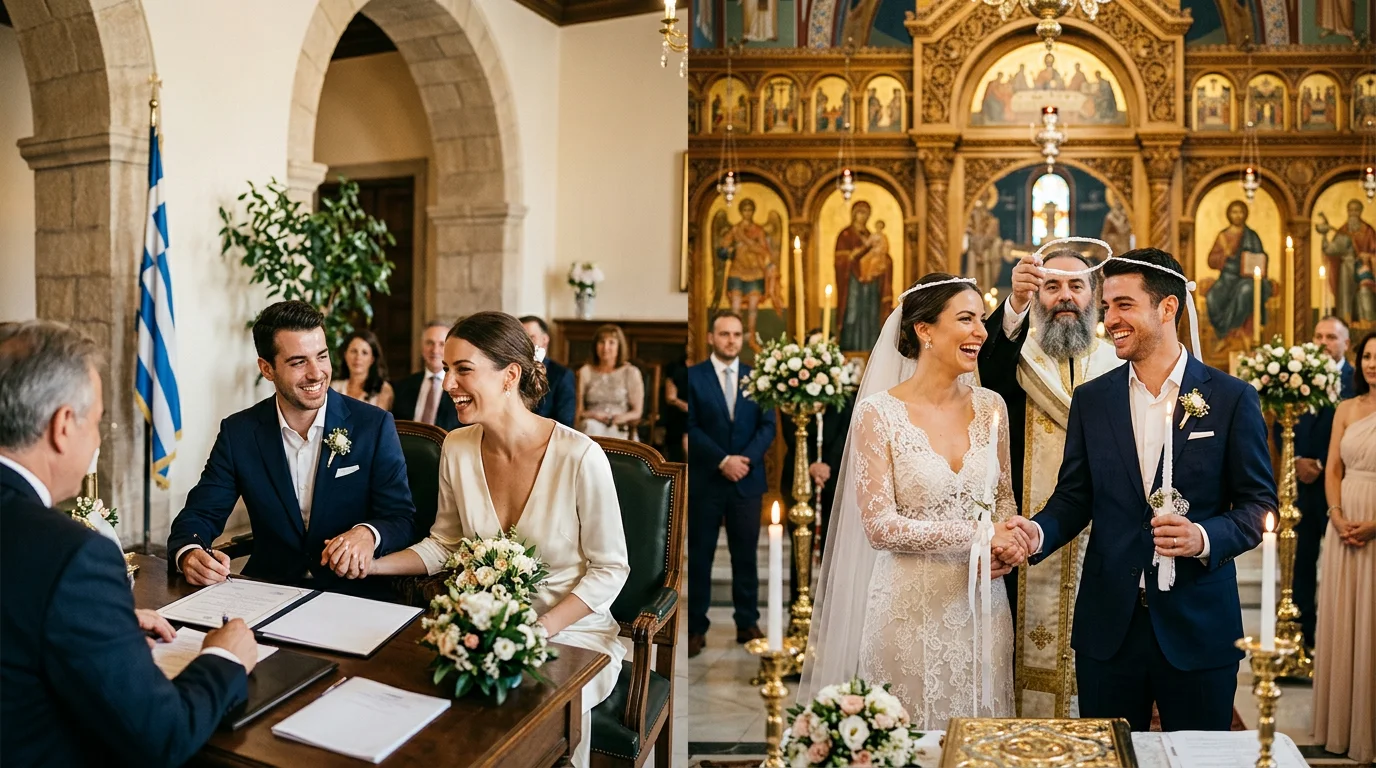
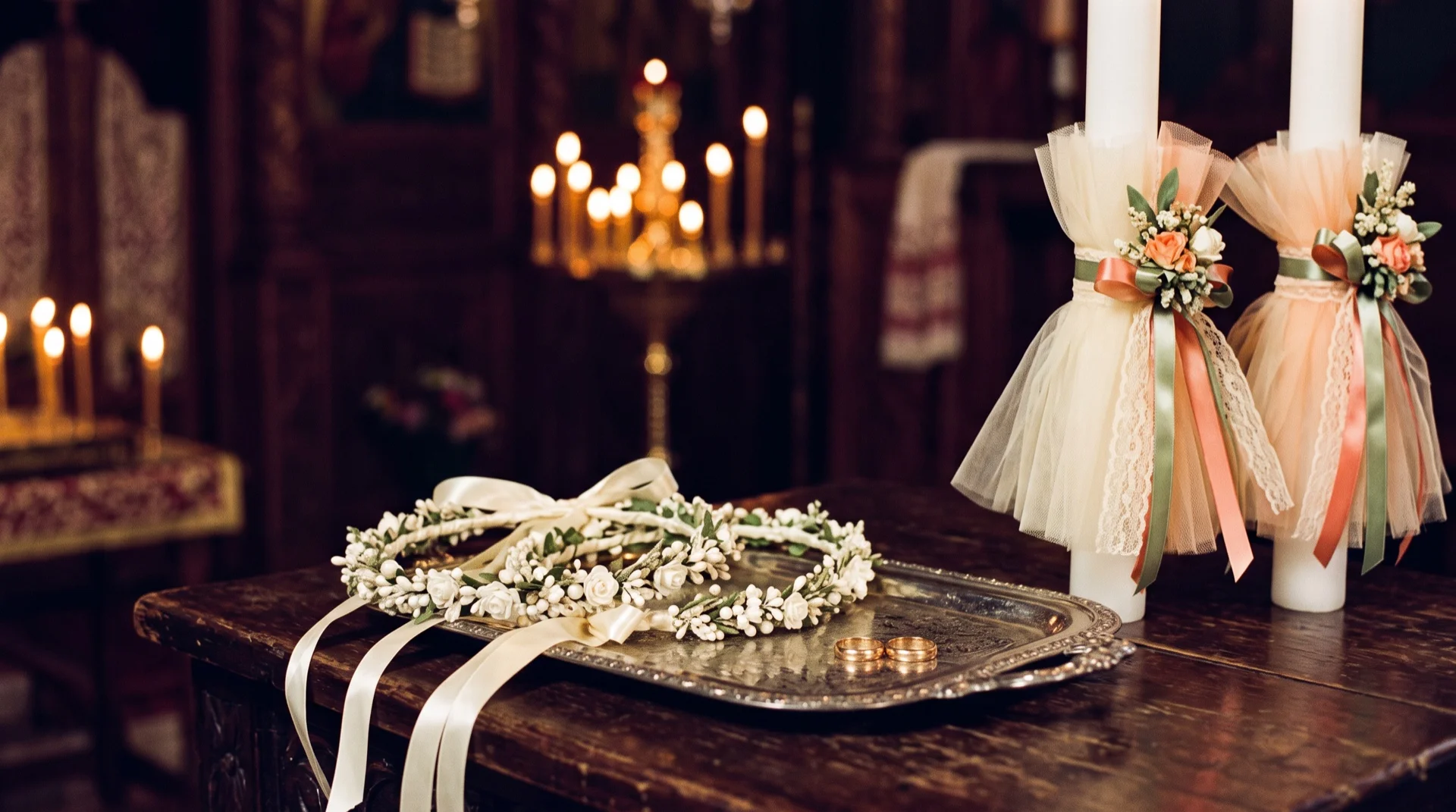
During the service, the koumbaros swaps the rings between the couple three times, then swaps the wedding crowns, the stefana, three times. They walk behind the couple during the procession around the table. After the service they sign the declaration that registers the marriage. In Greek families the tie is supposed to last: your koumbaros is often later asked to baptise your first child.
For the whole ceremony step by step, our guide to Greek wedding traditions lays it out.
Civil wedding in Greece: two witnesses, no koumbaros
Article 1367 of the Greek Civil Code says a civil marriage is a public declaration by the couple before two witnesses, made to the mayor or community president of the place where it happens.
The government's own service catalogue (mitos.gov.gr) describes the witnesses as two people over 18 who show ID and sign the record alongside the couple. Nothing is asked about their religion or whether they're family, and they have no role in the ceremony beyond being there and signing.
So at a town hall in Athens or on an island, Jack can be a witness, and so can your sister or your oldest friend from school. Plenty of couples still call their witnesses "koumbaros" informally, which is fine.
If one of you or a witness doesn't speak Greek, ask the municipality how they handle interpretation. The US Embassy in Athens, for example, notes that one of the two witnesses usually acts as interpreter for American couples.
Our guide to civil vs religious weddings in Greece compares the two routes in more detail, and Greece marriage laws for foreigners covers the documents.
Church wedding: why you need at least one koumbaros
Greek law leaves the conditions of a religious wedding to the church itself. So here we looked at what the Church of Greece publishes.
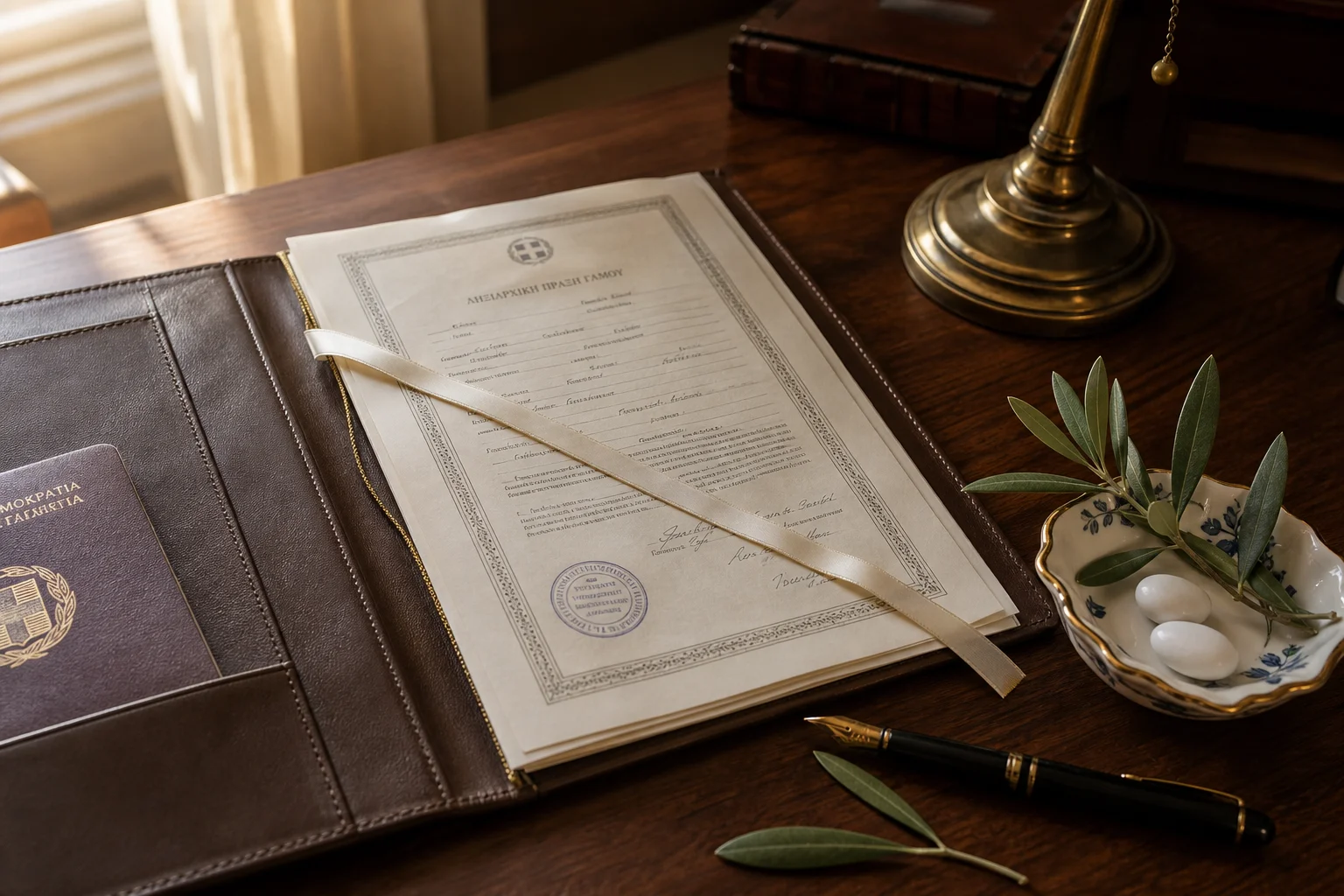
The Holy Synod's guidance on the conditions for a religious wedding says that after the service the couple receive a declaration of marriage signed by the priest, the couple and the koumbaroi. That declaration must be filed at the civil registry within 40 days. A metropolis guide from the Peloponnese says exactly the same.
A 2024 circular from the Metropolis of Thessaloniki adds that the priest must check that the koumbaros is a baptised Orthodox Christian.
We found no official text describing an Orthodox wedding without a koumbaros, which is why we say "in practice". If you want to try, raise it with your parish priest before you plan around it.
Pro tip: Ask the priest three things at the first meeting. Does the koumbaros need to be Orthodox here? What do you need from them, and by when? Can we have more than one? Then talk to your friends.
What if your best friend isn't Orthodox?
Most mixed couples end up here. Sam and Eleni split the role in two:
- Christos, Eleni's cousin, is the koumbaros. He's baptised Orthodox, gave the priest his details a few weeks before, and swaps the rings and crowns.
- Jack is the best man. He stands next to Sam, holds the rings until the service, gives the speech at the reception and runs the stag weekend.
Parishes abroad often say this explicitly. One Greek Orthodox church in Canada, for example, writes that couples "may still designate a 'Best Man' and 'Maid of Honour' who are not members of the Orthodox Church", with the Orthodox sponsor standing beside them.
It took one dinner to sort out. Jack was mostly relieved he didn't have to learn when to swap the crowns.
Can you have more than one koumbaros?
Yes. The church documents themselves refer to koumbaroi in the plural. A common split is one person for the rings and one for the crowns, or one chosen by each of you.
Two also helps when you can't choose between friends, or when family politics rule out any single choice. We didn't find a published maximum, so if you're thinking of four, check with your priest.
Who can be a koumbaros?
From the sources we read, the baseline is a baptised Orthodox Christian. Some parishes add conditions. The Canadian parish above, for instance, asks that a married koumbaros was married in the Orthodox church. Rules can differ from one metropolis to another, which is one more reason to ask early.
A koumbaros also takes on costs by custom, not by law: often the crowns, the candles and sometimes a gift to the priest. That varies a lot by region and family, and we put numbers on it in koumbaros duties and costs.
Civil vs church, side by side
| Civil wedding | Orthodox church wedding | |
| Koumbaros required? | No | In practice, yes, at least one |
| What the law or church asks | Two witnesses, over 18, with ID | Koumbaros signs the marriage declaration |
| Must they be Orthodox? | No | Yes, baptised Orthodox, checked by the priest |
| Can a non-Orthodox friend take part? | Yes, as a witness | Yes, as best man or maid of honour beside you |
| Paperwork after | Recorded by the municipality | Declaration filed at the registry within 40 days |
Do you need one at all?
You can marry in Greece without a koumbaros at the town hall, with two adult witnesses of your choosing. For an Orthodox church wedding, plan on at least one koumbaros who is baptised Orthodox, and let your non-Orthodox best friend take the best man role alongside.
The hard part is the order you find things out in. Sam asked Jack first and the priest second. Do it the other way round and the conversation with your friends is easy.
Once the koumbaros and witnesses are settled, they're the first names on your list. Start your wedding guest list with them at the top, and keep the list of papers and dates the priest or municipality need in the planning hub.
Frequently asked questions
Do you need a koumbaros for a civil wedding in Greece?
No. A civil wedding needs two witnesses over 18 with ID, under Article 1367 of the Greek Civil Code. They don't have to be Orthodox or related to you. Couples often call them koumbaros informally.
Can my non-Orthodox best friend be koumbaros?
Not in an Orthodox church wedding. Church guidance asks the priest to check that the koumbaros is a baptised Orthodox Christian. A non-Orthodox friend can stand beside you as best man or maid of honour.
Can a Greek Orthodox wedding happen without a koumbaros?
We found no official text that describes one. The marriage declaration is signed by the koumbaroi, so in practice at least one is expected. If you have a special situation, ask your parish priest directly.
Can you have two koumbaroi?
Yes. Church documents refer to koumbaroi in the plural, and a common split is one for the rings and one for the crowns. Check with your priest if you're considering more.
Does the koumbaros have to be a man?
No. A woman in the role is the koumbara and does exactly the same things.
Recommended
Written by
Nikos L
Part of the WhiteClover team, helping couples and hosts plan unforgettable events with modern digital tools. Passionate about simplifying the celebration planning journey.
You Might Also Like
 Wedding Planning
Civil vs Religious Wedding in Greece
Civil or Orthodox wedding in Greece? Legal equivalence, documents, timelines, venue options, costs, and family conversations, clear facts for 2026 couples.
 Wedding Planning
Greece Marriage Laws Guide for Foreigners (2026)
How foreigners legally marry in Greece in 2026: the civil licence, documents for UK, US and EU citizens, apostille, translations, church rules, registration.
 Wedding Planning
Koumbaros Duties and Costs, Explained
Asked to be koumbaros at a Greek wedding? What the role involves in church, who can do it, what it costs in 2026 and a timeline from the engagement to the day.