
Advertisement
 Sponsored
Choosing the right wedding transportation is less about the prettiest car and more about how people move through the day. The best plan gets the couple, families, wedding party, guests, and vendors to the right place at the right time without making the celebration feel like a logistics drill.
That matters more than couples often realise. A late shuttle can delay the ceremony. A missing driver contact can pull the best man out of photos. A venue with beautiful views but tight access can create a queue of taxis at exactly the wrong moment. Good transport planning protects the mood of the day: guests arrive relaxed, VIPs are where they need to be, and you are not tracking vehicles while trying to enjoy your wedding.
Plan Your Event
One platform for every occasion: weddings, baptisms, corporate events and private parties.
Start with a movement map
Before you ask for quotes, map every movement that matters. This stops you from buying transport based on guesswork or choosing a vehicle because it looks good in photos but does not solve the practical problem.
Your movement map should include:
- couple movements
- parents and immediate family
- wedding party
- elderly guests or guests with mobility needs
- guests staying in shared hotels
- guests arriving from the airport, port, or train station
- vendor movements, if access or setup timing is sensitive
- after-party or late-night return routes
For each movement, write the pickup point, drop-off point, passenger count, ideal arrival time, and what happens if the route is delayed.
Here is a simple example:
| Group | From | To | Target arrival | Notes |
| Couple | Hotel suite | Ceremony venue | 4:35pm | Needs private car and photo-friendly arrival |
| Parents | Family villa | Ceremony venue | 4:20pm | Must be seated before general guests |
| Guests hotel A | Lobby | Ceremony venue | 4:30pm | One coach, visible meeting sign |
| Guests hotel B | Lobby | Ceremony venue | 4:30pm | Smaller shuttle due to narrow road |
| Wedding party | Prep house | Ceremony venue | 4:15pm | Keep separate from guest shuttle |
| Late-night guests | Reception | Hotel district | 12:30am / 2:00am | Two return waves |
Once you see movements this way, the right wedding transport option becomes much clearer. You may need one premium car, one reliable coach, two smaller vans, and a taxi plan, not a full fleet of luxury vehicles.
Match transport style to the purpose
Different wedding transportation options solve different problems. The right choice depends on reliability, access, passenger needs, and the tone of the event.
Private car for the couple
A private car is ideal when you want privacy, a calm arrival, and control over timing. It does not have to be the most expensive vehicle available. A clean, comfortable, punctual car with a professional driver is often better than a dramatic vintage car that struggles with hills, heat, or long distances.
Use a private car when:
- the couple needs a quiet moment before the ceremony
- the entrance is being photographed
- the route is sensitive or unfamiliar
- the outfit needs space
- the ceremony and reception are in different locations
Family or VIP vehicles
Parents, grandparents, siblings, and key family members often need separate planning. They may need to arrive early for photos, sit before guests, carry ceremony items, or avoid walking long distances.
Treat VIP transport as a reliability question, not a status symbol. The best vehicle is the one that gets the right people there calmly.
Guest shuttles and coaches
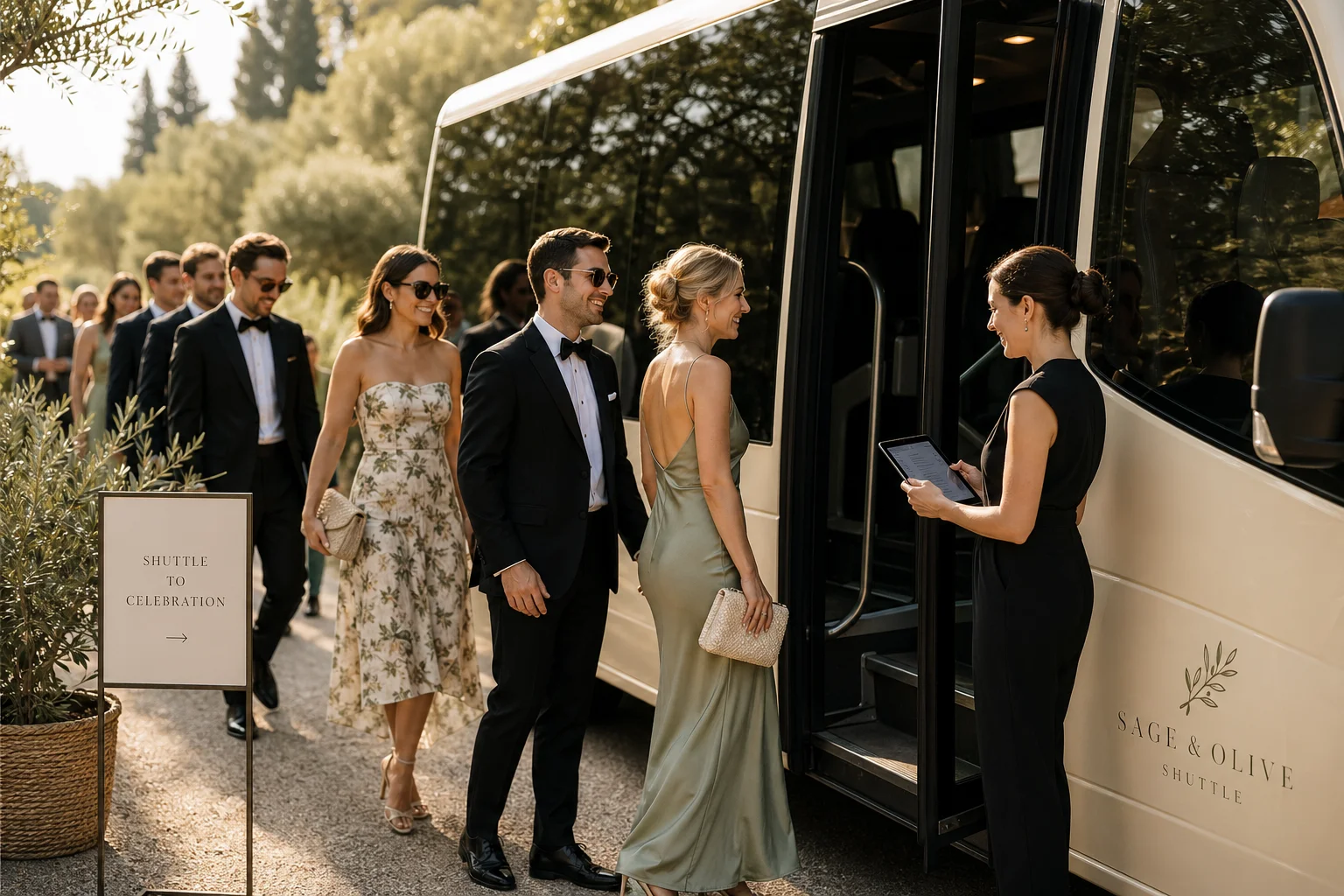
Shuttles are helpful when guests are staying in one or two clusters, parking is limited, the venue is remote, or alcohol service makes driving home less ideal. For destination weddings, guest shuttles can be the difference between a relaxed group and 80 people trying to find taxis in a place they do not know.
The key is clarity. Guests need exact pickup times, meeting points, return options, and a named contact who is not the couple.
Taxis and ride-hailing
Taxis can work well for city weddings or small groups, but they are risky as the only plan in remote areas, islands, or high-season destinations. Ride-hailing availability changes by city and time of day. If you are relying on taxis, test the route and ask the venue what usually works.
Boats, golf carts, and special transfers
Some weddings need unusual transport: boats to an island venue, golf carts inside a large estate, minibuses through old town streets, or 4x4 vehicles for remote villas. These options can be charming, but they need more planning. Think about shoes, weather, elderly guests, luggage, lighting after dark, and backup if wind or access rules change.
Score each route for risk
Not every route deserves the same level of attention. A five-minute hotel-to-venue transfer with wide roads is different from a 40-minute coastal road at sunset or a narrow old-town route where coaches cannot enter.
Give each route a score from 1 to 5 across five factors:
- traffic volatility
- route complexity
- passenger importance
- delay impact
- fallback availability
Then add the scores. The higher the total, the more carefully you should plan that route.
| Factor | Low risk | High risk |
| Traffic volatility | Predictable local road | City centre, island port, weekend peak |
| Route complexity | One clear entrance | Multiple gates, old town, private road |
| Passenger importance | General guests | Couple, parents, officiant, wedding party |
| Delay impact | Guests wait at cocktail hour | Ceremony cannot start |
| Fallback availability | Taxis nearby | No spare vehicles or long response time |
High-risk routes need earlier departure, a direct driver contact, a backup plan, and someone watching the clock. Low-risk routes can stay simpler.
If your venue is not final yet, check access before falling in love with the view. The guide on what to look for in an event venue is a useful companion because transport, parking, loading zones, and guest flow all begin with the venue.
Group guests by behaviour, not only by hotel
Most couples group wedding guests by hotel, and that is a good start. But the best wedding transport plans also consider behaviour and needs.
Separate groups such as:
- guests who tend to arrive late
- elderly guests
- families with young children
- guests who do not speak the local language
- VIP family members
- guests with mobility concerns
- guests who will leave early
- party guests who will want the latest return option
This does not mean making people feel labelled. It means designing clearer instructions. A family with toddlers may need the earlier shuttle and a seat near the front. Elderly relatives may need a vehicle that can drop closer to the ceremony entrance. Friends who love a late night may need the 2:00am return rather than the midnight coach.
For destination weddings, also consider arrival days. Guests who land the morning of the wedding should not be placed in a tight transport plan with no recovery time. Build a small safety net.
Ask vendors the questions that reveal reliability
Transport quotes can look similar, but the service behind them may be very different. Ask questions that show how the vendor handles real wedding pressure.
Useful questions include:
- How early does the driver arrive before pickup?
- Will we receive driver names and phone numbers in advance?
- What happens if a vehicle has a mechanical issue?
- Are vehicles licensed and insured for passenger transport?
- Can the driver wait if the ceremony runs late?
- Are overtime fees charged per vehicle or per hour?
- Can coaches access the exact venue entrance?
- Is there air conditioning?
- Can elderly guests board comfortably?
- What is the backup plan during high season?
- Who is the operational contact on the day?
If a vendor gives vague answers to backup and access questions, keep looking. Pretty photos do not compensate for uncertainty on the wedding day.
Not sure where to start the search? Browse the WhiteClover partners directory to find transportation providers and other trusted wedding vendors in your area, then bring the same questions to each one before you commit.
Include transport confirmations in your wedding vendor checklist so the timing expectations are visible beside the rest of your supplier details.
Build one operational run sheet
Your transport run sheet is the document that keeps movement decisions out of your head. It should be shared with your planner, venue contact, transport provider, and one trusted person from your side.
Include:
- pickup windows
- exact meeting points
- driver contacts
- vehicle descriptions or plate numbers
- passenger groups
- route notes
- accessibility notes
- escalation contact
- backup actions
- final return schedule
Avoid vague pickup points like "outside the hotel". Use exact language: "hotel lobby by the marble stairs", "north gate beside the olive tree", "coach stop opposite the pharmacy". A tiny detail can save 15 minutes.
For weddings with more than one event day, keep one coordinated system using multi-event planning principles. Welcome dinners, ceremony transfers, beach parties, and next-day brunches all affect the same guests.
Protect transitions with buffer logic
Most transport delays happen at transitions, not during the drive itself. People take time to leave rooms, gather bags, find children, finish drinks, say hello, and board vehicles.
Add buffers around the human parts:
- +10 minutes for guests to gather at hotel pickup
- +10 minutes for loading a large coach
- +15 minutes before critical arrivals
- +20 minutes for elderly or mobility-sensitive groups
- +15 minutes after ceremony if guests must walk to reception
- one coordinator during peak movement windows
Do not schedule a coach departure for the exact time guests are told to meet. If the shuttle must leave at 4:00pm, tell guests to gather at 3:45pm and have someone visible there at 3:35pm.
Transport should also connect to your master wedding timeline. If the ceremony starts at 5:00pm, the transport target is not "arrive at 5:00pm". It is "guests seated before 4:50pm, close family settled by 4:40pm, couple hidden by 4:45pm".
Plan communication before the wedding day
The best transport plan can still fail if guests do not understand it. Send instructions more than once, but keep them consistent.
A clear guest note should include:
- pickup time
- meeting point
- what the vehicle looks like
- whether the shuttle waits
- return times
- contact person
- parking guidance for those driving
- walking or accessibility notes
Put the same details on your wedding website so nobody has to search an old message. For destination celebrations, WhiteClover’s Destination Wedding Greece page shows how travel, schedule, guest communication, and local planning can sit together instead of being scattered across chats.
If you are also collecting RSVPs, dietary notes, and guest groups, link transport planning to your wedding guest list. Knowing who is staying where, who is travelling with children, and who needs assistance makes transport decisions far more accurate.
Budget for reliability, not just vehicle type
Wedding transportation costs vary widely by location, season, vehicle size, waiting time, and distance. The cheapest quote is not always the best value if it creates risk around your ceremony or guest safety.
Budget for:
- waiting time
- overtime
- late-night returns
- extra driver hours
- parking or access fees
- backup vehicle availability
- multiple pickup points
- airport or port transfers if needed
You do not need premium vehicles everywhere. Spend where timing matters most: couple arrival, VIP family, remote venues, and guest groups with no easy alternative. Save where the route is simple and low risk.
For destination weddings, book earlier than you think. High-season vehicles, especially comfortable minibuses and reliable coaches, can disappear quickly.
Frequently Asked Questions
Do all weddings need shuttle transportation?
No. A small city wedding with easy parking and local guests may not need shuttles. Shuttle transportation is strongly recommended when parking is limited, guests are staying in hotel clusters, the venue is remote, alcohol service is significant, or the route is unfamiliar to guests.
How early should wedding transportation be booked?
For peak season, destination weddings, islands, or large guest counts, book 4-6 months in advance where possible. For simpler local weddings, 3-5 months is often enough. If your wedding date falls on a holiday weekend or in a busy tourist area, start earlier.
What is the most common wedding transportation mistake?
The most common mistake is treating transport as a final-week detail. Transportation affects ceremony timing, guest experience, photography, vendor arrivals, dinner service, and late-night safety. It should be planned alongside the timeline and guest list.
Should we separate VIP and guest transport?
Usually, yes. VIP family, the wedding party, and the couple often have different timing needs from general guests. Separate transport helps protect ceremony readiness, family photos, and private moments before the event begins.
What should guests receive about wedding transport?
Guests should receive exact pickup times, meeting points, return options, parking notes, accessibility information, and a contact person. Keep the message short and repeat the same details on your wedding website.
When wedding transportation is planned well, guests rarely talk about it. They simply arrive calm, find their way easily, and leave safely at the end of the night. That quiet reliability is the point. With a clear route map, sensible buffers, trusted vendors, and one place for guest communication, the movement around your wedding supports the story instead of interrupting it.
Written by
Nikos L
Part of the WhiteClover team, helping couples and hosts plan unforgettable events with modern digital tools. Passionate about simplifying the celebration planning journey.
You Might Also Like
 Wedding Planning
What to Look for in an Event Venue
Choosing an event venue? Check capacity, flow, what is included, access and parking, wet-weather plans, contracts, and photo-friendly light.
 Vendor Tips
7 Essential Checklist Steps for Wedding Vendors in Greece
Follow this checklist for wedding vendors in Greece to improve online presence, leads, profile quality, and conversion from discovery to booking.
 Wedding Planning
Manage Multiple Wedding Events in One Place
Manage multiple wedding events in one place: welcome dinner, ceremony, reception, brunch.