Advertisement
 Sponsored
In Greece it's common for a couple who already have a child to marry and baptise them on the same day. There's a word for it, gamovaptisi, and there's a lot written about the ceremony order, the godparents and keeping the children entertained. There's very little about the seating plan, which is where most couples get stuck.
The problem is the top table. Two sets of guests of honour want to sit there: the koumbaros and koumbara from the wedding, and the godparents of the child. Add a baby who will be tired long before the dancing stops. Below are the two layouts that work and how to choose between them.
Plan Your Event
One platform for every occasion: weddings, baptisms, corporate events and private parties.
First: are the koumbari also the godparents?
In many Greek families, the koumbaros who stands for the wedding also baptises the first child. At a combined wedding and baptism that often happens on the same day, and then the problem mostly solves itself. Your guests of honour are the same people and they fit comfortably at one table.
If the godparent is someone else, you have two pairs of guests of honour, both sets of parents and a high chair. That needs a decision, and it's better made before the venue asks for it.
Layout A: one table for everyone
The two of you in the middle, the baby in a high chair next to the mother, the koumbari on one side and the godparents on the other.
It fits when the koumbari are also the godparents, or when everyone together comes to no more than 8 to 10 people. It looks good in photos, and nobody feels they've been put on the "second" table.
The risk is where the table sits. The top table usually faces the dance floor, which is also where the speakers are. A one-year-old won't sleep next to a speaker at eleven at night. Decide in advance who takes the baby when they get tired, and seat that person at the end of the table nearest the door.
Layout B: top table plus a family table beside it
The two of you and the koumbari at the top table. Right next to it, a family table with both sets of parents, the godparents, and the baby with a grandmother or whoever's looking after them.
It fits when the godparent isn't the koumbaros, when there are a lot of parents to seat (divorced parents with new partners, for instance), and when you want to dance without checking the high chair every five minutes.
The risk is distance. The two tables must sit side by side, not across the room from each other. The baby is half the reason for the party, and guests will want to see them.
| One table | Two tables | |
| Who sits there | You, the baby, koumbari, godparents | Top table: you and the koumbari. Family table: parents, godparents, baby |
| Fits when | The koumbari are also the godparents | The godparents and koumbari are different people |
| Watch out for | The baby next to the speakers | Keeping the two tables side by side |
The rest of the room has more children
At a wedding alone, plenty of parents leave the children with a grandparent. At a wedding and baptism they bring them, because half the celebration is for a child. Plan for more high chairs and more children's meals than you would for a wedding, and seat families with small children near an exit.
For splitting families across tables without separating any child from their parents, the same rules apply as in our baptism seating plan guide.
If the baptism is on another day, say the Sunday after the wedding, you have two receptions and two separate plans. Our guide to managing multiple wedding events covers that side of it.
Try both before you decide
The decision rarely gets made on paper. It gets made when your mother-in-law sees she's on the second table. So it helps to have both layouts ready to show the parents before anything is fixed.
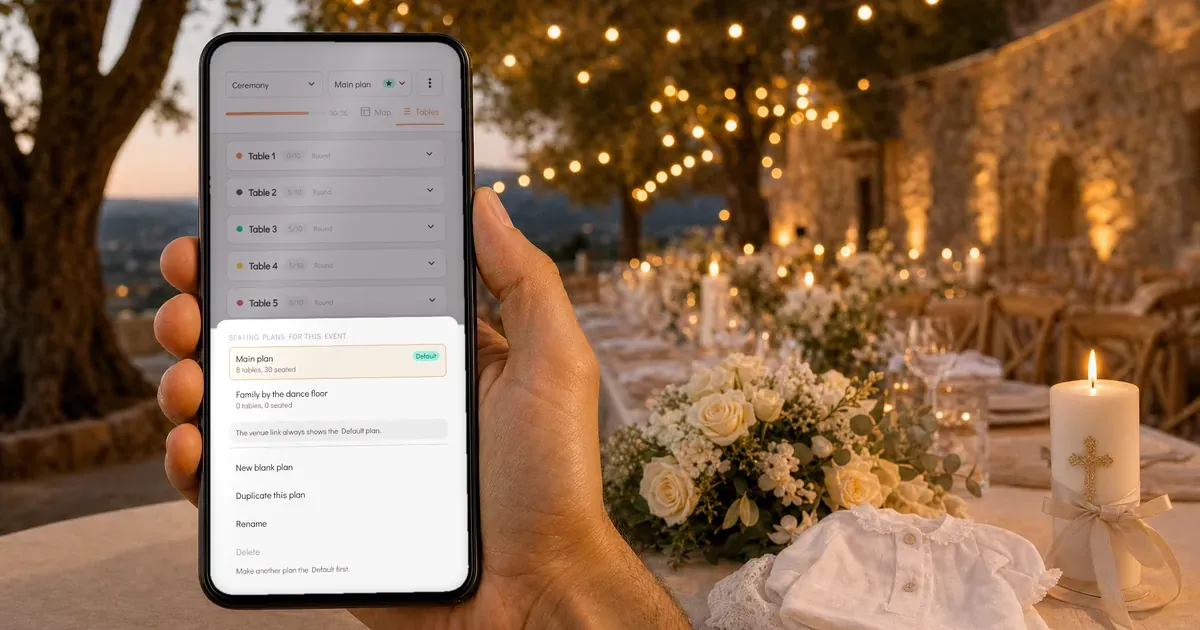
In the WhiteClover seating chart you can keep a second plan next to the main one. Duplicate it, call it "Two tables", change only the top and family tables, and make it the Default once you've decided. The first plan for each event is free, and extra plans for the same event are €3.99, once.
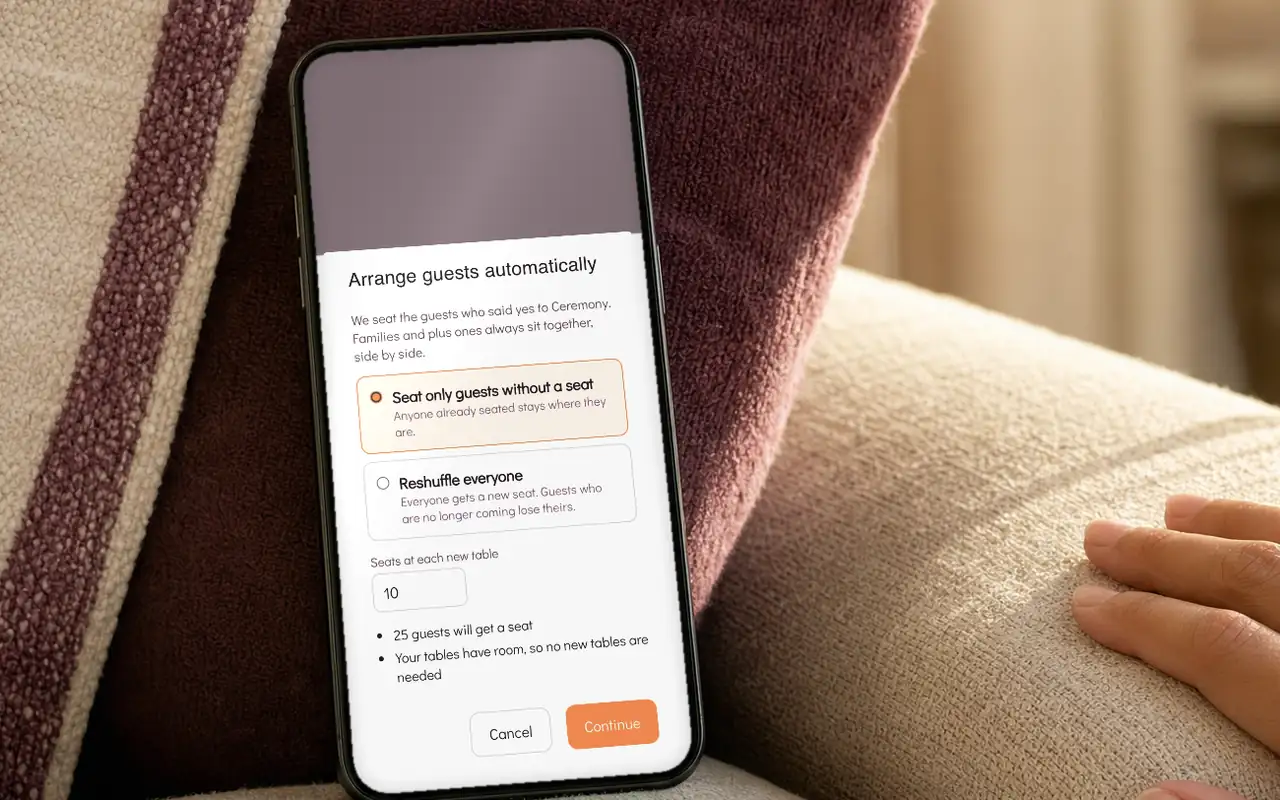
Arrange automatically seats everyone else and keeps every family together, and you can undo any move. The link you send the venue always shows the Default plan, so the venue never sees a draft you're still arguing about. If the baptism is on a different day, each event has its own plan.
Greek venues usually ask for the final plan 7 to 10 days before. At a wedding and baptism, settle the top table question earlier than that, because the flowers and table styling depend on it.
In short
If the koumbari are baptising the child, one table is enough. If not, two tables side by side keep everyone happy and let you dance. Either way, the baby sits with whoever will take them home to bed, on the side nearest the door.
If you want one guest list across every event, with replies and a seating plan for each one, see how WhiteClover handles a wedding and baptism.
FAQ
Who sits at the top table at a wedding and baptism? The couple, the baby and the koumbari. If the godparents are different people, they sit either at the same table or at a family table right next to it, with the parents.
Where does the baby sit at a gamovaptisi? In a high chair next to the mother or next to whoever's looking after them, on the side of the table nearest the door and as far from the speakers as you can manage.
Where do the godparents sit if they aren't the koumbari? At the top table, if everyone fits in 8 to 10 seats. Otherwise at the family table beside it, with your parents. Never at a friends' table on the far side of the room.
Do I need two seating plans? Only if the baptism has its own reception on another day. If it's all one meal on one evening, one plan is enough. A second plan only helps you compare two layouts.
Further reading
Written by
Ioanna V.
Part of the WhiteClover team, helping couples and hosts plan unforgettable events with modern digital tools. Passionate about simplifying the celebration planning journey.
You Might Also Like
 Wedding Planning
Combined Wedding and Baptism 2026: A Complete Planning Guide
Plan a wedding and baptism on the same day in Greece: 12-month timeline, dual guest lists, budget, venue needs, and digital tools, without the stress.
 Wedding Planning
Manage Multiple Wedding Events in One Place
Manage multiple wedding events in one place: welcome dinner, ceremony, reception, brunch.
 Baptism
 Seating Plan: Who Sits Where
How to plan seating at a baptism or christening: the family table with the godparent, where the children sit, and when to send the plan to your venue.