Advertisement
 Sponsored
A note before we start: Tom and Despina are a fictional couple, put together from situations Greek and British weddings run into all the time.
Tom, from Bristol, married Despina in Chania. They had 140 guests: about 90 Greek, about 50 British, and around 30 of Despina's older relatives who speak no English at all.
Their first draft of a bilingual order of service ran to eight pages. Their best man's speech ran to nine minutes of Bristol in-jokes, and Despina's aunts sat through it in polite silence.
They ended up with something much simpler. Below is how they ran the day in two languages: the ceremony, the speeches, the person on the microphone, the menus, the signs and the messages on the day. The website side is in our guide to a bilingual Greek and English wedding website. This post covers what happens off the screen.
TL;DR:
- Translate the information. Times, places, food and toilets go in both languages. Feelings can stay in one.
- A ceremony card, Greek on one side and English on the other, explains the Orthodox service in six moments.
- Speeches stay in their own language, followed by a short summary in the other.
- One bilingual MC for the whole night. Greek first when the grandparents are listening.
- Day-of messages go to each guest in their own language.
Plan Your Event
One platform for every occasion: weddings, baptisms, corporate events and private parties.
Information in both languages, emotion in one
Most couples start by trying to translate everything. That doubles every printed item, every announcement and every speech, and the day starts to feel like a conference.
Tom and Despina settled on a simple rule. Anything a guest needs in order to be in the right place, eat the right thing or find the bathroom goes in both languages. Anything meant to move people stays in the language it was written in, with a short bridge for the other half. Most of their later decisions came straight out of that.
The ceremony: a printed card
An Orthodox service is sung and read in Greek, and the priest won't run it twice. Your British guests can manage without the words if they know roughly what is happening and when.
Tom and Despina printed an A5 card, Greek on one side and English on the other, with six moments: the rings, the candles, the crowns, the reading where the bride may step on the groom's foot, the common cup, and the walk around the table when the rice is thrown. They printed one per couple or family, 80 in total, at a print shop in Chania for a few tens of euros.
If you're having a civil ceremony instead, ask the municipality what they do for a non-Greek speaker. Interpretation is often done by a witness or a friend.
Some priests will read a short passage in English if asked. Don't count on it, and ask at your first meeting rather than on the day. Our ceremony guide for guests is written for the people holding that card. For what each custom means, our guide to Greek wedding traditions has the background you can borrow for the card.
Pro tip: Put the card on chairs or hand it out at the church door with the rice cones. A card that arrives in an inbox three weeks earlier is a card nobody brings.
Speeches: each in its own language, with a bridge
The speeches nearly went wrong for Tom. Rob's nine-minute speech was cut to four. Straight after it, Despina's cousin stood up and gave a 60-second summary in Greek. She translated the jokes, not the sentences, and the Greek tables laughed harder than the British ones had.
The same works in reverse. When Despina's father spoke in Greek for three minutes, the MC gave the British tables four sentences in English.
| Speech | Language | Bridge |
| Father of the bride | Greek | Four sentences in English from the MC |
| Best man | English | One minute in Greek from a bilingual friend |
| Couple's thank you | Both, alternating | None needed |
| Koumbaros toast | Greek | One line in English |
Keep every speech under five minutes. Half the room is waiting for the summary, and to them a long speech feels twice as long.
The MC: one voice, two languages
Pick one bilingual person to run the microphone all night. Tom and Despina asked their friend Nikos. He switched language with every announcement and always went Greek first, because the grandparents were the least able to catch up.
Two MCs, one per language, sounds fair. In practice it doubles every announcement, and the room goes flat each time it waits for the second version.
Lines Nikos used, which you can copy:
- "Καλησπέρα σε όλους. Good evening, everyone."
- "Παρακαλούμε, καθίστε στα τραπέζια σας. Please take your seats."
- "Το ζευγάρι μπαίνει! The couple are coming in!"
- "Σηκώνουμε τα ποτήρια για τους νεόνυμφους. Let's raise a glass to the newlyweds."
- "Ο πρώτος χορός. Their first dance."
- "Τώρα χορεύουμε όλοι! Everyone on the dance floor!"
- "Ζεϊμπέκικο! This next one is a solo dance. Clap and watch, don't join in."
- "Last shuttle to Chania leaves at 2am from the main gate. Το τελευταίο λεωφορείο φεύγει στις 2."
Keep the solo dance line. When the DJ plays a zeibekiko, the dancer usually dances alone, and sooner or later a well-meaning British guest steps in to join him.
Menus and signs: both languages, short
Menus are where translation really pays off. A British guest staring at kalitsounia and apaki on a card wants to know whether to save room. Despina listed each dish by its Greek name with one line of English underneath. Allergens went in both languages.
For signs, keep to the ones that move people:
- Parking / Πάρκινγκ
- Church / Εκκλησία, with a walking time
- Toilets / Τουαλέτες
- Shuttle back to town / Λεωφορείο για την πόλη, with the times
- Gifts and cards / Δώρα και ευχές
Tom and Despina needed only these five. If you'd like ideas for the food itself, our post on traditional Greek wedding menus is a good start.
Messages on the day, in each guest's language
On the day, plans move. The shuttle is late, the ceremony starts twenty minutes behind, a ferry is cancelled. One message in English to everyone leaves 30 relatives guessing. One in Greek leaves 50 British guests at the wrong gate.
Send two instead. Tom and Despina split their guest list by language in advance and sent the same update twice, once to each group, as text messages with a link to their page. Our post on wedding SMS notifications covers when texts beat email and WhatsApp. Wedding SMS lets you pick recipients straight from your guest list, which is what makes the two-group split quick. Texts can't be sent to US or Canadian numbers, so guests from North America get the same update by email.
Copy and adapt:
- "Η τελετή ξεκινάει στις 19:20, με 20 λεπτά καθυστέρηση. Όλα εδώ: [link]"
- "The ceremony starts at 7:20pm, 20 minutes late. Everything's here: [link]"
- "Το λεωφορείο για το κτήμα φεύγει από την πλατεία στις 20:45."
- "The shuttle to the estate leaves from the square at 8:45pm."
Who needs what
Tom was surprised to find that the British guests needed far more explaining than the Greek ones. They needed the timeline (dinner at 10:30!), the ceremony card and the rice warning. The Greek guests needed almost nothing explained, except the British parts: why the best man stands up to roast the groom, and why everyone raises a glass at the words "to the bride and groom".
If you plan around what each side finds unfamiliar, you'll translate far less than you expect.
One card, four minutes, one voice
Stop trying to say everything twice. Times, places, food and signs go in both languages, feelings stay in one with a short bridge, one bilingual friend holds the microphone, and each guest gets messages in the language they read.
Tom and Despina's eight-page order of service became one card, and the nine-minute speech became four. Their 30 Greek-only relatives followed the whole day.
When you're ready to tell both sides of the family, invite them digitally and link the invitation to a wedding website that holds the Greek and English versions behind one address, so every guest starts with the same information in their own language.
Frequently asked questions
How do you run a bilingual Greek and English wedding?
Put practical information in both languages, keep speeches in their own language with a short summary in the other, use one bilingual MC, and give guests a ceremony card explaining the Orthodox service. Send day-of updates separately to each language group.
Should wedding speeches be translated?
Not word for word. Keep each speech in its own language and under five minutes, then have a bilingual friend give a 30 to 60 second summary in the other language. Translating the jokes works better than translating the sentences.
Can a Greek Orthodox ceremony be in English?
The service is in Greek. Some priests will read a short passage in English if you ask in advance, but don't assume it. A printed card explaining the main moments works for every guest.
Do we need two MCs for a two-language wedding?
No. One bilingual MC who switches languages keeps the energy up. Two MCs double every announcement.
What should be bilingual at a Greek and English wedding?
The invitation details, the ceremony card, menus with allergens, the main signs, and messages on the day. Speeches, vows and the toast can stay in one language each.
Recommended
Written by
Marios P
Part of the WhiteClover team, helping couples and hosts plan unforgettable events with modern digital tools. Passionate about simplifying the celebration planning journey.
You Might Also Like
 Digital Tools
One Wedding Site, Greek and English Guests
Half your guest list needs Greek and half needs English. Why two separate sites break, and how to run one that serves both without maintaining it twice.
 Inspiration
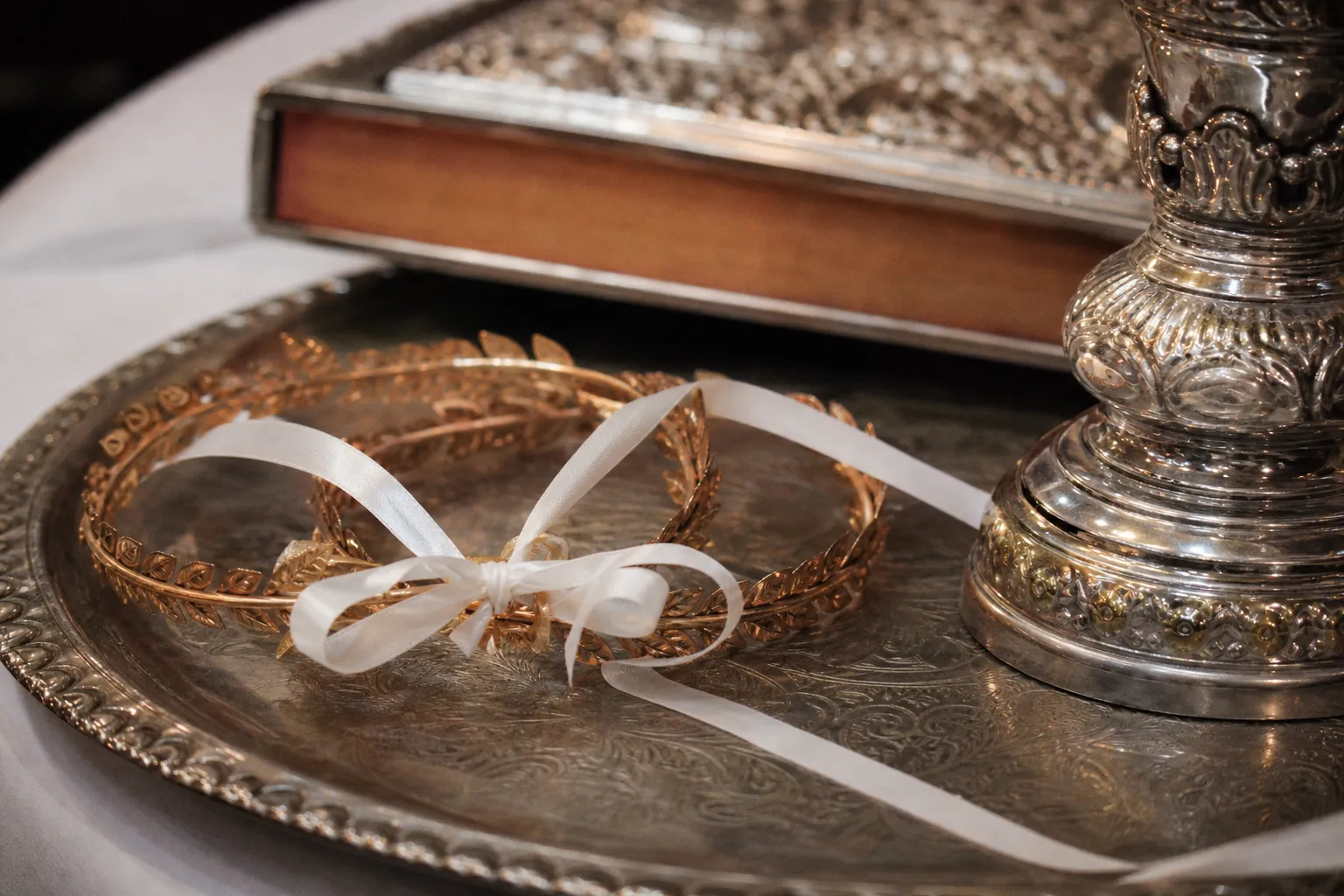
Greek Wedding Traditions: A Complete Guide
From the stefanoma crowning to koufeta favours, 10 authentic Greek wedding traditions every couple, Greek or not, can weave into their big day.
 Guest Experience
Easiest Way to Share Wedding Details With Guests
The easiest way to share wedding details with guests is a single wedding website: one link for schedule, venue.